Il viaggio di ispezione nelle regioni meridionali dell'imperatore Kangxi, Rotolo tre: da Jinan al monte Tai
Artwork Details
- 清 王翬等 康熙南巡圖 (卷三: 濟南至泰山) 卷
- Titolo: Il viaggio di ispezione nelle regioni meridionali dell'imperatore Kangxi, Rotolo tre: da Jinan al monte Tai
- Artista: Wang Hui, Cinese, 1632-1717
- Periodo: Dinastia Qing
- Data: 1698
- Materiale e tecnica: Dipinto su rotolo; inchiostro, colore su seta
- Dimensioni: 67,8 x 1393,8 cm
- Crediti: Acquistato, donazione di The Dillon Fund, 1979
- Numero d'inventario: 1979.5
- Curatorial Department: Asian Art
Audio
7610. The Kangxi Emperor's Southern Inspection Tour, Scroll Three: Ji'nan to Mount Tai
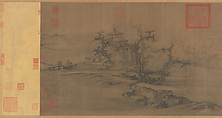
In this mammoth scroll, we see the Kangxi Emperor and his entourage making their way through the mountains and valleys of Xandong province. Their journey culminates at the sacred peak of the east, Mount Tai. An altar stands in front of the path leading up the mountain. A group of Buddhist and Taoist priests mingle with members of the Emperor’s retinue. As they prepare for his arrival, nearby servants sweep the ground in a last-minute effort to neaten up.
The scene is a recreation of one event from the Kangxi Emperor’s 1689 tour to south China. The country had experienced great civil unrest during the opening decades of the Manchu Qing Dynasty. The emperor made this journey as a gesture toward unification.
Traditionally, Mount Tai was the place where Chinese rulers worshipped heaven and reported on the state of the empire below. Only a legitimate ruler would dare stand before heaven and perform this ceremony. Kangxi did not actually perform the ceremony. But the fact that he visited the mountain held a tremendous symbolic importance. It identified him as a ruler who aspired to govern China according to the precepts of a traditional Confucian monarch. This symbolism was not lost on his Chinese subjects.
This is one of twelve handscrolls commemorating Kangxi’s trip. Laid end to end, these scrolls would have measured some seven hundred feet—more than the length of two football fields. Kangxi chose the preeminent orthodox painter of the time, Wang Hui, to illustrate his journey. In doing so, Kangxi intended to put traditional scholarly ideals to use in the service of the court.
And indeed, this scroll evokes the golden age of landscape painting during the Tang and Sung periods. For example, Kangxi visited Mount Tai in early February. Rather than covering the landscape in snow, however, Wang Hui has painted it in blue and green mineral pigments. This not only imitated a classical style of landscape painting, but it also conveyed the suggestion that Kangxi’s reign would revive a golden age of rulership. Wang Hui’s painting by employing a style derived from high antiquity enhances the aura of majesty and importance surrounding Kangxi’s tour.
More Artwork
Related Content

Research Resources
The Met provides unparalleled resources for research and welcomes an international community of students and scholars. The Met's Open Access API is where creators and researchers can connect to the The Met collection. Open Access data and public domain images are available for unrestricted commercial and noncommercial use without permission or fee.
To request images under copyright and other restrictions, please use this Image Request form.
Feedback
We continue to research and examine historical and cultural context for objects in The Met collection. If you have comments or questions about this object record, please contact us using the form below. The Museum looks forward to receiving your comments.
Content Notice
The Metropolitan Museum of Art presents over 5,000 years of art from around the world, and our online collection reflects ongoing work conducted over the course of our more than 150-year history. You may encounter objects or images that may be inappropriate for some viewers or information that may be outdated.