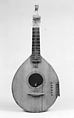
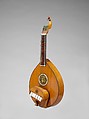
Pianoforte Guittar (Keyed cittern/English guittar)
This instrument is an excellent example of Claus’s instruments and includes multiple features from his 1783 patent. Namely the "harp stop", built into the bridge, which could slide into contact with the strings immediately next to the saddle and would mute the sound and removed higher partials, making it sound more like a harp.
(Daniel Wheeldon, 2023)
Artwork Details
- Title: Pianoforte Guittar (Keyed cittern/English guittar)
- Maker: Christian Claus (German, active London ca. 1783–1793 New York)
- Date: 1783–89
- Geography: London, England, United Kingdom
- Culture: British
- Medium: Wood and various materials
- Dimensions: Total length 71.4 cm., Fingerboard width 22.7 cm., Fingerboard width--top/bottom 4.7/6.0 cm.,
Body length 40.5 cm.
Body width--widest/narrowest 30/-
Body depth--neck/foot 6.5/8.5 cm.
Vibrating length of strings 44 cm., Bridge height 2.5 cm. - Classification: Chordophone-Lute-plucked-fretted
- Credit Line: The Crosby Brown Collection of Musical Instruments, 1889
- Object Number: 89.4.1013
- Curatorial Department: Musical Instruments
More Artwork
Related Content
 Free to download
Research Resources
The Met provides unparalleled resources for research and welcomes an international community of students and scholars. The Met's Open Access API is where creators and researchers can connect to the The Met collection. Open Access data and public domain images are available for unrestricted commercial and noncommercial use without permission or fee.
To request images under copyright and other restrictions, please use this Image Request form.
Feedback
We continue to research and examine historical and cultural context for objects in The Met collection. If you have comments or questions about this object record, please contact us using the form below. The Museum looks forward to receiving your comments.
Content Notice
The Metropolitan Museum of Art presents over 5,000 years of art from around the world, and our online collection reflects ongoing work conducted over the course of our more than 150-year history. You may encounter objects or images that may be inappropriate for some viewers or information that may be outdated.