Pendant
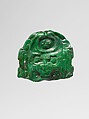
The apex of the work terminates in a visual element that is common in artists’ depictions of crown jewels worn by Late Classic period (ca. 550 – 900 CE) kings and queens, especially in the 7th and 8th centuries. In fact, the pendant itself was likely a pectoral or a crown jewel, the centerpiece of a royal diadem, such as those found in the tombs of important historical figures. Fiber run through drill holes on the reverse side would have affixed the jewel to a bark paper or cloth fiber diadem, and multiple drill holes along the jaw of the ruler’s portraits would have allowed beads to dangle below. Red pigment in the drill holes indicates it was once part of a funerary assemblage, which the Maya often dusted with red minerals upon burial, as a king or queen took his or her jewels into the next life.
The work is exceptional for its relative size, the beauty of the apple-green jade (the shade most preferred by the Maya), and the outstanding sculptural qualities of the work. The richly volumetric carving sets this work apart from known, flatter compositions. There are two other pendants of comparable quality and imagery. The first was created for a ruler at Piedras Negras, Guatemala, and later deposited in the Great Cenote at Chichen Itza, Mexico; it is now in the collections of the Peabody Museum at Harvard University. The second was excavated from Burial 77 at Tikal, which likely held the final ruler of the city before its abandonment in the 9th century.
Artwork Details
- Title: Pendant
- Artist: Maya artist(s)
- Date: 600–700 CE
- Geography: Southern Mexico, Guatemala, Honduras, or Belize
- Culture: Maya
- Medium: Jadeite, pigment
- Dimensions: H. 3 × W. 1 1/2 × D. 1 1/2 in. (7.6 × 3.8 × 3.8 cm)
- Classifications: Stone-Ornaments, Jade
- Credit Line: Gift of Steven Kossak, The Kronos Collections, 2015
- Object Number: 2015.677
- Curatorial Department: The Michael C. Rockefeller Wing
More Artwork

Related Content
 Free to download
Research Resources
The Met provides unparalleled resources for research and welcomes an international community of students and scholars. The Met's Open Access API is where creators and researchers can connect to the The Met collection. Open Access data and public domain images are available for unrestricted commercial and noncommercial use without permission or fee.
To request images under copyright and other restrictions, please use this Image Request form.
Feedback
We continue to research and examine historical and cultural context for objects in The Met collection. If you have comments or questions about this object record, please contact us using the form below. The Museum looks forward to receiving your comments.
Content Notice
The Metropolitan Museum of Art presents over 5,000 years of art from around the world, and our online collection reflects ongoing work conducted over the course of our more than 150-year history. You may encounter objects or images that may be inappropriate for some viewers or information that may be outdated.