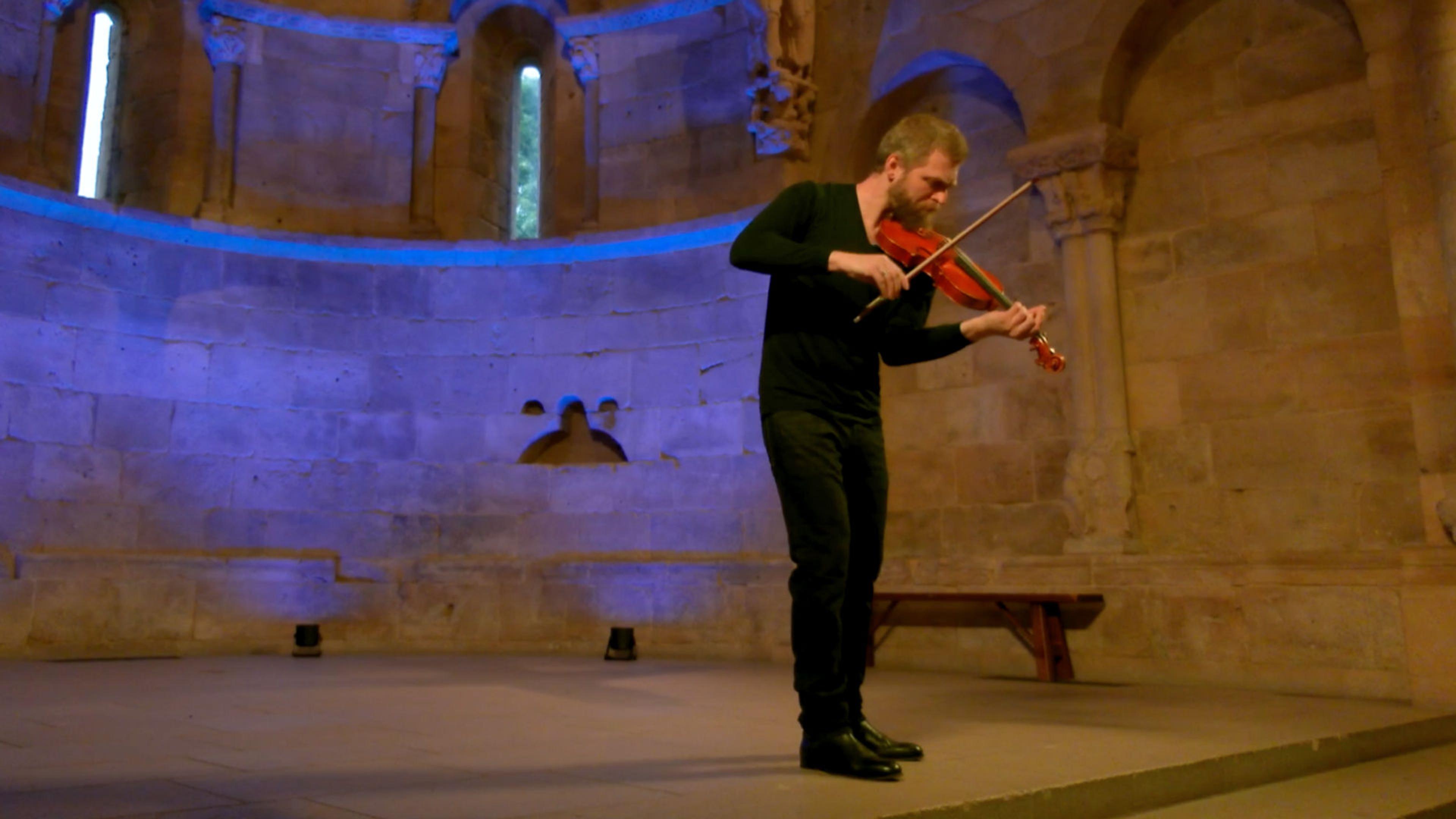
The cello is, supposedly, modeled after the female form. Its hourglass shape, widest at the bouts and smallest at the waist, is said to resemble an abstracted torso. And when I play my cello, arms wrapped around the instrument, it feels like an embrace. Body to body.
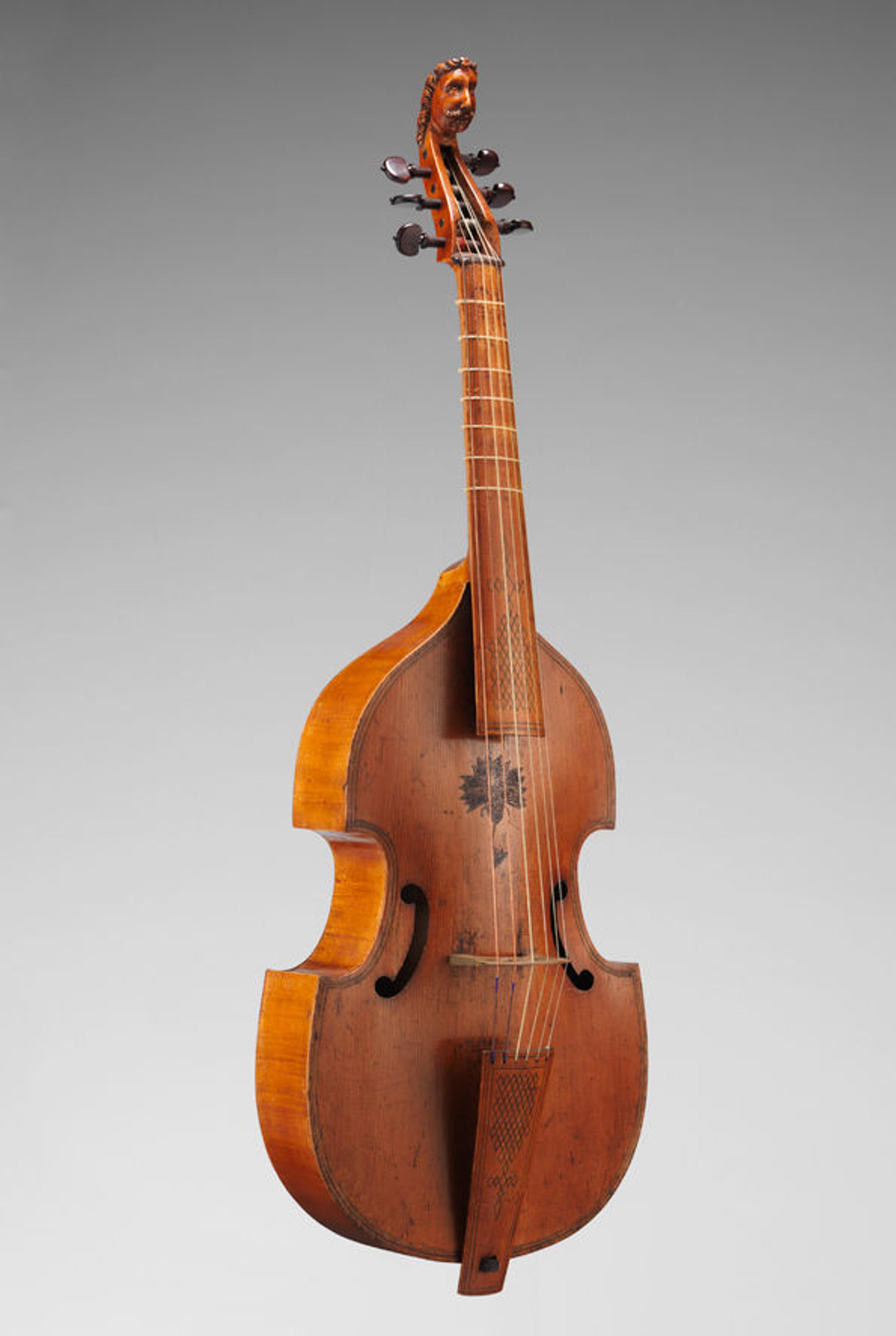
Likewise, the parts of the cello are named after human anatomy. The ribs connect the belly to the back. At the end of the neck is a head or scroll, which is sometimes even carved with realistic human features, such as on several viola da gambas in The Met collection.
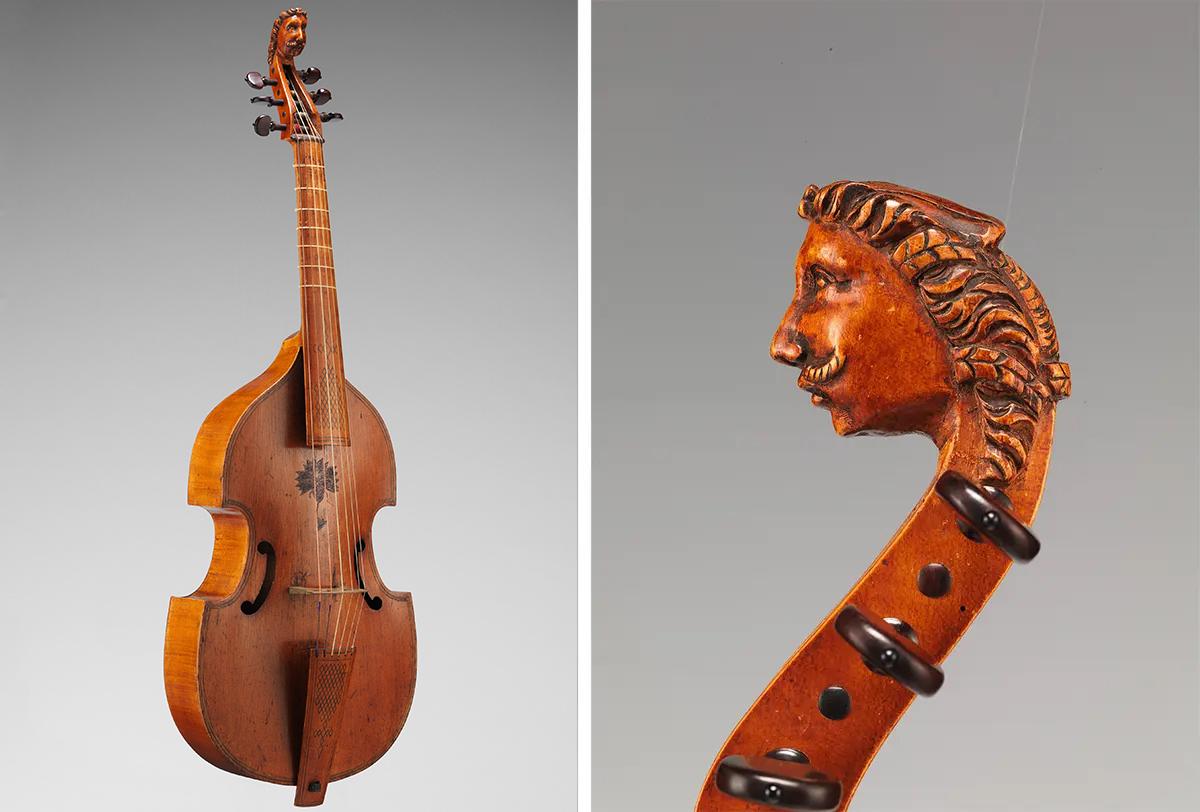
Division Viol and detail, 1640–65. London, United Kingdom. Maple, spruce, gut, Height: 45 1/4 in. (115 cm) Width: 14 3/4 in. (37.4 cm). The Metropolitan Museum of Art, New York, Purchase, Robert Alonzo Lehman Bequest, 2009 (2009.42)
Of course, most female bodies don’t resemble cellos, and not all bodies that resemble cellos are female. Still, this voluptuous shape, a sort of cultural shorthand for feminine sensuality, has inspired countless artists and performers.
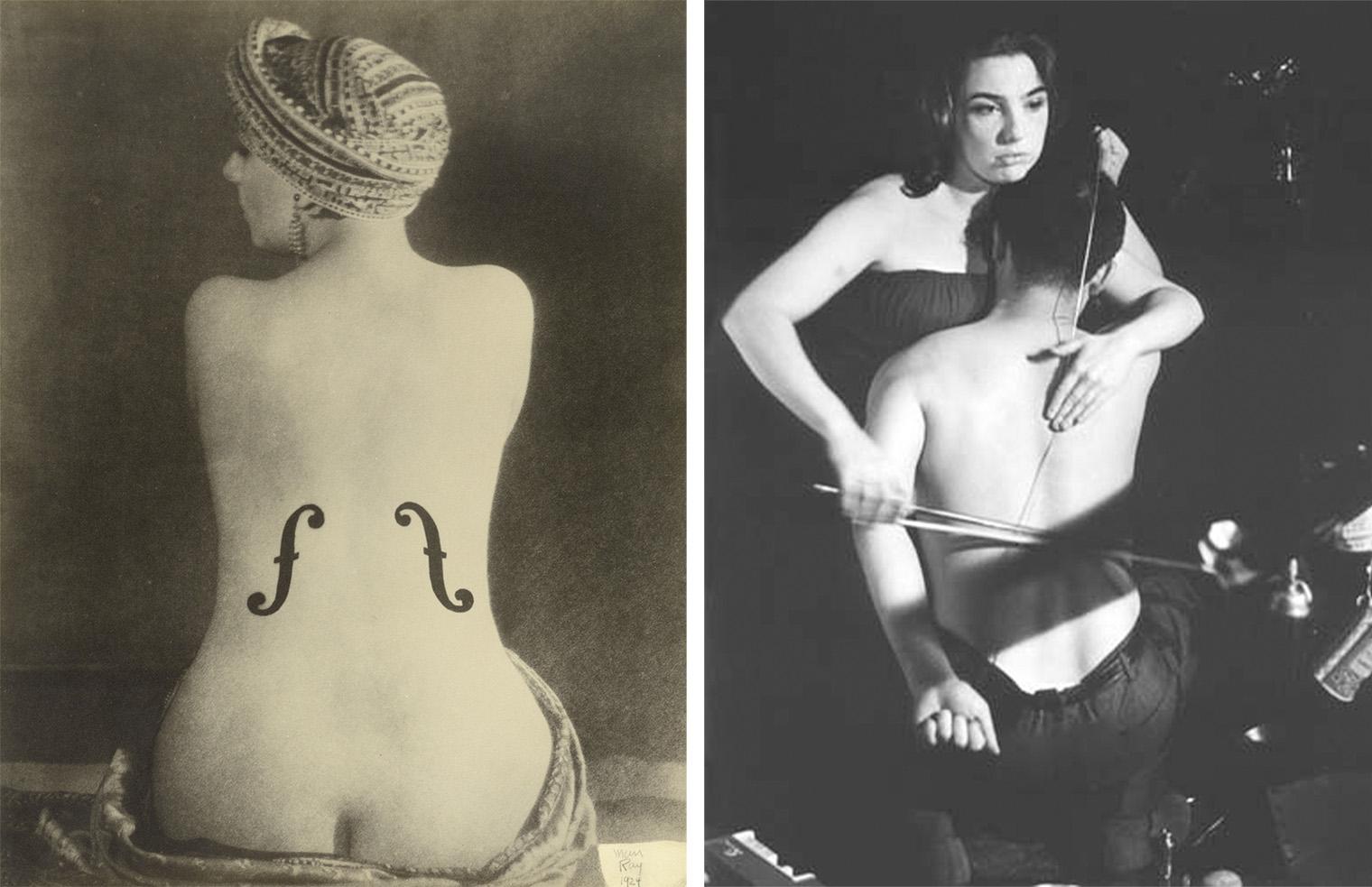
Left: Man Ray (American, 1890–1976). Le Violon d'Ingres (Ingres's Violin), 1924. Gelatin silver print, 11 5/8 × 9 in., 29.6 × 22.7 cm. The Getty Center, Los Angeles, (86.XM.626.10). © Man Ray Trust ARS-ADAGP. Right: Peter Moore (1932–1993). Charlotte Moorman and Nam June Paik Performing 26'1.499" for a String Player, 1965. Photograph by Peter Moore; © Northwestern University. Courtesy of Peter Moore Photography Archive, Charles Deering McCormick Library of Special Collections, Northwestern University Libraries
A famous 1920s photograph by Man Ray of Kiki de Montparnasse’s unclothed backside, printed with F-holes, transforms her into a living instrument. This work, titled Le Violon d’Ingres (1924), a French expression meaning “hobby,” depicts Kiki purely as Man Ray’s muse, even though she was an artist in her own right; here, Kiki is, quite literally, object-ified. In the 1960s, the avant-garde cellist Charlotte Moorman reversed the narrative, bowing the shirtless Nam June Paik as part of a performance piece. Paik is totally subservient to Moorman, holding a string across his back. Finally, the woman was playing the man.
But to understand the associations between the cello and the gendered, sexualized body, you need to go back much further, to a time before the cello even existed. In The Met’s Cycladic galleries, you’ll encounter a familiar shape: two stacked circles, topped by a long neck. These palm-sized marble figures are said to represent fertility goddesses, perhaps proto-Venuses. Even though they date from around 3000 BCE, long before violins or cellos, the resemblance is so uncanny that they are called by a deliberate anachronism: violin-type.
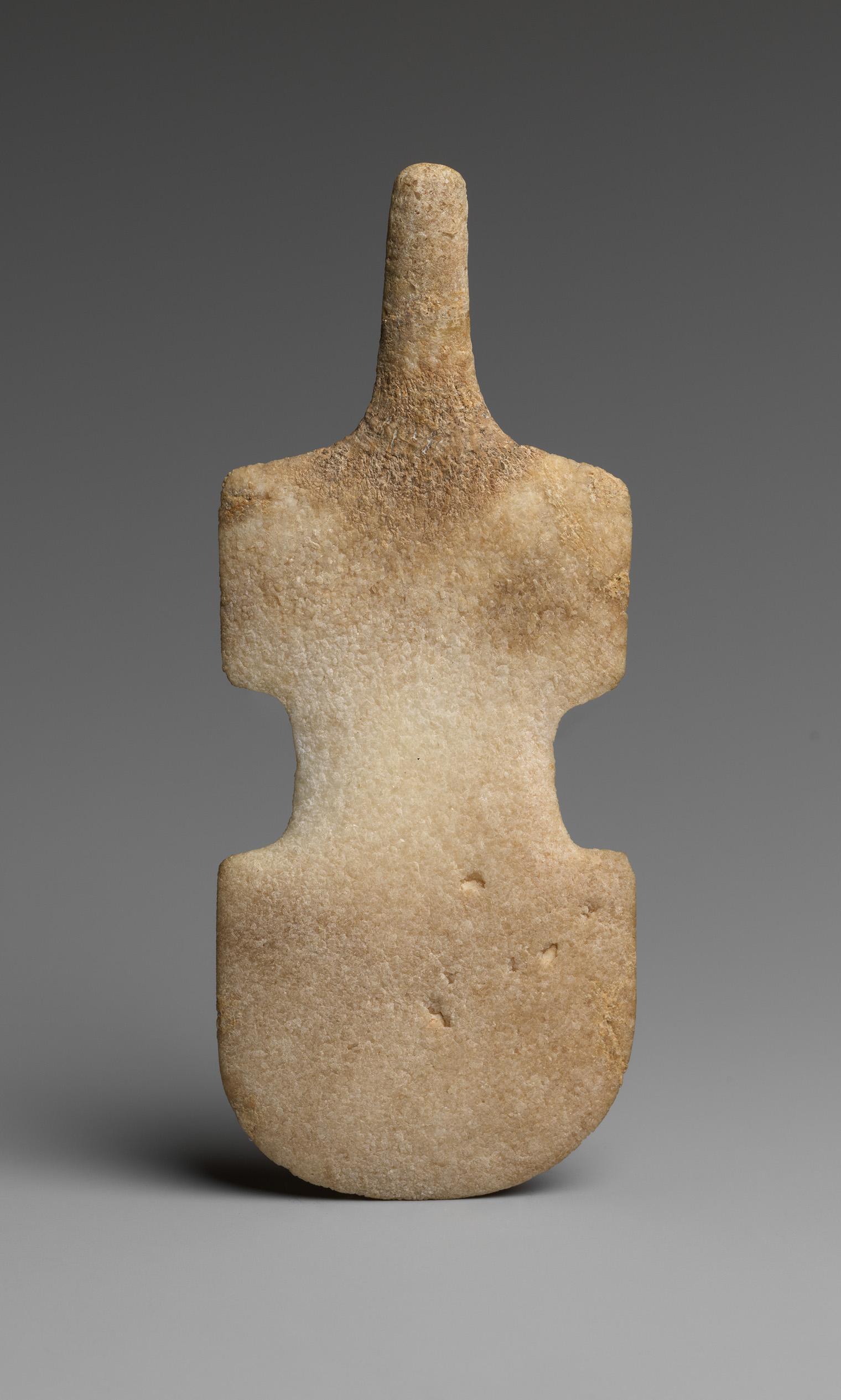
Marble female figure, ca. 3200–2700 BCE. Early Cycladic I, Cycladic. Marble, 6 1/4 × 2 1/2 in. (15.9 × 6.4 cm). The Metropolitan Museum of Art, New York, NY, Gift of André and William Spears, 2024 (2024.319.2)
Here, the human body is stripped to its most essential elements, a bit like the graphic, gendered icons on bathroom signs. But as Joseph Alexander MacGillivray writes, not all the Cycladic figures are clearly female. There are intersex figures with both breasts and penises. Even the violin-type ones are suspect, as there’s something phallic about their “rod-like” necks.
How did the cello get its distinct shape? The probable answer is partly ergonomic—as something body-shaped easily fits a body, and a cinched-in waist helps with bowing—and partly subconscious, as human beings love modeling things after ourselves.
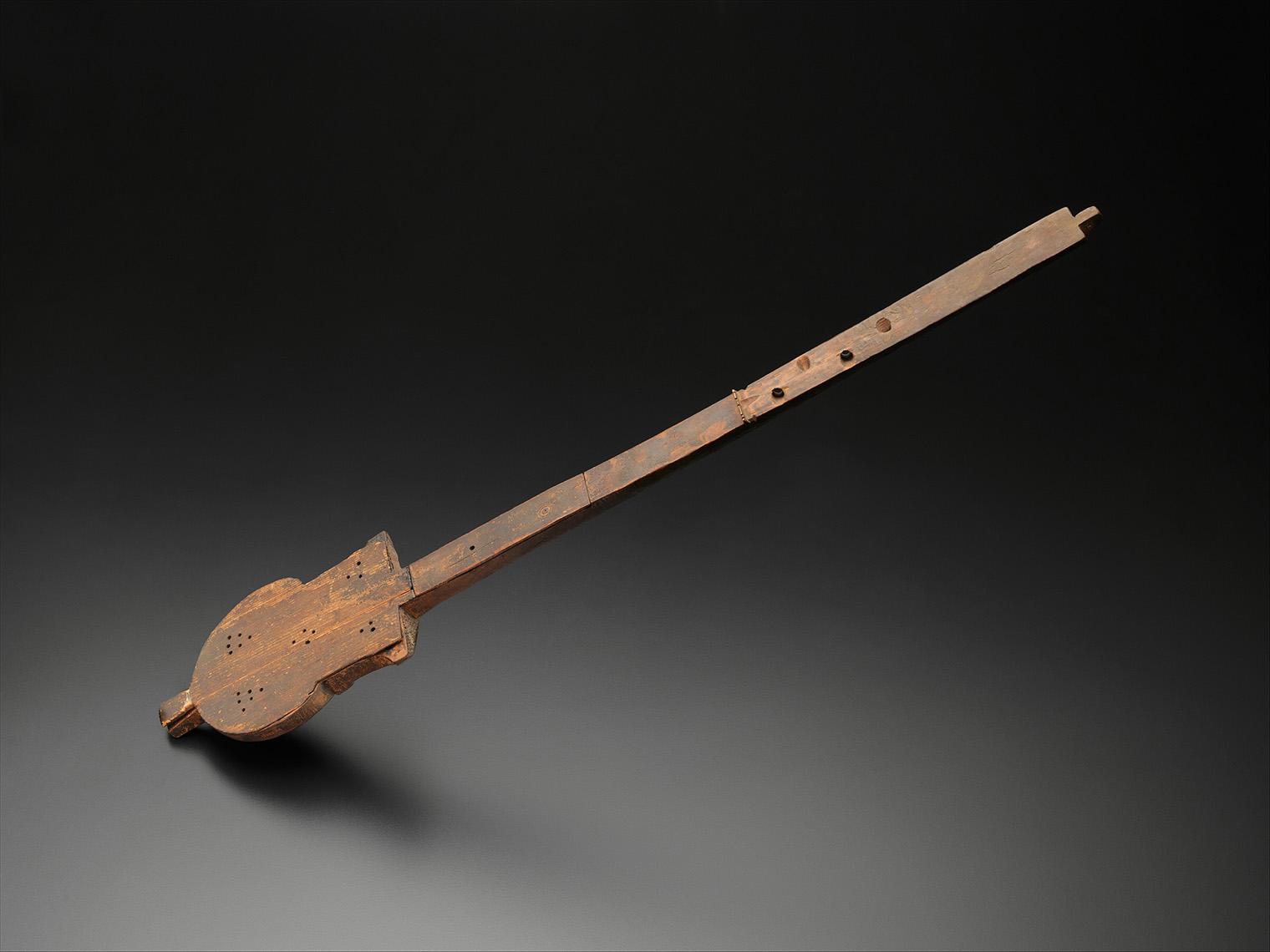
Lute, 200–500 CE. Roman/Byzantine. Wood with traces of paint, 4 3/4 x 1 1/2 x 28 7/8 in. (12 x 3.7 x 73.2 cm). The Metropolitan Museum of Art, New York, NY, Rogers Fund, 1912 (12.182.44a, b)
One of the cello’s earliest precursors is the ancient lute. The Met owns an extraordinarily early Roman/Byzantine example from around 200–500 CE whose waisted, vessel-like shape evokes a Cycladic figure. But it wasn’t until the late sixteenth century with the Amati family, and the seventeenth century with Niccolo Stradivari, that the violin’s shape was standardized. What makes the cello even more bodily than the violin or viola is its size: a cello’s back typically measures around thirty inches, about the same as a person’s.
Gender ambiguity is a throughline from the Cycladic figure to the cello. The cello is not easily pigeonholed as its “feminine” shape might suggest. With a sound “closest to the human voice,” the cello has a range of more than four octaves, from low baritone to high soprano. In Richard Strauss’s Don Quixote (1897), for example, the cello represents the hypermasculine protagonist.
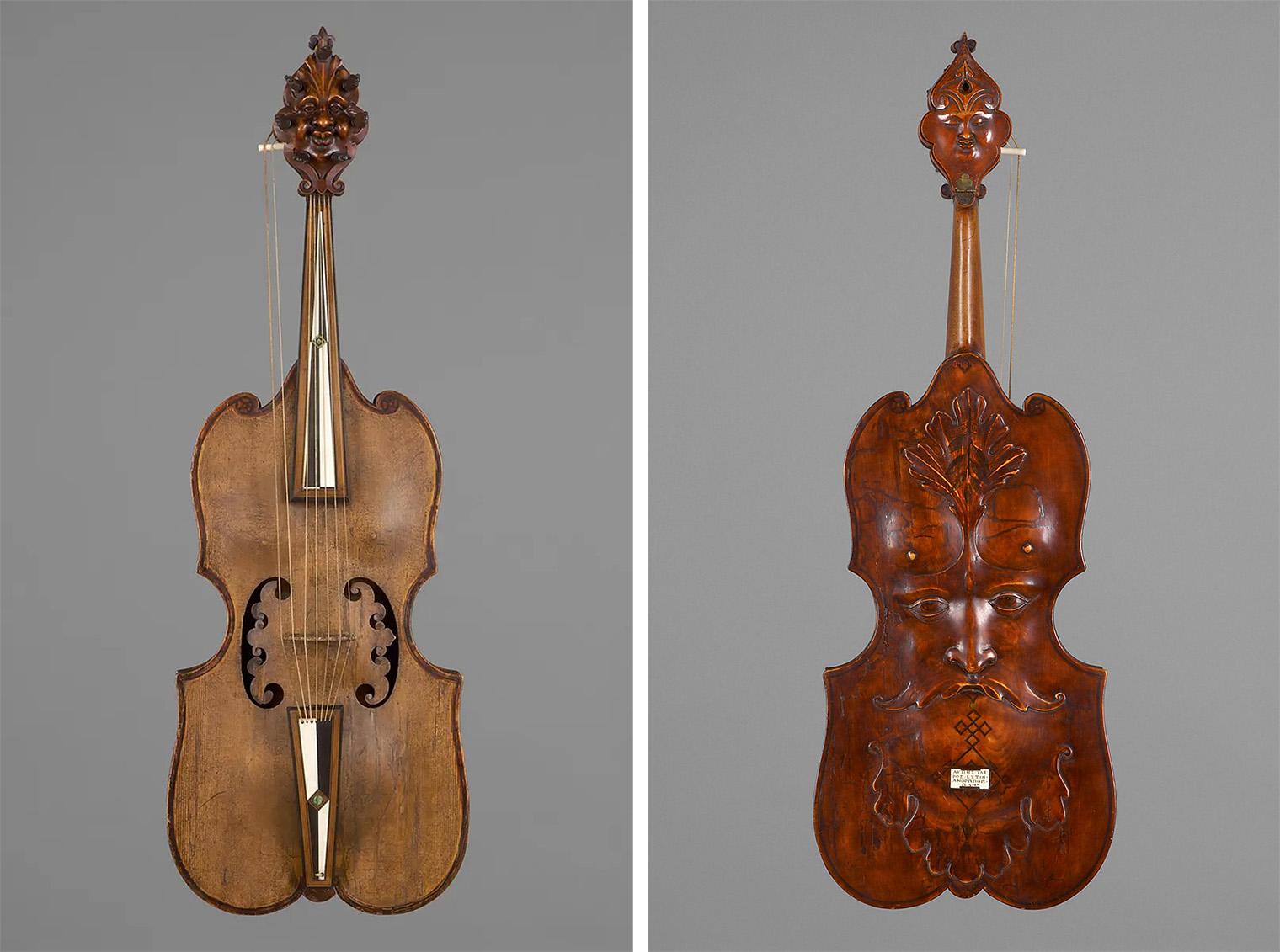
Lira da braccio, 1511. Italy, Verona. Wood, various materials, 32 in. x 10 in. x 3 in. (81 x 25 x 9 cm.) Kunsthistorisches Museum Wien, Sammlung alter Musikinstrumente
Likewise, other parts of the cello—the neck, endpin, and bow—have historically carried phallic associations. In that way, the cello might be considered a hermaphroditic instrument, not unlike one peculiar lira da braccio on loan from the Kunsthistorisches Museum in Vienna. This instrument’s back shows female breasts and, bizarrely, a mustachioed face below. The instrument’s front, on the other hand, shows a male chest. This union of bodies may be symbolic of marriage.
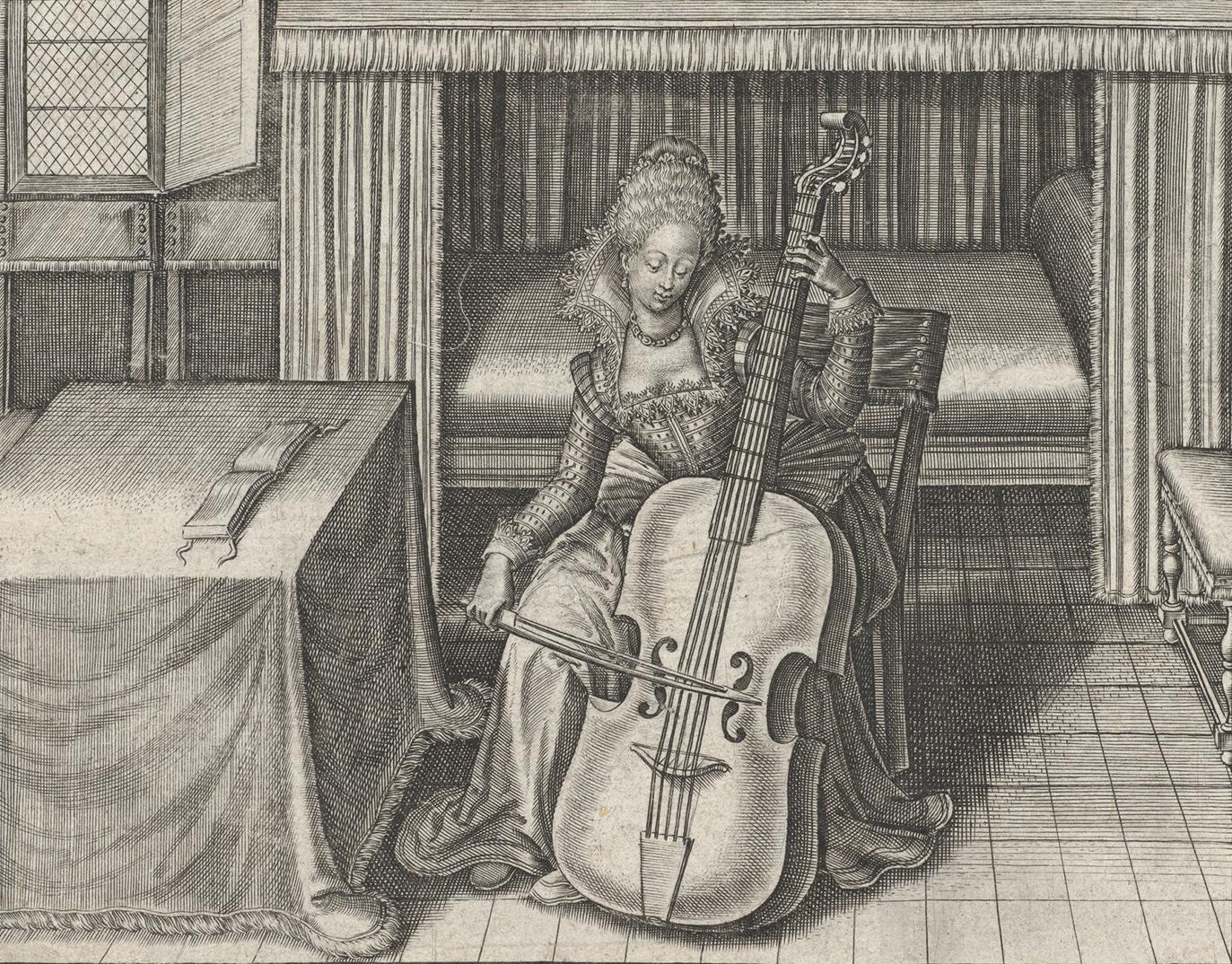
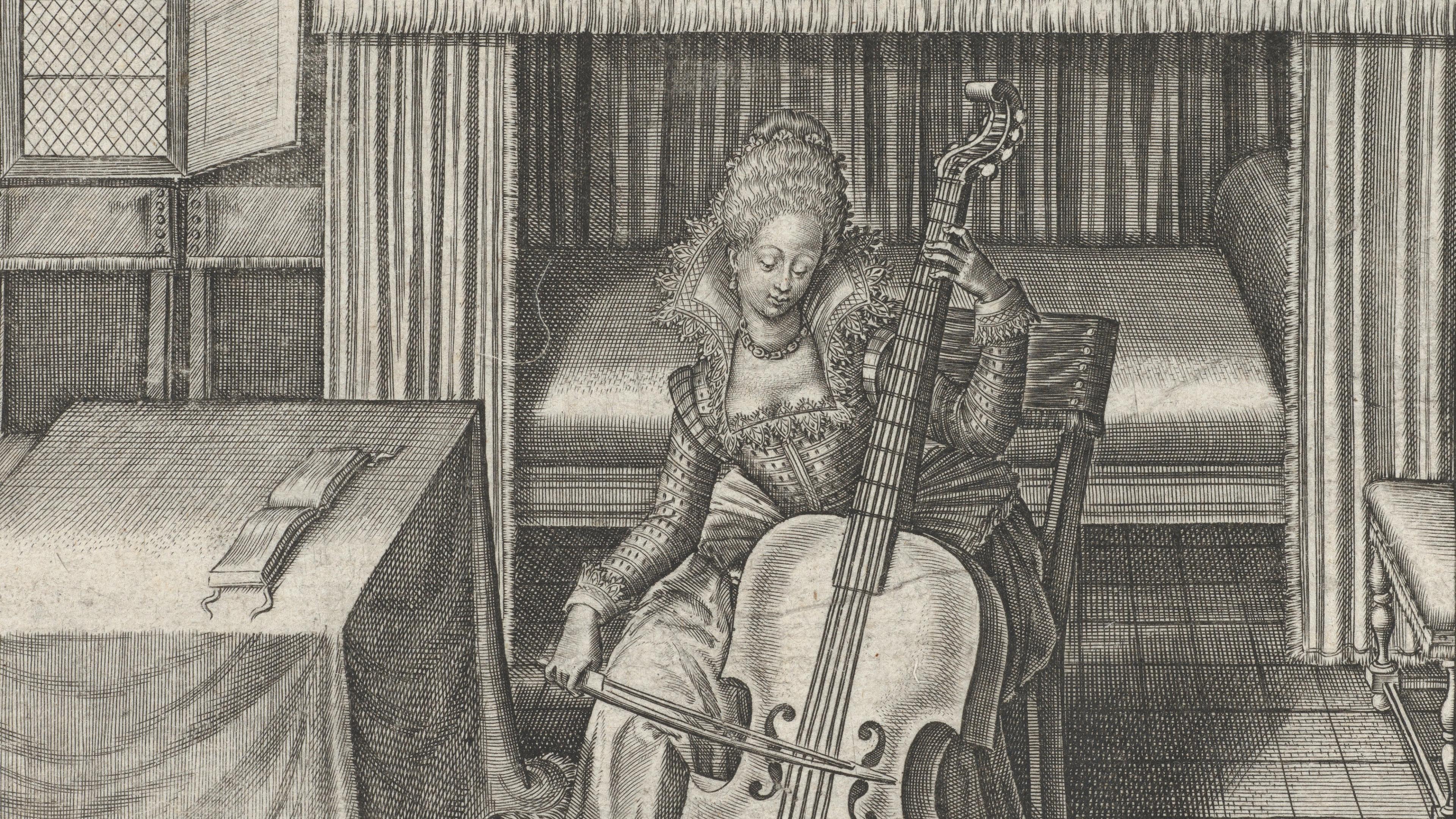
Jan van Haelbeeck (Flemish, ca. 1600–1630). Enigmes Joyeuses pour les Bons Esprits Plate 8, ca. 1615. Copper engraving, 4 5/8 × 5 7/8 in. (11.7 × 14.9 cm). The Metropolitan Museum of Art, New York, NY, Mary Oenslager Fund, 2016 (2016.360.8)
Another union to consider is that of player and instrument. The cello’s playing position, straddled by the legs, has long been hypersexualized. An early seventeenth-century Flemish etching by Jan van Haelbeeck in The Met’s collection, which accompanies an erotic sonnet by Jean Leclerk, shows a woman playing a cello-like instrument, her ample bosom spilling from her corset. In the background is an inviting bed and a wide-open window. The sonnet contains references to a male “friend” held between the thighs, “stiffening” “nerves” or strings, and “wriggling” hand gestures.
The cello’s lascivious associations limited who could play it. Not until the turn of the twentieth century did it become more widely acceptable for women to play the cello thanks to the advent of the “side-saddle” position, which allowed for more modest legs-off-to-the-side playing, made possible by the popularization of the endpin, the wooden or metal rod that anchors the instrument to the floor. The question naturally follows: What happens when a woman plays a supposedly woman-shaped instrument? Or more broadly, how do the genders of player and instrument complement, contrast, or intertwine?
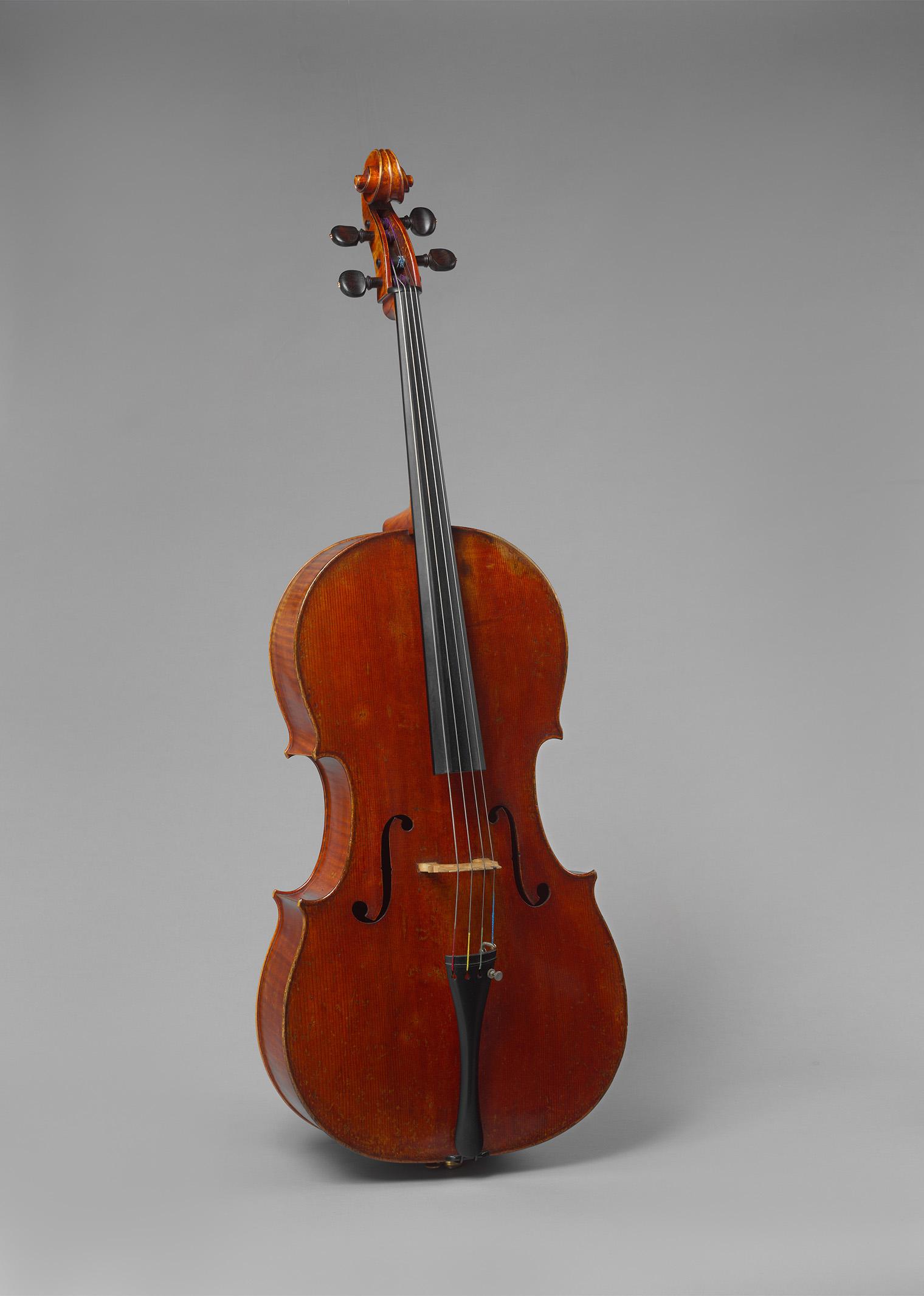
Antonio Stradivari (Italian, 1644–1737). The Batta-Piatigorsky Violoncello, 1714. Spruce, maple, ebony, 30 x 17 3/8 in. (76 x 43.9 cm). Private Collection, U.S.A. (L.2013.71a–g)
The relationship between the cellist and the cello is symbiotic. We change, and are changed by, the instruments we play. The Batta-Piatigorsky cello from 1714 is one example where the interfaces between body and instrument are especially apparent. You can see where the varnish has rubbed away on the upper-left bout, where a cellist often rests their hand when not playing, as if on a shoulder.
Conversely, fingers form calluses from playing, lower backs ache from sitting, and right arms grow more muscular than left. These are bodies sculpting each other. And quickly, the boundaries between player and instrument, artist and muse, perhaps even man and woman, become blurred.
Instruments, like bodies, change over time. There’s what we call the ephemera—old strings and bow hairs that are regularly replaced, much in the same way that we clip our fingernails, or get a haircut—but there are also more substantial alterations.
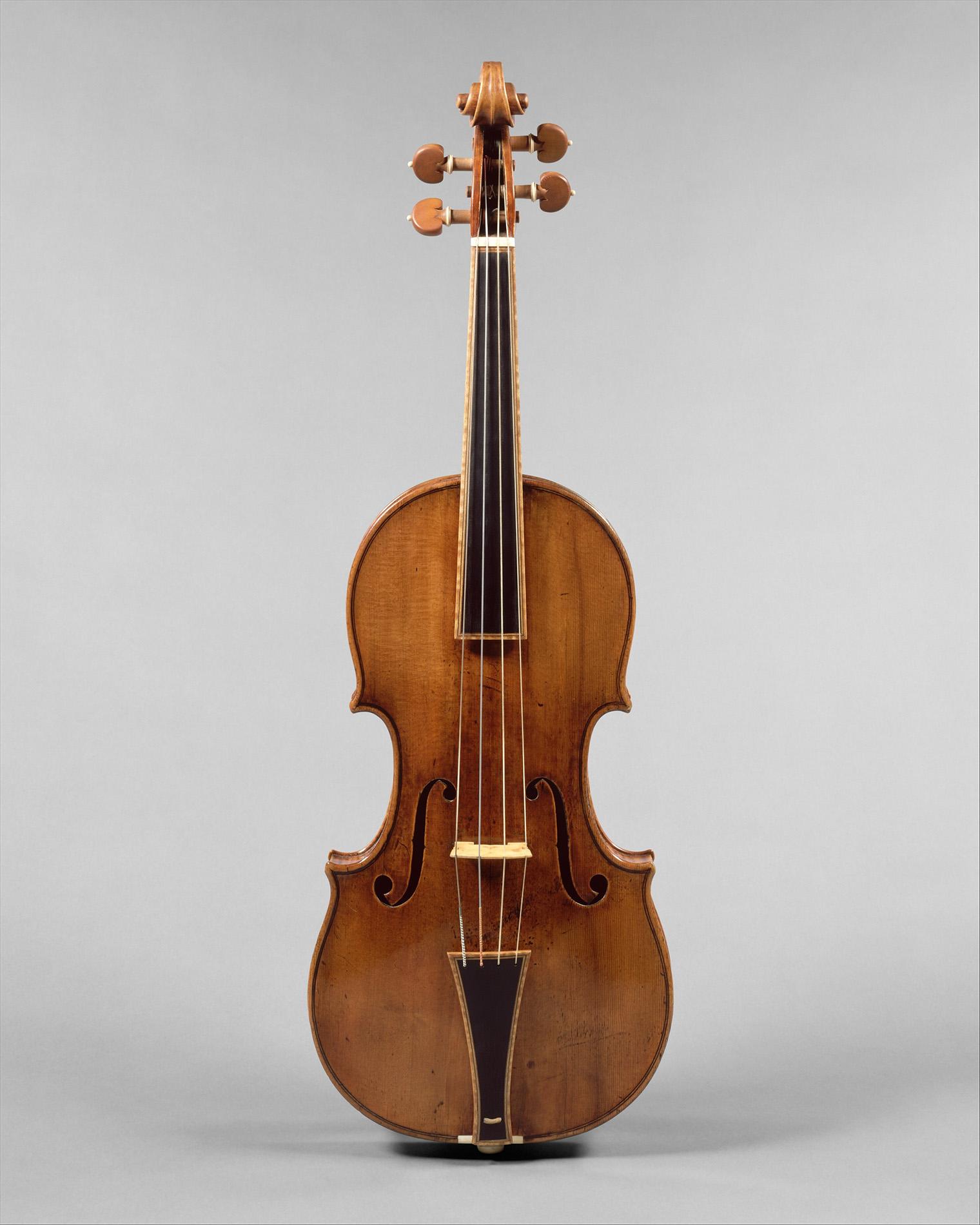
Antonio Stradivari (Italian, 1644–1737). "Gould" Violin, 1693. Spruce top, maple sides and back, ebony fingerboard, and gut strings. The Metropolitan Museum of Art, New York, Gift of George Gould, 1955 (55.86a–c)
The Met’s “Gould” violin has changed drastically since it was made by Stradivari in 1693. At some point, possibly in the nineteenth or twentieth century, the violin was modernized. But then, in 1975, the “Gould” was returned to a more antiquated Baroque setup, meaning that it was restrung with gut strings, typically made from a sheep or pig’s small intestine, refitted with a Baroque neck and fingerboard, and given a shorter bass bar.
Historical cellos, too, are often cut down from the hefty “bass violin” size popular during the sixteenth century to a smaller-bodied instrument. An extreme example is the world’s oldest surviving cello, Amati's “The King,” which is housed in the National Music Museum at the University of South Dakota. Like a tattooed body that has been sutured back together, “The King’s” alterations are made even more apparent by its emblazoned back.
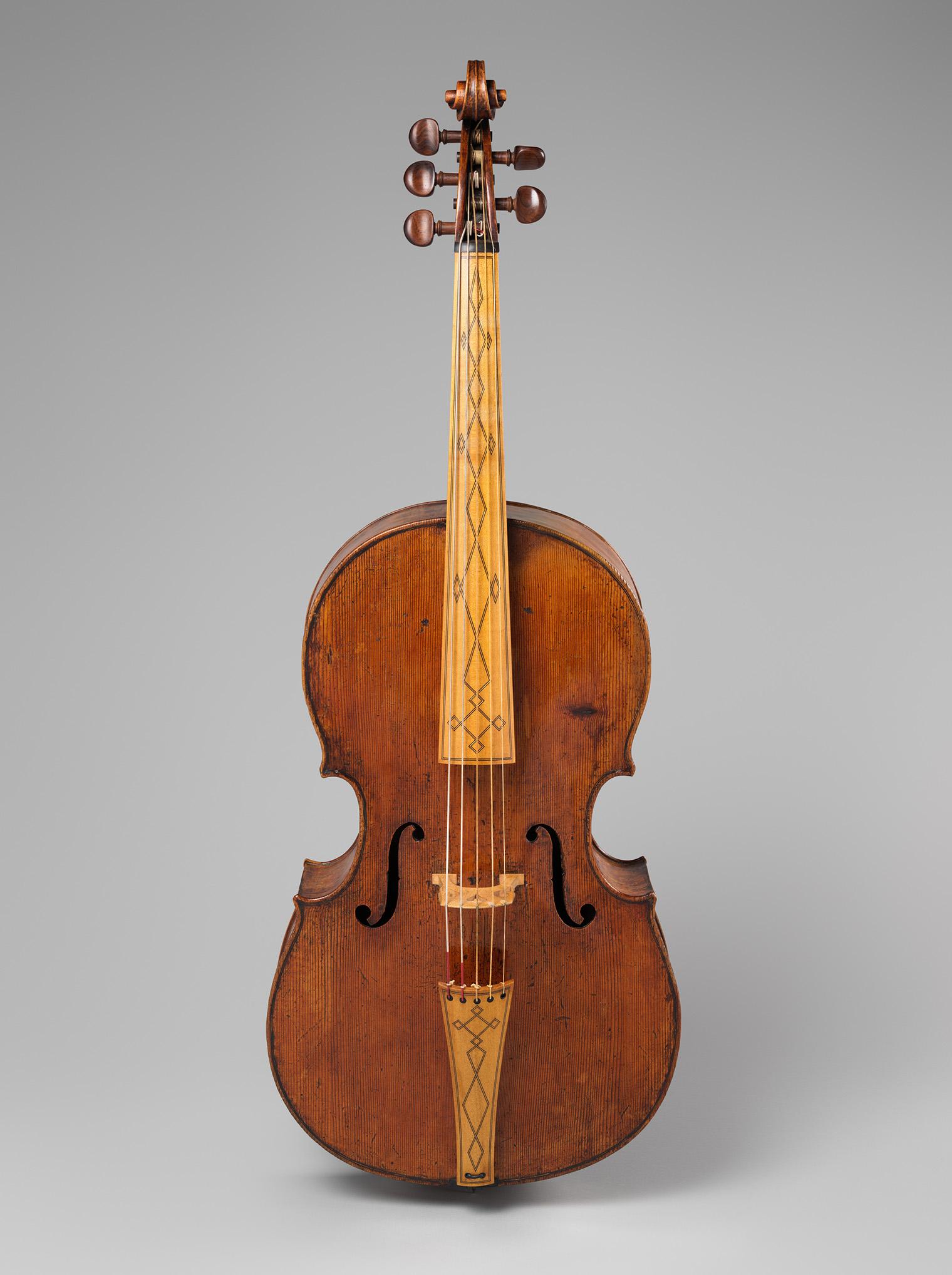
Brothers Amati. "Amaryllis Fleming" Cello, 1610–20. Spruce, maple, varnish, ebony, gut, metal, Length of back: 70.7 cm Upper bouts: 35.35 cm Middle bouts: 23 cm Lower bouts: 42.45 cm Vibrating string length: 64cm. The Metropolitan Museum of Art, New York, Purchase, 2020 Benefit Fund, Amati Gifts, in honor of Sally B. Brown, and Robert Alonzo Lehman Bequest, 2023 (2023.331)
The Met’s “Amaryllis Fleming”—named for its former owner, a legendary female Baroque cellist—is a rare Brothers Amati five-string cello that, being already of a smaller size, was never cut down. Even still, its fingerboard and tailpiece aren’t original, as is typical of older or well-loved instruments.
Sometimes viola da gambas are converted into cellos, and vice versa. These hybrids, called cellambas, show the messiness that happens when one instrument becomes another. The Met is full of instrumental experiments like the Arpeggione, a nineteenth-century cello-guitar hybrid, as well as Frankenstein-like instruments that defy categorization, like an early-twentieth-century “viola pomposa d’amore.”
From this discussion, the paradigm of Theseus’s ship emerges: How much of an instrument has to be replaced for it to become a new one? For instance, does a Stradivarius ever cease to be considered a Stradivarius? These questions might also be asked about trans or queer experience. We are all constantly in the process of rebuilding our identities as well as our bodies. We grow, we age, and parts get replaced. Sometimes, our sense of self changes. While this might seem destabilizing, it is also freeing: I am not quite the same person I was a moment ago. Even on a cellular level, I am changed.
The cello is modeled after the female form—or is it? As we’ve seen, the cello’s social history is more complicated than that. And besides, there is no standard male or female form. For example, my transmasculine body, once quite cello-shaped, has changed since starting testosterone. My hips have shrunk, my waist has filled out, my shoulders have broadened.
This past year, I’ve started thinking of my body as an instrument that I am conserving. Preparing for top surgery, I envisioned my torso as a cello that was being cut down, my scars conservational evidence of what had been removed.
When you conserve or restore an instrument, you sometimes think about returning it to an original or earlier state. What would this state be for me? It’s an unanswerable question.
But I do know that as my own body moves farther away from a “cello shape,” through hormones or through surgery, I paradoxically feel a greater kinship with my instrument. And the first time that I played the cello post-surgery, my new flat chest resonating against the wood, I felt something shift inside me, like a sound post settling into place.