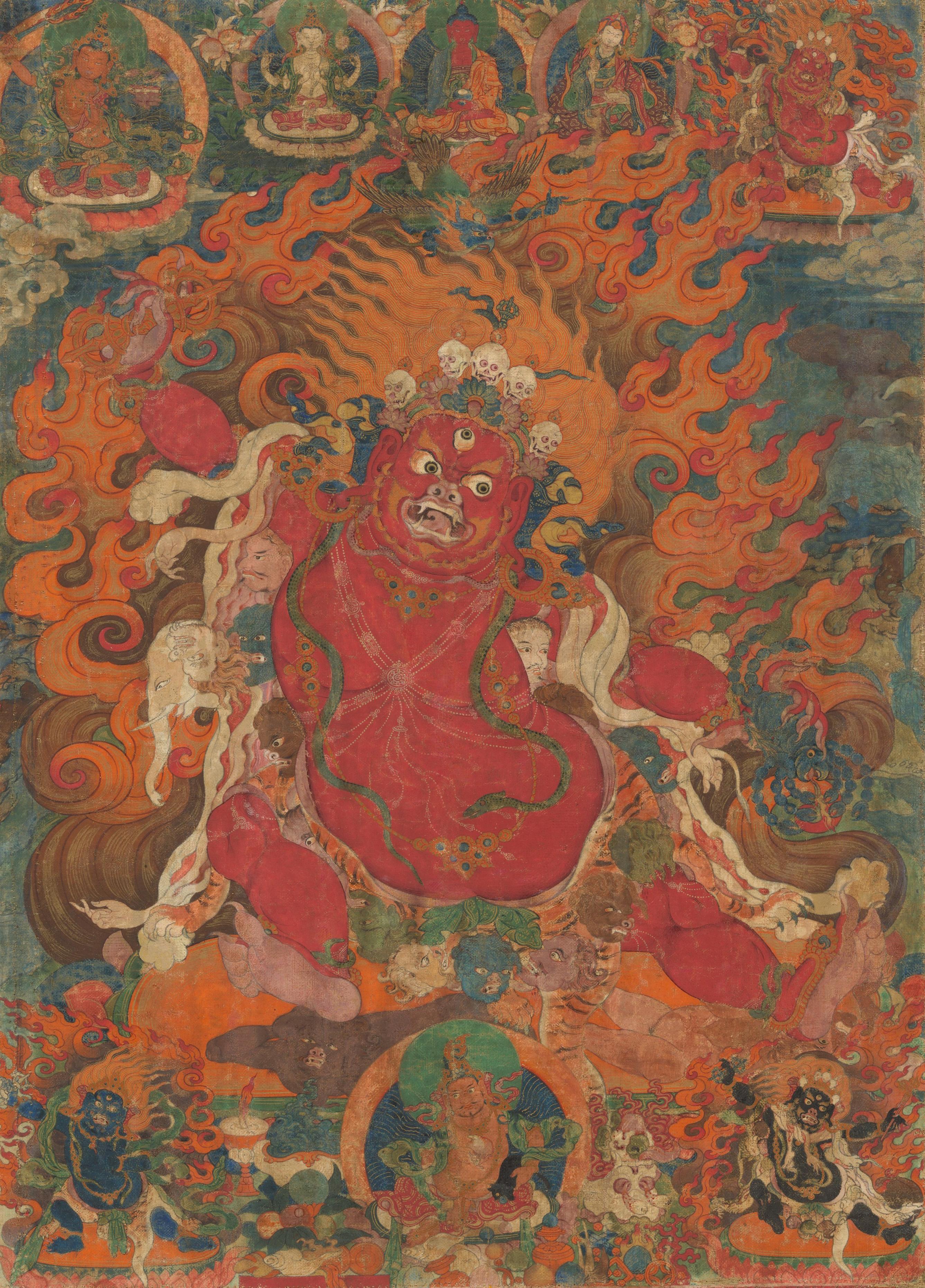
Guru Dragpo, Padmasambhava’s Fierce Emanation, 18th century. Tibet. Distemper on cotton, Image: 24 × 17 1/2 in. (61 × 44.5 cm); framed: 33 1/8 × 25 7/8 in. (84 × 65.5 cm). The Metropolitan Museum of Art, New York, Purchase, Friends of Asian Art Gifts, 2015 (2015.269)
My name is Fred Tomaselli and I’m an artist.
I’m a collagist and I work with the language of others. So this work appeals to this notion of the collective that’s part of my art. The iconography in this work is really a collective heritage of images passed down through generations.
Guru Dragpo, from what I understand, is the protector of the dharma, the way of Buddhism. This is somebody that you don’t want to mess with, I mean, a guy with a garland of severed heads, a crown of human skulls, a fanged mouth, three eyes—he’s a tough guy! The fire emanating from his body is supposed to symbolize divine wisdom. The two bodies he’s trampling are ignorance, so he’s a violent protector of beauty, inner peace, and tranquility, which is one of these contradictions that’s fantastic about the piece.
Within all of this brutality and carnage, up along the top these Buddhist saints are emanating complete calm and peace. To me, the piece acknowledges a kind of absolute of the world, which is that there is this unspeakable cruelty going on at all times, but there are places where one can find peace and beauty. So that dualism of the world is encapsulated in this work. So much of Tibetan Buddhism is about moving into this other place and not being afraid of death, confronting it.
I’m basically an atheist, so I have to look at this as an object devoid of the ideology that once was its foundation. Yet it still holds a lot of power for me. Buddhist iconography was hijacked by the hippies, and so maybe it frightens me a little less since it almost seems familiar. I grew up in this sort of metal, stoner, biker, punk rock world. It was through bastard, kitsch versions of this that I ended up finding my way to the real stuff. And obviously this is infinitely better, but thank god that I had a gateway, at least.
It does have a hallucinogenic quality. Even though everything is hard-edged and very, very finely made, the work seems to be in a constant state of movement. The way that the flaming hair is pushing to the left side of the picture and the fire emanating from the body swirls out to the right side of the picture, the central figure is in this dance.
There’s a difference between being pretty and being beautiful. A pretty thing is something that traffics in a language that we already know and are comfortable with. And beauty is a little strange. This work is more than a little strange. And it’s beautiful.
There’s art that’s easily exhaustible, but the longer you look at this work the more mysterious it becomes. It just keeps opening up and opening up. And that’s something that I aspire to in my own work.