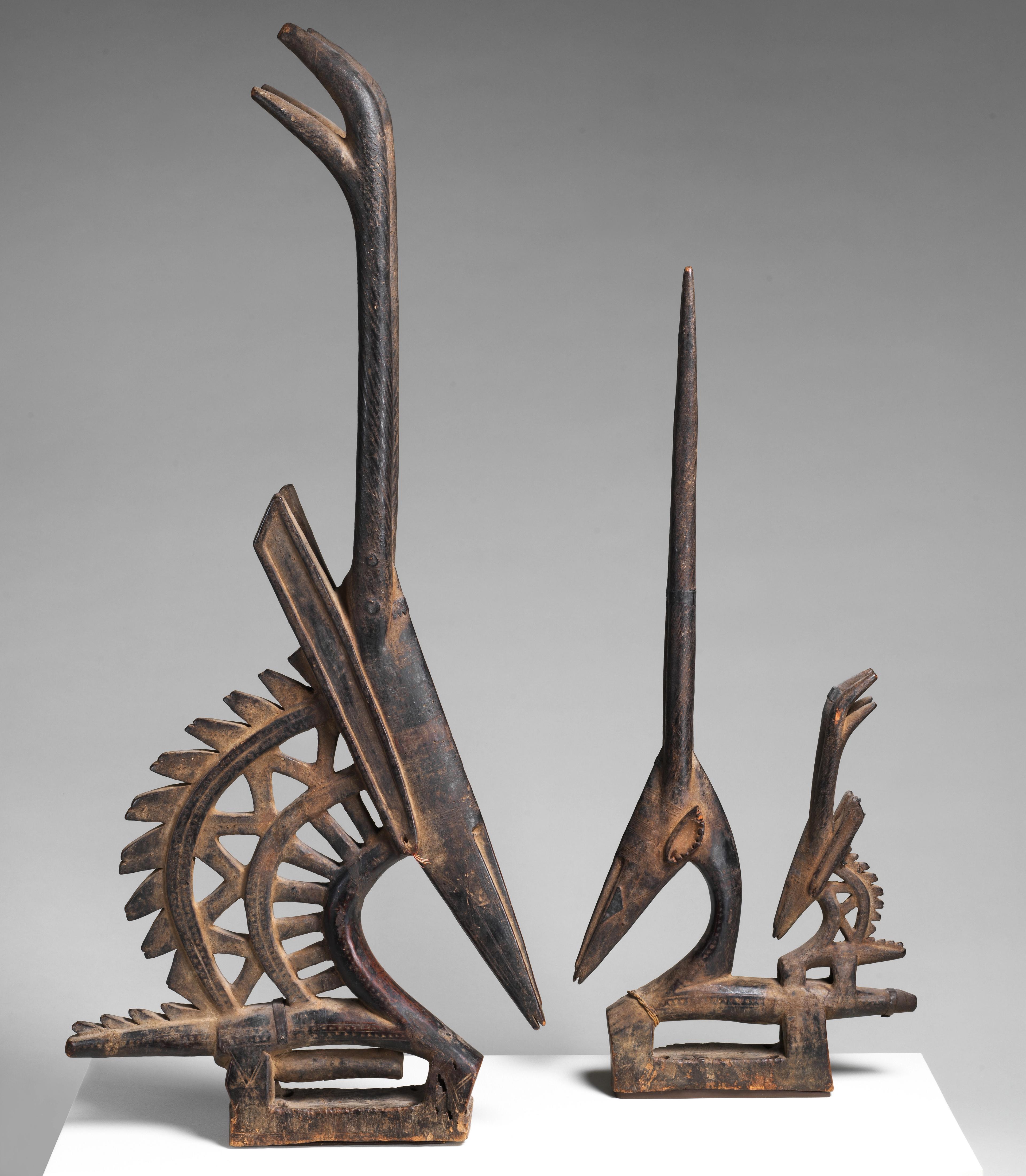
Ci wara headdress, 19th–early 20th century. Bamana numu (blacksmith). Bamana peoples, South-central Mali. Wood, metal, fiber, 35 3/4 x 15 3/4 x 3 3/8 in. (90.7 x 40 x 8.5 cm). The Metropolitan Museum of Art, New York, The Michael C. Rockefeller Memorial Collection, Gift of Nelson A. Rockefeller, 1964 (1978.412.435)
My name is Willie Cole and I'd like to think of myself as a perceptual engineer.
Perception is an outgrowth of awareness or education. And I was in high school from '68 to '72—just after the riots in the '60s, the Kennedy assassination, Martin Luther King—so there was a big Black Consciousness Movement. That influence led our art department to begin discussing African art in the classroom. So we were not searching for Africa, but they were putting Africa on us. And one assignment we had was to choose a piece to make, and I chose the Ci Wara headdress.
I could extrapolate and say that because it was used ceremonially as part of an agricultural ritual, that the connection to this image and the land appealed to me. But that’s only through knowledge about it. At first glance it's just the graphic quality, the symmetry of it. I mean, even though you can pretend it has a front view—but the front view doesn’t really reveal it—but the left and the right side are identical. I'm of that age where I read MAD magazine—Spy vs. Spy—that's the same face.
There's just expression: there's life. This Ci Wara where there's a small one on the back—I see that as a mother-and-child image. I read everything as living. And things that are designated as ceremonial objects, I sense the power in those things.
And of course years later I began to make them out of bicycles. Someone told me that the word Ci Wara means "work animal," and in the U.S. the bicycle is a work animal, to me. My ritual objects come with life and with history by using things that people use and handle. And I would assume that these things, being carved from wood, it's the life in the tree that that carver may have considered. So the life in this first existed in the natural form, and the artist is aware of that. After it's carved it's going to have to go through some ceremony itself to be empowered.
Without education you don't recognize that as something from the past. I mean the quality of the wood, the surface of the patina could suggest that to you, but if you just look at the form itself, it could be from the future. Our education will make us see things differently. It inspires everything I see. So suddenly Africa is in my world, and my reference points for shapes and designs are going to come from that too.
It made me start to explore the word "African-American," and I decided at that point that I would make African things out of American things. That opened the door, anyway.