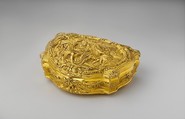
Box
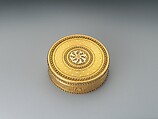
Circular gold boxes without hinges are generally described as bonbonnières, a term which came into use circa 1770. They contained confectionery in the form of a type of pastille called dragée.
Boxes of this style were produced by many Parisian goldsmiths in the 1780s. Using a range of colored gold and decorated with concentric engine-turning scattered with applied or engraved dots and rosettes, this box is very similar to 48.187.476a, b, although considerably smaller. Jean Baptiste Fay’s series of designs Cahier de Bijouteries dans le goût modern, published between 1780-1790, which may well have provided the inspiration for this box, specifically states that the designs could be used for cane-handles, seals, and pieces of jewelry as well as boxes.
Daughter of one of the founders of the Weyerhaeuser Timber Company, Catherine D. Wentworth (1865–1948) was an art student and painter who lived in France for thirty years. She became one of the most important American collectors of eighteenth-century French silver and on her death in 1948 bequeathed part of her significant collection of silver, gold boxes, French furniture and textiles to the Metropolitan Museum.
Artwork Details
- Title: Box
- Maker: Probably by Barthélemy Cabaille (master 1775; active 1791)
- Date: 1783–84
- Culture: French, Paris
- Medium: Gold
- Dimensions: 3/4 × 2 3/8 in. (1.9 × 6 cm)
- Classification: Metalwork-Gold and Platinum
- Credit Line: Bequest of Catherine D. Wentworth, 1948
- Object Number: 48.187.477a, b
- Curatorial Department: European Sculpture and Decorative Arts
More Artwork
Research Resources
The Met provides unparalleled resources for research and welcomes an international community of students and scholars. The Met's Open Access API is where creators and researchers can connect to the The Met collection. Open Access data and public domain images are available for unrestricted commercial and noncommercial use without permission or fee.
To request images under copyright and other restrictions, please use this Image Request form.
Feedback
We continue to research and examine historical and cultural context for objects in The Met collection. If you have comments or questions about this object record, please contact us using the form below. The Museum looks forward to receiving your comments.
Content Notice
The Metropolitan Museum of Art presents over 5,000 years of art from around the world, and our online collection reflects ongoing work conducted over the course of our more than 150-year history. You may encounter objects or images that may be inappropriate for some viewers or information that may be outdated.