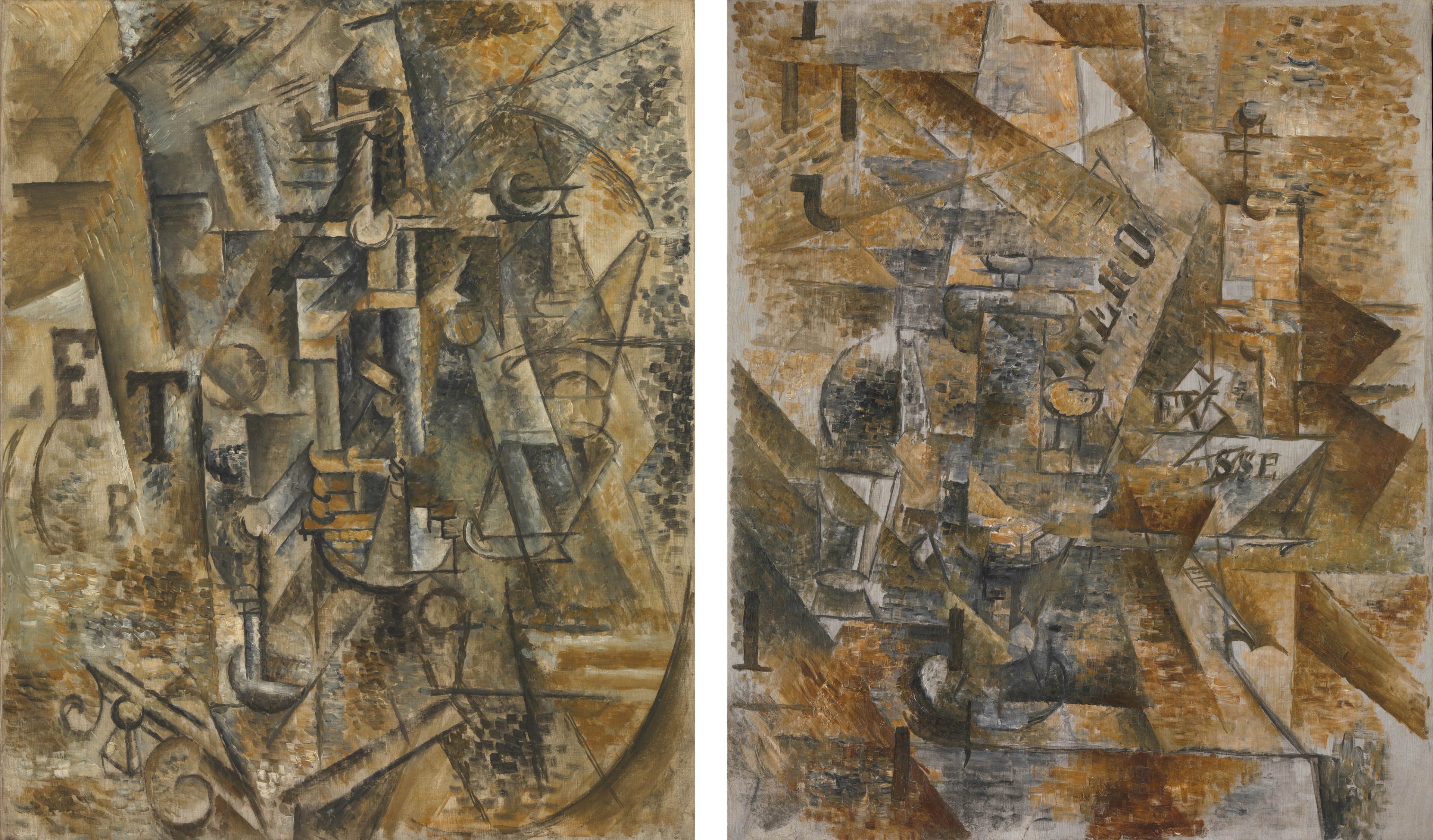
Left: Pablo Picasso (Spanish, 1881–1973). Still Life with a Bottle of Rum, 1911. Oil on canvas, 24 1/8 x 19 7/8 in. (61.3 x 50.5 cm). The Metropolitan Museum of Art, New York, Jacques and Natasha Gelman Collection, 1998 (1999.363.63). © Estate of Pablo Picasso / Artists Rights Society (ARS), New York. Right: Georges Braque (French, 1882–1963). Still Life with Banderillas, 1911. Oil and charcoal with sand on canvas, 25 3/4 × 21 5/8 in. (65.4 × 54.9 cm). The Metropolitan Museum of Art, New York, Jacques and Natasha Gelman Collection, 1998 (1999.363.11). © 2015 Artists Rights Society (ARS), New York / ADAGP, Paris
Je m'appelle Jacques Villeglé— My name is Jacques Villeglé. I am a visual artist.
I've been often accused of making art against art, but I feel my art is very much a response to paintings of the past and paintings of the present, and I feel very much at home in the tradition of painting.
I discovered these paintings by chance, going to a bookstore in the middle of the second World War when it was not possible to get to know modern artists like Braque, and I was stunned by these paintings which I did not understand. And what I could recognize in them was something that had interested me and that I was familiar with: typography, which I mainly knew from posters. And as a young painter, I struggled with the question, what I should choose as a subject, and in these paintings I found that typography could be a subject of my art.
I've always been fascinated by Chinese characters, by Latin letters, and by the social and political context that letters can have. Typography is something that speaks even if you don't understand it. And these signs spoke to me because I recognized them—as letters, as signs, as having a meaning. I don't try to read the words as one would read a text; I see them as part of the construction of the painting. There is the sense of volume even if you don't completely understand the space.
What I recognize in Braque is that he's from Normandy, a part of France that is not the most inspiring, maybe, not the most culturally rich, but a peaceful region, and that is something I sense and appreciate in Braque's painting. In contrast, Picasso, who has a Mediterranean background, comes to France and works in Paris and there's much more going on that's immediately reflected even in these paintings that are so close to Braque's. These paintings are very much paintings, not collages. The objects and the letters and the forms are all integrated in one composition and float in the composition with the specific place that the artists wanted.
Braque certainly, for me, was a revolutionary artist because, as I grew up under the German occupation of France, I was shut off of a lot of new things that were happening and received a very traditional education. And outside school, where I was very unhappy and a bad pupil, I tried to find my own education. And this is really the kind of new art—art I had never seen and did not understand at first. These paintings were fresh and new and shocking to me when I discovered them in 1943, and they still are alive and interesting to me today.