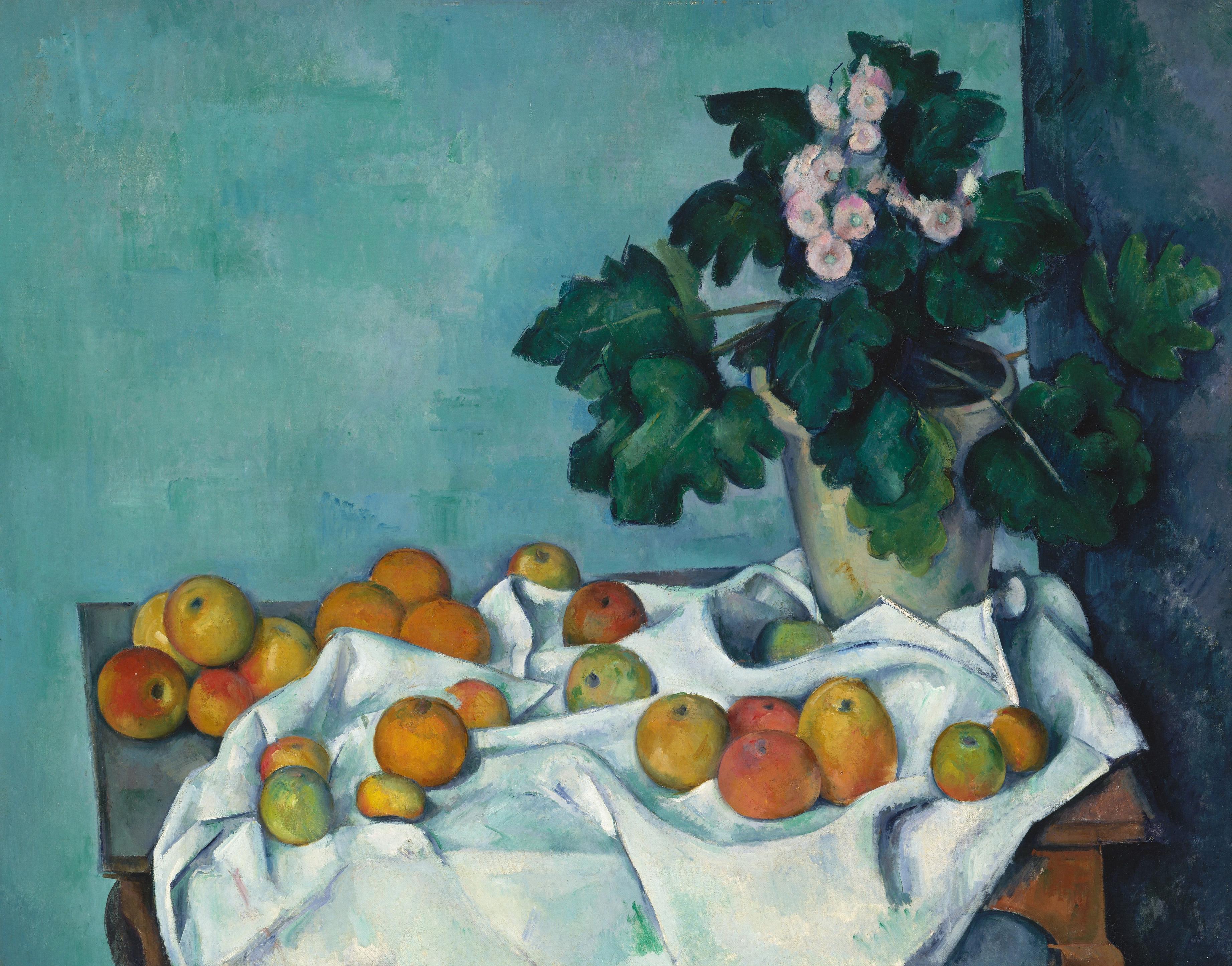
Paul Cézanne (French, 1839–1906). Still Life with Apples and a Pot of Primroses, ca. 1890. Oil on canvas, 28 3/4 x 36 3/8 in. (73 x 92.4 cm). The Metropolitan Museum of Art, New York, Bequest of Sam A. Lewisohn, 1951 (51.112.1)
My name is Maureen Gallace and I’m a painter.
Cézanne really gets credit for opening the door for abstraction. These paintings are so relevant, particularly now. We have abstraction and representation, both equally represented, in our current moment. When I first saw the paintings I was young. I remember thinking, “Oh, you can paint like this.” I did not find them intimidating. Cézanne gave permission. There was a way in for me. And then, getting older and being a painter for twenty five years, they still deliver.
He was taking this simple, naïve, everyday object that we’re all familiar with, but the paintings don’t ever feel about copying the apples. The paintings are about painting. You can see the canvas. Everything points back at what it took to make the painting. Every single mark is laid bare so he really wanted everybody to know the experience of the painter.
And he took forever to make the paintings, so sometimes they’re not apples, sometimes they’re peaches or pears, but I’m fairly sure that one of the reasons he used the apple was it didn’t spoil. I’m someone who often takes an hour to make a brush mark. Painting is a lot of thinking, a lot of staring.
The emotion comes from the way paint is handled. The forms seem kind of crude because they’re built up from the marks. They’re so solid, the apples; they almost become sculptural. It’s like you could feel those apple in your hand. And then there’s a black outline, which doesn’t quite touch the shape. So they vibrate.
There is an uneasiness to these paintings, and I think that comes from the shifting perspective. There’s no horizon line. The tablecloth hides the edge of the table and the tilting can be a little claustrophobic and destabilizing.
There’s perfectionism in there. It’s so tightly controlled, but also it wasn’t about the one painting that was going to be the masterpiece. I mean I think that was the point: to keep going, keep going, keep going and get better and better and better and so it was ok to fail. There’s less pressure on the painting, because we’ll just get it right the next time.
I think he was trying to put everything that he knew about painting into each object. It’s hard, but I think it’s a real thing. I think it’s a type of experience that some painters have: a need to distill things down, to get at the essence of what painting is, even if it’s just using an apple.