Embroidered Sampler
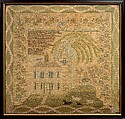
In 1779, the Quakers founded their first co-educational boarding school, the Ackworth School in Yorkshire, England, and soon after Quaker schools were opened in other areas of England. By 1799, the Westtown School was opened near Philadelphia in the United States. These well-respected schools were financially accessible to most, reinforcing the Quaker beliefs in equality, and provided both girls and boys with a strong academic education. The curriculum was largely the same for both sexes, although in the early years of the schools, girls spent less time on topics like science and mathematics, which were traditionally thought to be more important for boys to learn. Instead, the girls took embroidery and sewing classes. Sewing skills would stand them in good stead whether they worked in the home or outside it as seamstresses or teachers, which were some of the few professions open to women in the late eighteenth and early nineteenth centuries. Samplers made at Quaker schools tended to be utilitarian, like this exercise in pattern marking, rather than intentionally decorative.
It is hard to know exactly at which Quaker school this sampler was made, or if it originated at an English or American school. Those created at the Ackworth School tend to be more intricate and often include the school’s name within the design. It does not appear to be from any of the known American schools either; for a related example from the Westtown School, see 2005.463.2. American Quaker samplers are also often inscribed with the school’s name, and the embroidery work was usually more delicate than the stitching on this piece. This sampler has a fairly coarse linen ground, and the monochromatic dark green cross-stitched patterns are bold. It is decorated with at least two patterns also found on another English Quaker sampler in the collection (57.122.613). Today, eight Quaker secondary schools remain in England, while many more than that number continue to thrive in the United States.
Artwork Details
- Title: Embroidered Sampler
- Maker: A. H.
- Date: 1810
- Geography: Probably made in Chester County, Pennsylvania, United States
- Culture: American or English
- Medium: Silk embroidery on linen
- Dimensions: 11 3/4 x 11 3/4 in. (29.9 x 29.9 cm)
- Credit Line: Rogers Fund, 1913
- Object Number: 13.69.10
- Curatorial Department: The American Wing
More Artwork
Research Resources
The Met provides unparalleled resources for research and welcomes an international community of students and scholars. The Met's Open Access API is where creators and researchers can connect to the The Met collection. Open Access data and public domain images are available for unrestricted commercial and noncommercial use without permission or fee.
To request images under copyright and other restrictions, please use this Image Request form.
Feedback
We continue to research and examine historical and cultural context for objects in The Met collection. If you have comments or questions about this object record, please contact us using the form below. The Museum looks forward to receiving your comments.
Content Notice
The Metropolitan Museum of Art presents over 5,000 years of art from around the world, and our online collection reflects ongoing work conducted over the course of our more than 150-year history. You may encounter objects or images that may be inappropriate for some viewers or information that may be outdated.