Padrarulj (ancestor figure)
Artwork Details
- Title: Padrarulj (ancestor figure)
- Artist: Paiwan artist
- Date: 19th–early 20th century
- Geography: Taiwan
- Culture: Paiwan peoples
- Medium: Wood, porcelain
- Dimensions: H. 50 3/4 in. × W. 15 in. × D. 5 in. (128.9 × 38.1 × 12.7 cm)
H. (with mount) 54 1/2 in. (138.4 cm) - Classification: Wood-Sculpture
- Credit Line: Gift of Fred and Rita Richman, 1988
- Object Number: 1988.143.7
- Curatorial Department: The Michael C. Rockefeller Wing
Audio
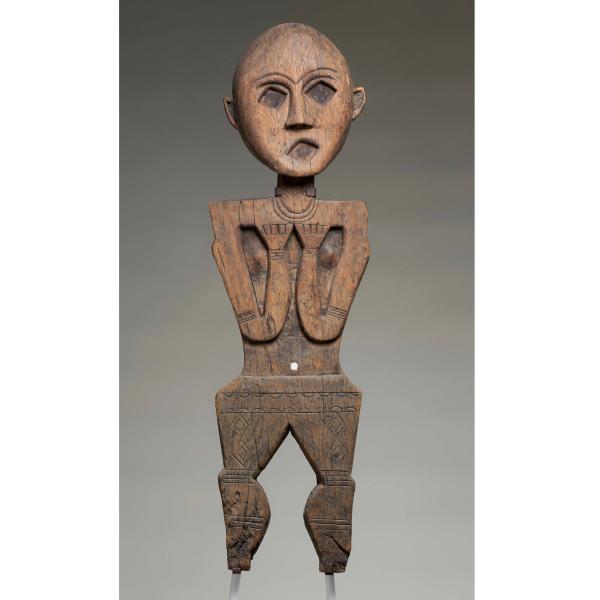
1772. Padrarulj (ancestor figure), Paiwan artist
Calivat Gadu
CALIVAT GADU (English translation): The eyes and mouth are diamond shaped, which means the eyes are able to see in all directions, and the mouth is able to speak to all directions.
KATERINA TEAIWA (NARRATOR): That was Calivat Gadu, Deputy Minister of the Council of Indigenous Peoples of Taiwan.
CALIVAT GADU (English translation): I was born and raised in a Paiwan community. So I’ve seen this kind of figure in the communities very often.
They only belonged to the families of the chieftains and the nobility. Usually they were attached to the main pillar of the house, and also the granary.
The artwork combines the features of male and female. The upper body is that of a woman. But it wears armbands, which only men are supposed to wear. And on the lower body, it wears men’s traditional Paiwan pants. It symbolizes how both men and women are working together to support the family.
When an object combines male and female features, it means wisdom. In the Paiwan language, we call it Zho-tsao, the person with wisdom.
The combination also refers to the umbilical cord that connects heaven and earth, and human and ancestral spirits.
More Artwork
Related Content
Publications
Books, guides, and catalogues published by The Met.
Research Resources
The Met provides unparalleled resources for research and welcomes an international community of students and scholars. The Met's Open Access API is where creators and researchers can connect to the The Met collection. Open Access data and public domain images are available for unrestricted commercial and noncommercial use without permission or fee.
To request images under copyright and other restrictions, please use this Image Request form.
Feedback
We continue to research and examine historical and cultural context for objects in The Met collection. If you have comments or questions about this object record, please contact us using the form below. The Museum looks forward to receiving your comments.
Content Notice
The Metropolitan Museum of Art presents over 5,000 years of art from around the world, and our online collection reflects ongoing work conducted over the course of our more than 150-year history. You may encounter objects or images that may be inappropriate for some viewers or information that may be outdated.