Statue of Ur-Ningirsu, son of Gudea
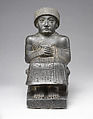
This sculpture depicts a standing figure with clasped hands. An inscription written in cuneiform on its back names Ur-Ningirsu, ruler of the city of Lagash and the son and successor of Gudea. Beneath the feet is a high base with a scene depicting in relief eight kneeling men carrying objects, perhaps as tribute bearers. The head of this statue, as well as the pose of the body and the hand position, conform to the stylistic and formal representation of the many statues of Gudea.
The Sumerian inscription on his back reads as follows:
For Ninĝišzida, his personal god, Ur-Ninĝirsu, ruler of Lagaš, son of Gudea, ruler of Lagaš, the builder Ninĝirsu's E-ninnu, fashioned his own statue. He named this statue for his sake "As I am someone loved by his personal god, may my life be prolonged!", and brought it before him into his temple.
Artwork Details
- Title: Statue of Ur-Ningirsu, son of Gudea
- Period: Neo-Sumerian
- Date: ca. 2080 BCE
- Geography: Mesopotamia, probably from Girsu (modern Tello)
- Culture: Neo-Sumerian
- Medium: Chlorite
- Dimensions: H. 55 cm (21 5/8 in.)
- Credit Line: Rogers Fund, 1947 and Lent by Musée du Louvre
- Object Number: 47.100.86+L.2014.59
- Curatorial Department: Ancient West Asian Art
More Artwork
Related Content
 Free to download
Research Resources
The Met provides unparalleled resources for research and welcomes an international community of students and scholars. The Met's Open Access API is where creators and researchers can connect to the The Met collection. Open Access data and public domain images are available for unrestricted commercial and noncommercial use without permission or fee.
To request images under copyright and other restrictions, please use this Image Request form.
Feedback
We continue to research and examine historical and cultural context for objects in The Met collection. If you have comments or questions about this object record, please contact us using the form below. The Museum looks forward to receiving your comments.
Content Notice
The Metropolitan Museum of Art presents over 5,000 years of art from around the world, and our online collection reflects ongoing work conducted over the course of our more than 150-year history. You may encounter objects or images that may be inappropriate for some viewers or information that may be outdated.