The Oxford English Dictionary defines “ephemera” as “things that exist or are used or enjoyed for only a short time.” Despite its definitional transience, The Costume Institute’s Irene Lewisohn Costume Reference Library’s holdings—in addition to over thirty thousand books—include a special collection of fashion ephemera that have been preserved for researchers to use far into the future.
Fashion ephemera include items such as lookbooks, invitations, flyers, direct mailers, and shopping bags, to name a few examples. Often, these objects weren’t produced to be sold, and sometimes weren’t even available to the general public. Their intended audience varied from fashion industry professionals to a brand’s customer base.
While such ephemera may have been deemed insignificant or even disposable at the time—imagine a fashion editor or a frequent client who is sent many promotional materials and has no need for them after the season passes—they are fascinating to look back on, revealing a brand’s aesthetic and communication style from a specific moment. Designer and brand ephemera represented in The Costume Institute Library’s holdings are diverse, from large fashion houses such as Yves Saint Laurent and Prada to independent brands such as BIBA and Todd Oldham. For this post, we’ll take a look at ephemera from Issey Miyake—a designer whose garments are well-represented in The Costume Institute collection and have been included in several exhibitions at The Met.
Miyake is known for his exploration of innovative materials and textiles, his spirit of collaboration, and his playful sensibility that was the throughline of his long career. Miyake Design Studio and all of its brands continue to possess a strong visual identity that was established from the beginning with Miyake’s frequent collaborators: graphic designer Ikko Tanaka, artist Tadanori Yokoo, and photographer Irving Penn, to name a few. This identity and the brand’s design ethos are reflected in the ephemera in The Costume Institute Library and are invaluable primary sources that add another dimension of understanding to the world of Issey Miyake.
Early career
From 1975 to 1977, the Japanese fashion retailer Parco sponsored Issey Miyake shows that were open to the public. The Costume Institute Library has ephemera from two of these shows.
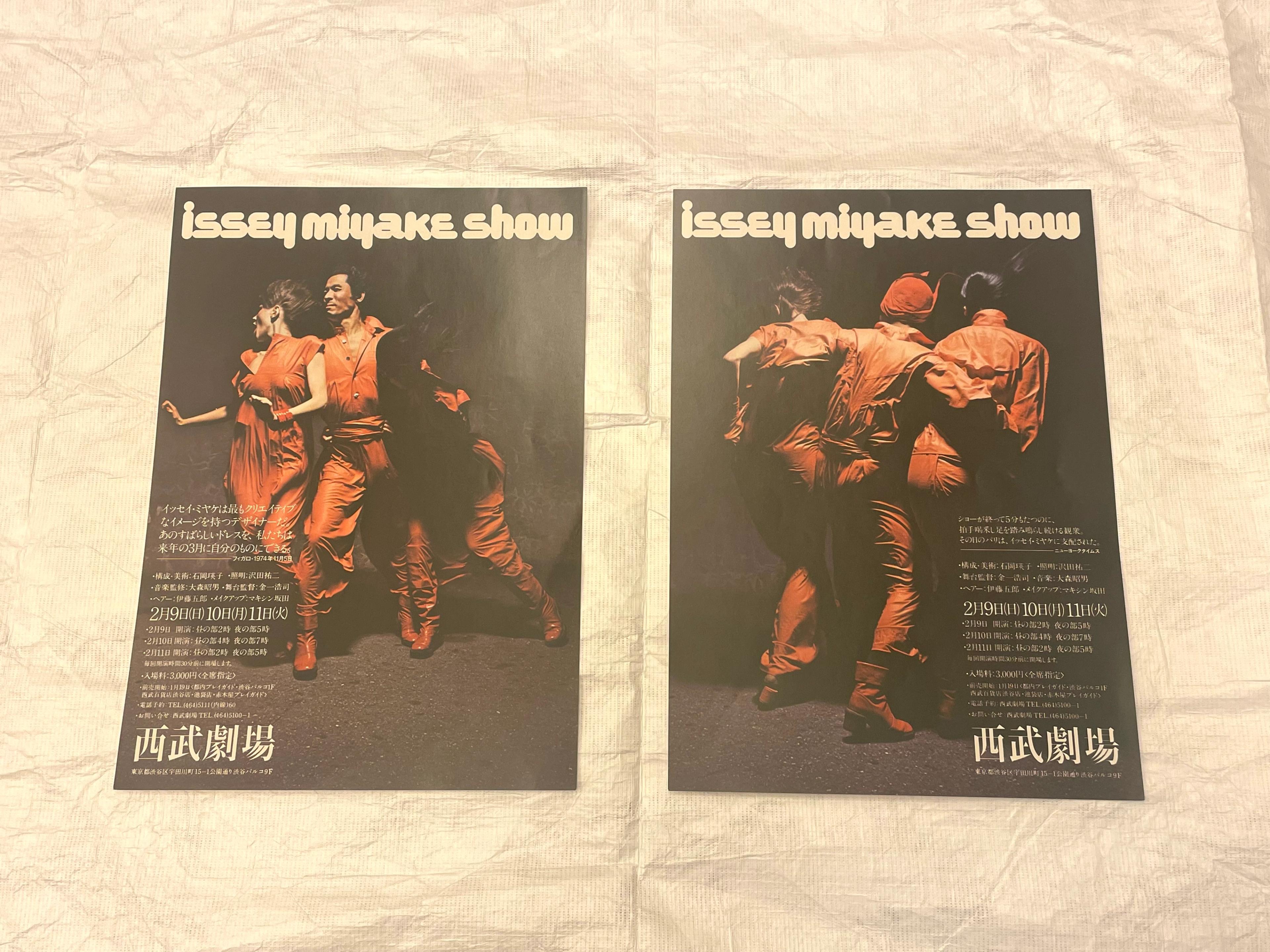
Issey Miyake Show flyer (1975)
To this day, performances and exhibitions are promoted via physical flyers in Japan. Many museums and theaters have racks or shelves devoted to flyers for upcoming shows; patrons are encouraged to take any that pique their interest. Fittingly, the Issey Miyake show held in Tokyo in February 1975 also had a flyer. There were two variations: one with an image of Miyake himself flanked with two models stepping out exuberantly, and another with the trio from behind.
These performances were a restaging of Issey Miyake’s spring 1975 collection, shown during Paris Fashion Week in October 1974. The introductory text on the back of the flyer recounts the fervor and success of the Paris show, which “proceeded with a never-ending storm of applause,” and featured translated reviews from Women’s Wear Daily, The New York Times, and Le Figaro. The flyer promises that the same fervor will be replicated in Japan, giving audiences the opportunity to experience the world of Issey Miyake and an exciting new take on the fashion show, complete with music and creative direction. It also includes practical information about ticket price (3000 yen, approximately $10 in the 1970s), location (Seibu Gegijyou, or theater, which was located on the ninth floor of Parco, the sponsor), and dates (matinees and evenings on February 9, 10, 11—six shows total). The six shows attracted approximately four thousand people.
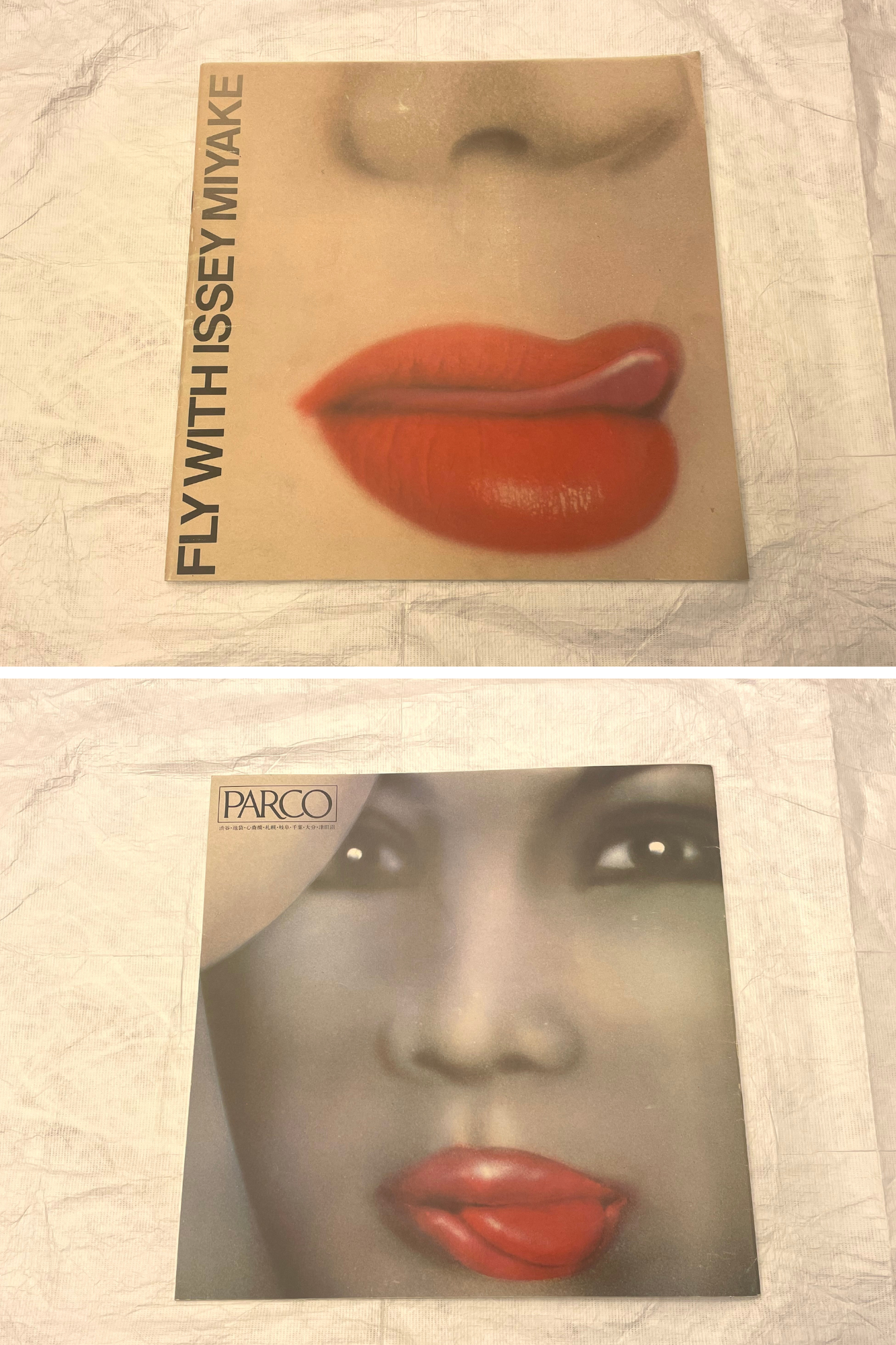
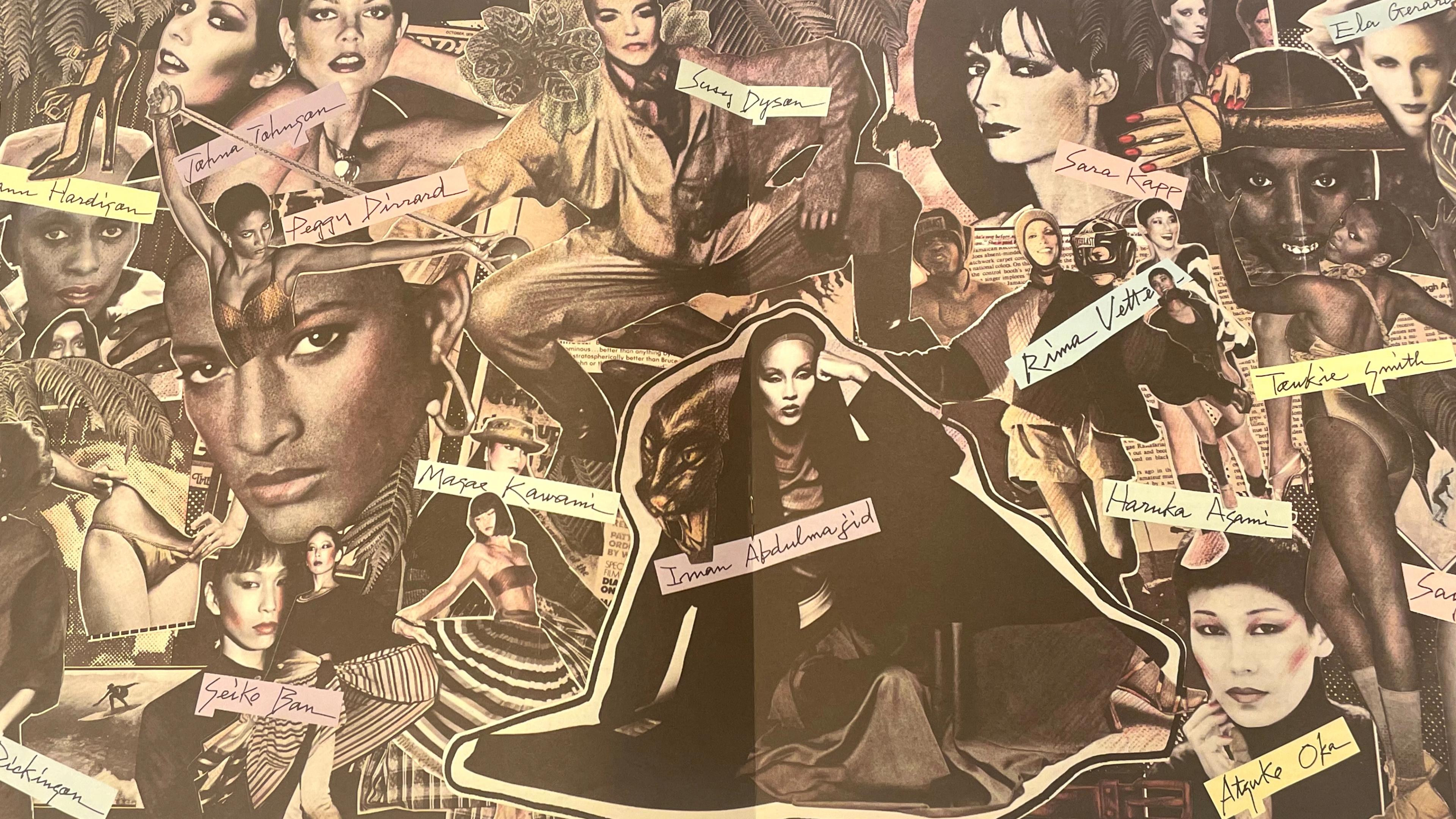
In July 1977, Miyake staged the “Fly with Issey Miyake” show featuring the fall 1977 collection. Shows were presented at the Meiji Jingu Indoor Field in Tokyo and the Kyoto Prefectural Gymnasium—approximately 22,000 people attended the five shows. This pamphlet was created in conjunction with these shows, though the contents don’t relate directly to it. Instead, the pamphlet features a far-ranging conversation between Miyake, Eiko Ishioka, and Hideyuki Sugimoto peppered with photos from fashion shows and Miyake’s trip to New York (New Yorkers may recognize Empire Diner, which is still in operation in Chelsea today). A photo collage (see marquee image) and accompanying biographies highlights some of the models who walked for Miyake, including Bethann Hardison, Sayoko Yamaguchi, and Iman.
Issey Miyake and photography
Lookbooks showcase a brand’s collection and are printed and circulated to press covering the collections or a client who might place an order. They were crucial assets for a fashion brand before the internet. Lookbooks from two brands under the Miyake Design Studio umbrella—Permanente and A-POC—are examples of the lookbook functioning as an experimental space for photography and art direction. They add depth to Miyake’s visual oeuvre beyond the rightly beloved but at the same time ubiquitous imagery resulting from the legendary Miyake/Penn collaboration.
Miyake observed many friends and customers re-wearing garments long after its debut season. Touched, he created the Permanente line in 1985, offering (as the name suggests) “clothes for a lifetime.” Miyake enlisted Antony Charles Robert Armstrong-Jones, or Lord Snowdon, to photograph the lookbooks. Nine lookbooks were published between 1986 and 1990, presented in an oversized portfolio housed in a cardboard sleeve. Inside the sleeve, thin paper folios with English and Japanese text on the subject encase a portrait printed on thicker paper. Miyake Design Studio classifies these volumes as “private publication,” likely with limited distribution to press and clients and not made available for sale.
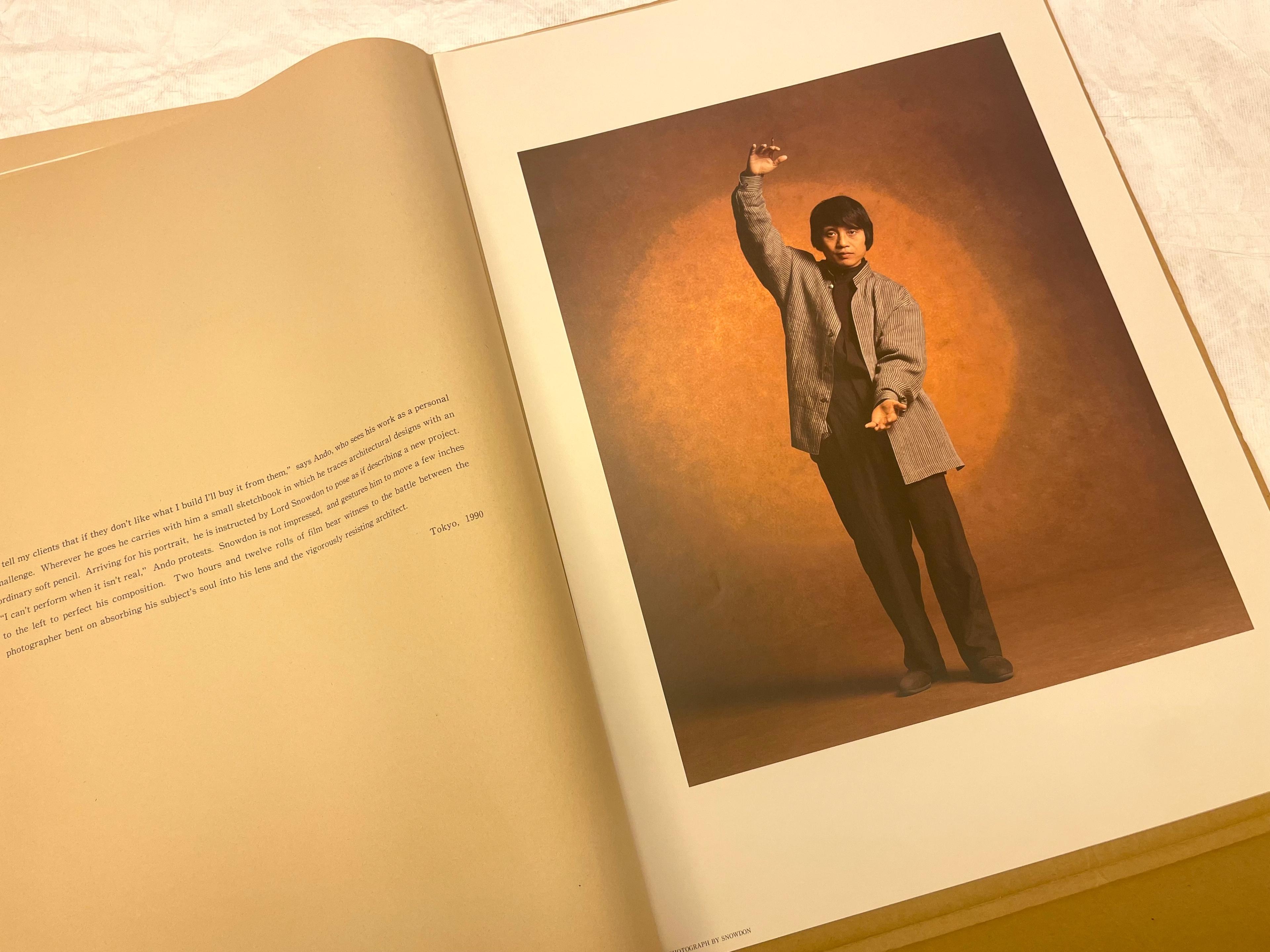
Architect Tadao Ando in a Permanente lookbook (1986–1990)
While the Permanente clothes pictured are beautiful, even more captivating are the subjects—a selection of masters in their respective fields, from architecture or soba noodle hand cutting to botany or dance. Photographing the collection on figures with such a strong sense of self conveys a sense of permanence and longevity, perhaps capturing the essence of what Miyake felt when he started Permanente.
With designer Dai Fujiwara, Miyake developed A-POC, an acronym for “A Piece of Cloth” in 1998 “to highlight the two-dimensional quality of cloth and to minimize waste.” This lookbook, circa 2001, was photographed by Friedmann Hauss. Titled A-POC in Berlin, the lookbook is perhaps one of the most youthful creative directions within Miyake’s visual oeuvre, from the youth of the models (including children) to the layered styling of the A-POC pieces, all juxtaposed with Berlin’s graffiti throughout.
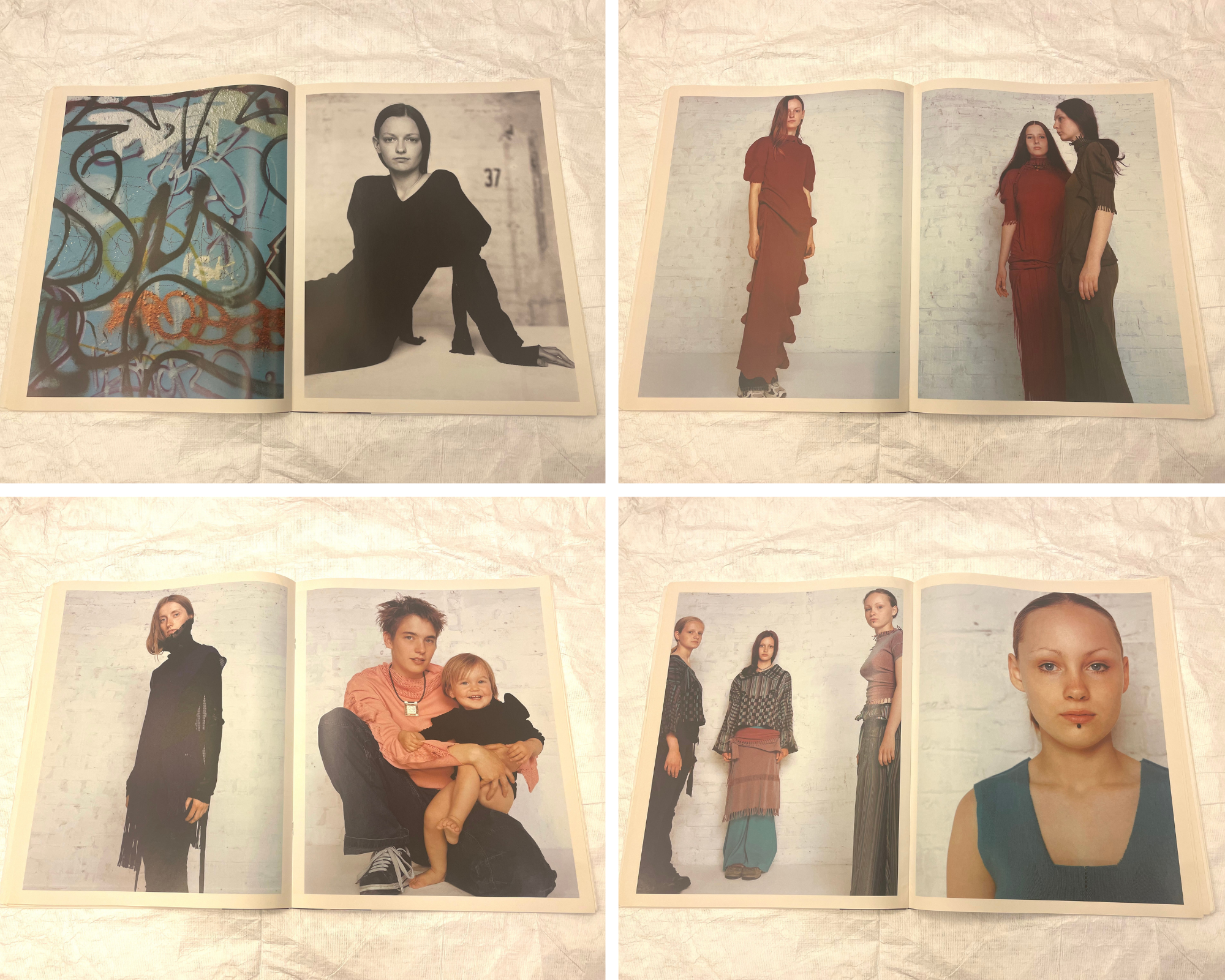
A-POC in Berlin (ca. 2001)
These two examples function almost like photobooks—in scale and in the photography—compared to more straightforward lookbooks that feature runway looks or product shots.
Miyake’s universe
With over fifty years in business, the world of Miyake is expansive. Between the permanent collection and the Library, The Costume Institute is lucky to have corresponding Miyake items that enable us to contextualize his work, aiding further research.
Another A-POC lookbook, featuring the spring/summer 1999 collection, utilizes runway and product imagery to help clients understand the offerings. Step-by step-images of the brand’s signature product, aptly titled “A-POC,” explain how a roll of cloth is marked with lines the demarcate a dress, a shirt, a skirt, and more, giving the wearer the agency to cut out their own wardrobe. Two uncut A-POC “Kits” from 1999 are part of The Met collection.
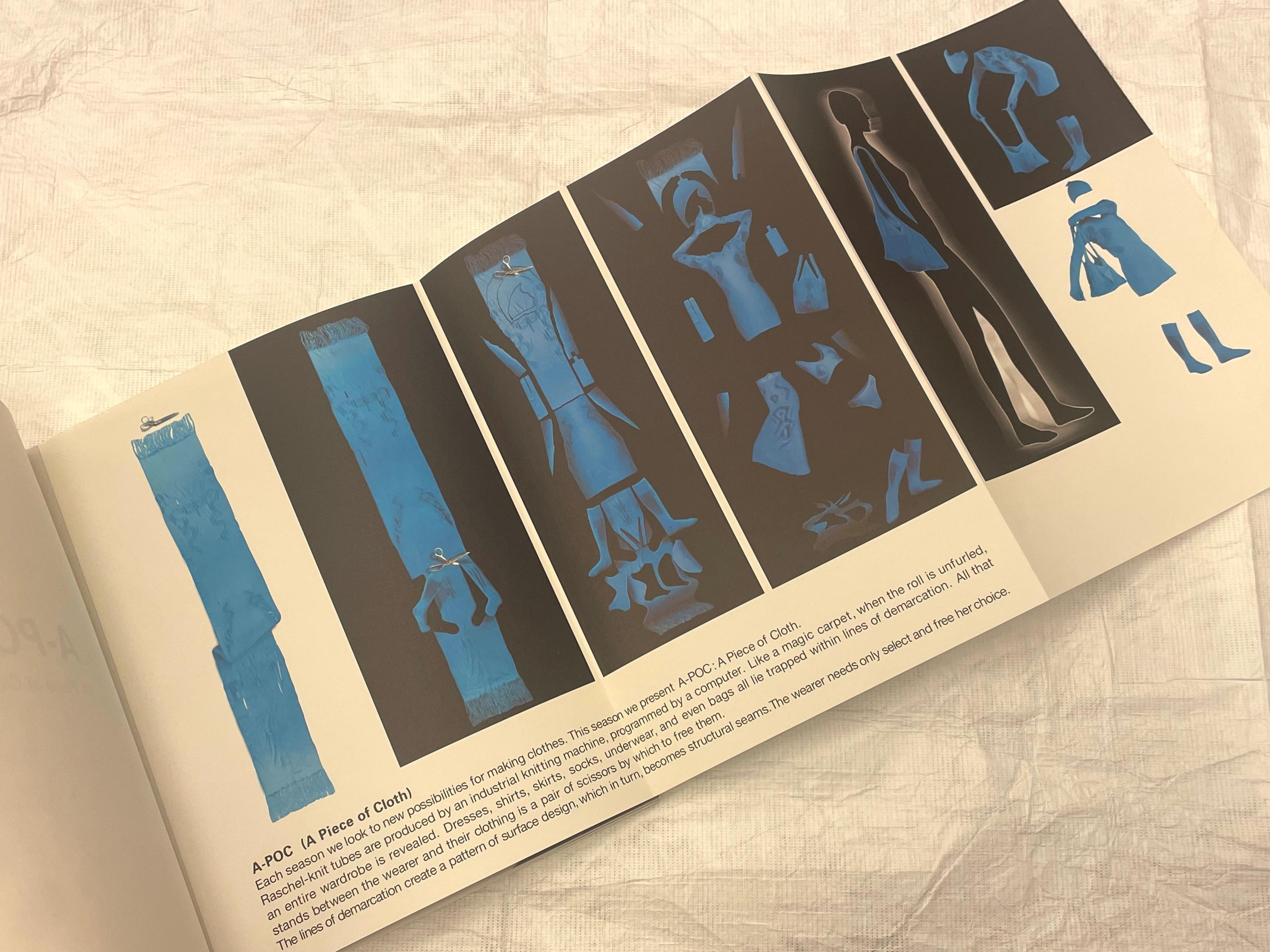
This lookbook is compact and thoughtfully designed. The accordion page unfolds to reveal a memorable moment on the runway: the finale showcasing models connected by a piece of vibrant red cloth. The movement of opening the elongated page echoes the presentation on the runway, demonstrating in a tactile way the length and scope of the final look.
Pleats Please Issey Miyake, founded in 1993, is one of the most popular and accessible brands within the Miyake umbrella. The brand’s output is prolific—releasing new offerings monthly—and this ambitious cadence is reflected in the abundance of ephemera.
Miyake believed that Pleats Please had the “potential to serve as an artist’s canvas,” and in 1997, invited various artists to participate in the Pleats Please Guest Artist Series. The first artist in the series was photographer Yasumasa Morimura, who combined a photograph of himself with Jean-Auguste-Dominique Ingres’s painting La Source and imposed it on Pleats Please tops and dresses. Miyake viewed this series as more of a commission than a collaboration, a way to explore “clothing as an art medium.”
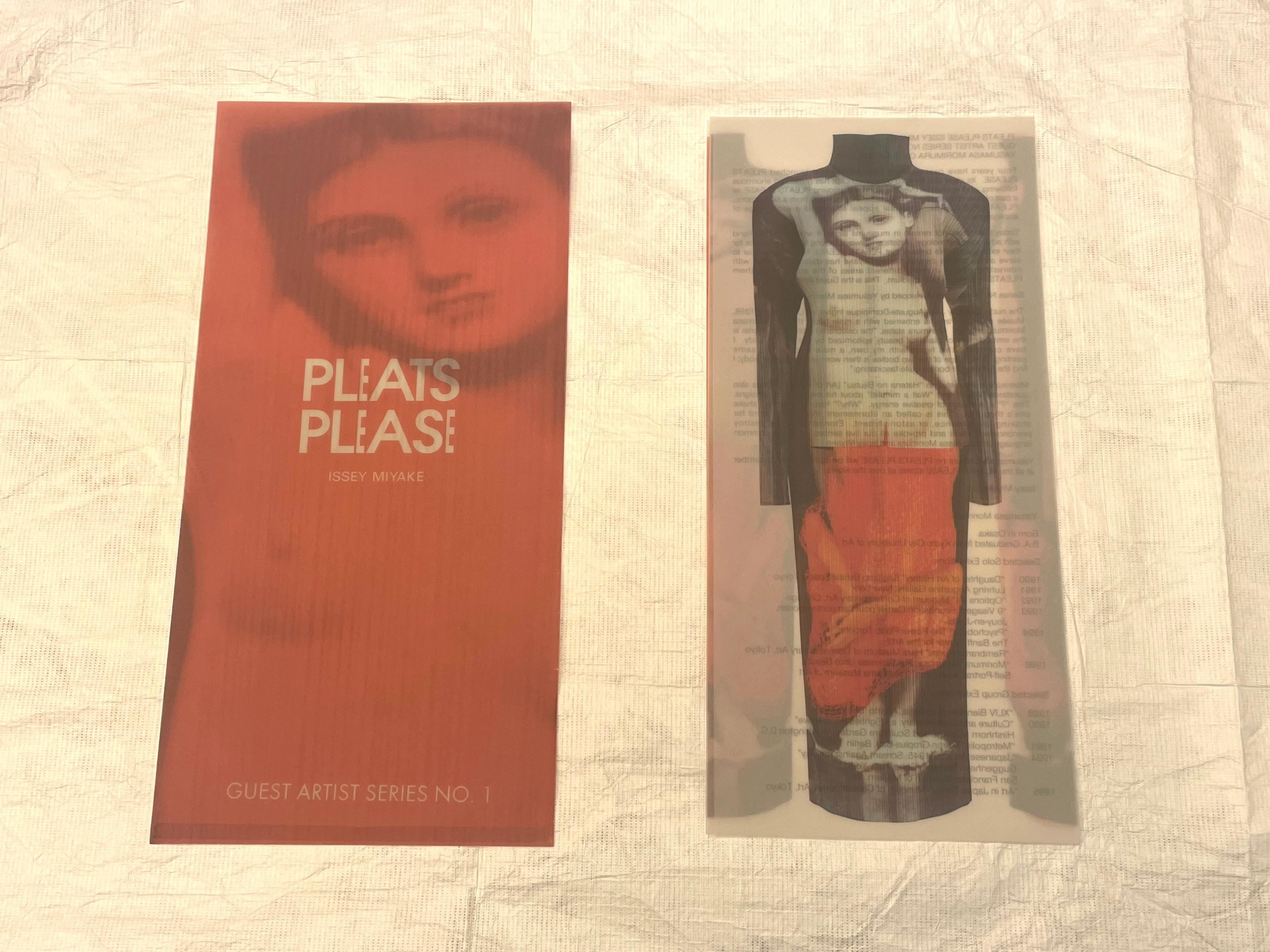
This mailer, a tri-fold pamphlet in a sleeve printed on wax paper, announced the new series and was likely sent to fashion industry professionals and clients. In fact, this particular mailer in the library is addressed to Harold Koda, the former Curator in Charge of The Costume Institute. The top and dress from this series are part of The Costume Institute’s permanent collection.
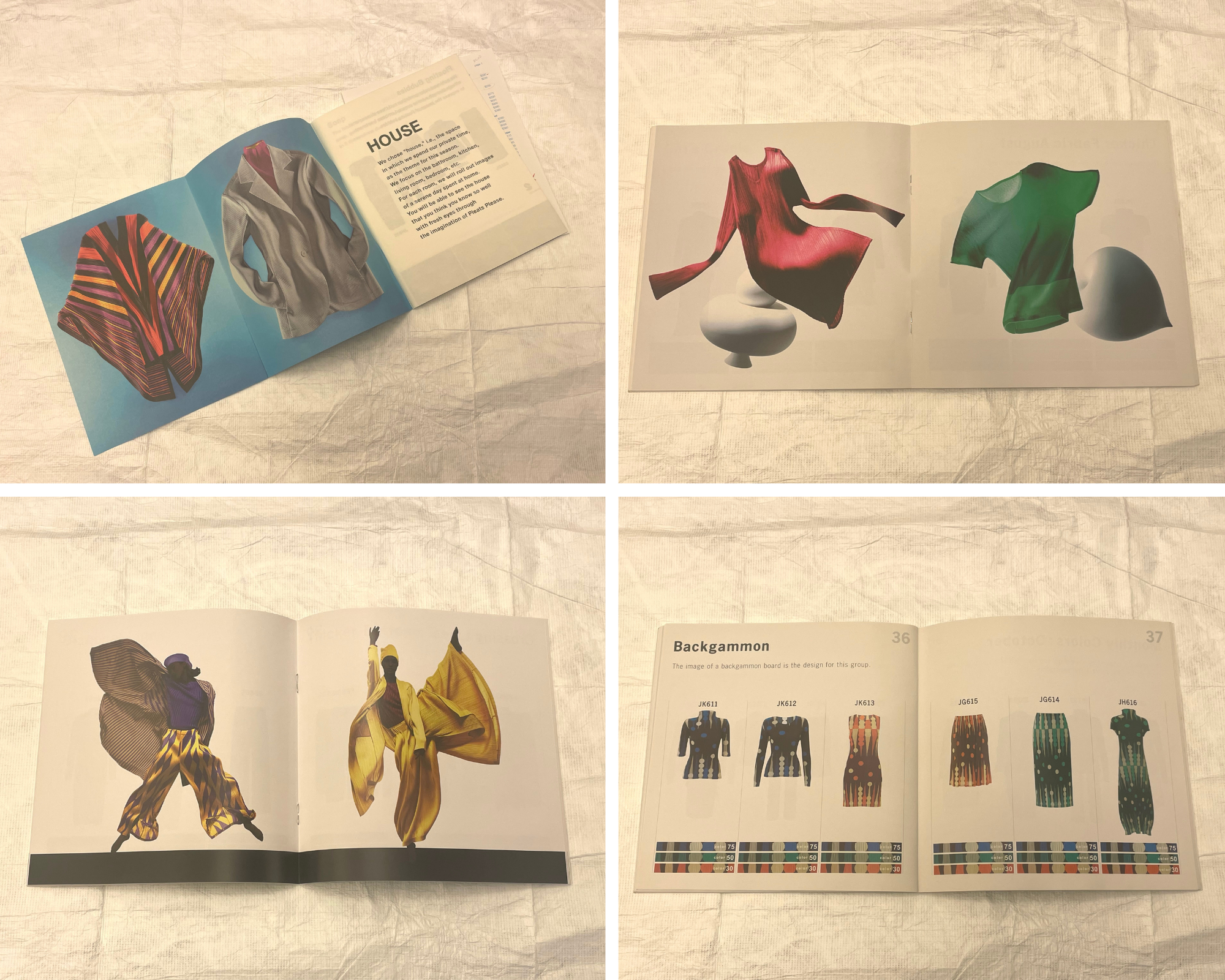
Pleats Please lookbooks were released twice a year in the spring/summer and fall/winter. These substantial booklets underscore the incredible volume of the brand’s output. As Miyake himself expressed for the Guest Artist Series, Pleats Please is an incredible canvas for creativity, and each collection offered new colors, different patterns and prints, various closures and surface decorations—all of which were neatly cataloged in the lookbooks. With a dizzying amount of product, these lookbooks are invaluable in identifying Pleats Please collections and eras.
Pleats Please “Sushi” (2015)
In honor of the company’s forty-fifth anniversary in 2015, the Miyake Design Studio created the Pleats Please “sushi,” a special keepsake to reflect the tradition of consuming sushi as a celebratory meal in Japan. The box reads “sushi” in traditional Japanese calligraphy, and the lid lifts to reveal a colorful array of “sushi” crafted from fabric. The “shrimp” and “maguro” unfurl to reveal tabi socks, the “tamago” (egg) opens to a small pouch to store tissue paper, and the “uni” (sea urchin) becomes a tiny pochette. While this version was not for sale, a rectangular version was sold in limited quantities at Pleats Please stores. The “sushi” boxes also recall the Pleats Please food campaigns, the first of which in 2008 turned Pleats Please garments into sushi. Created by art director Taku Satoh, he quipped: “All the keywords of Pleats Please also apply to sushi, Japan’s first ‘fast food.’ Easy. Shrinkable. Portable. Playful. Diverse. Colorful. Japan.”
In memory of the Tribeca Issey Miyake store
On December 12, 2025, the Frank Gehry-designed Issey Miyake store in Tribeca shuttered, the closure made even more bittersweet following the architect’s death on December 5. The Costume Institute Library’s copy of the Tribeca Issey Miyake publication is now a memento of the one-of-a-kind space. While this publication is marked “Issue 2,” the Library unfortunately does not have the full run.
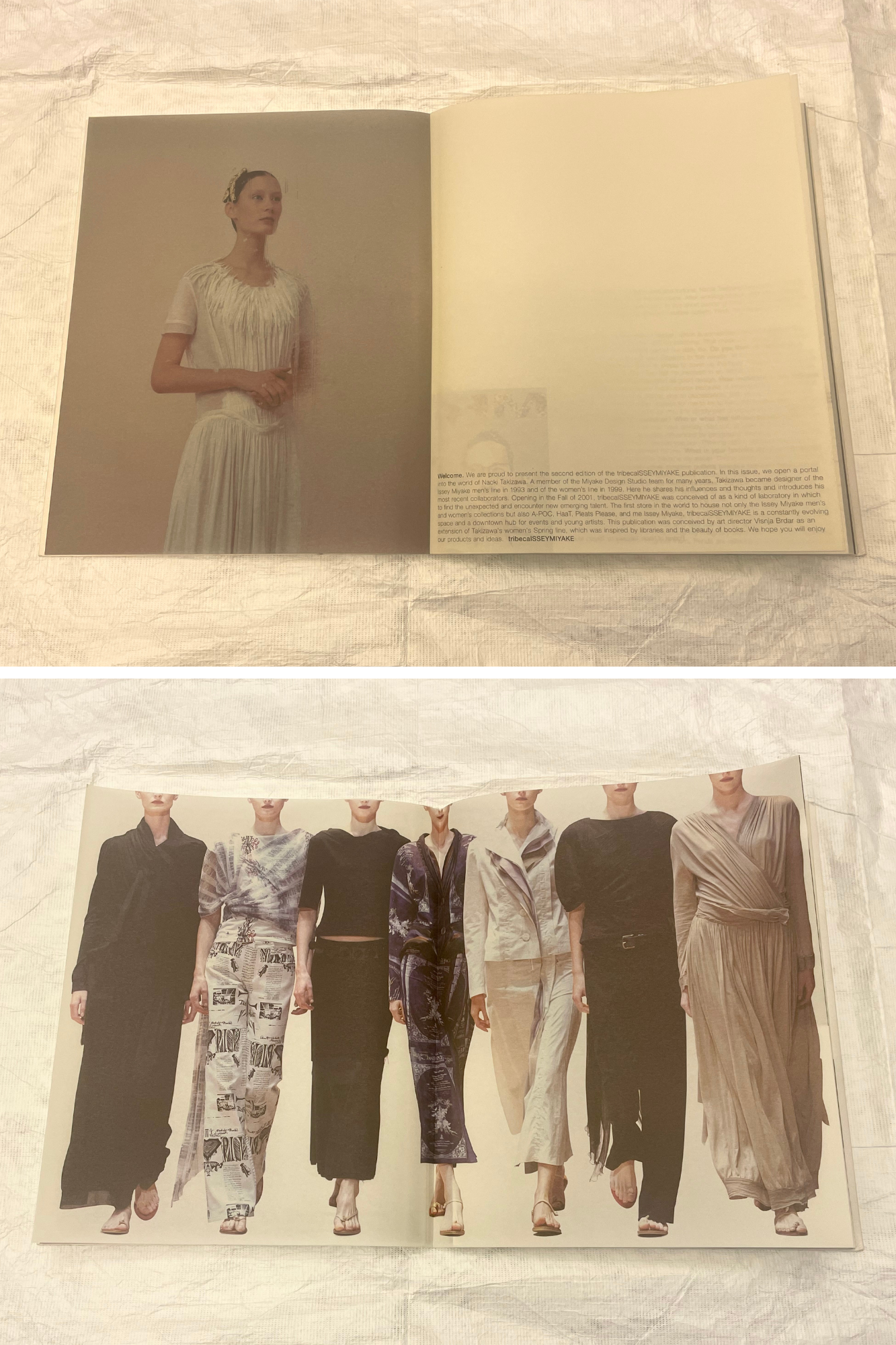
Tribeca Issey Miyake (2003)
Fittingly for a store publication, the booklet highlights the collections, with credits and prices, carried by Tribeca Issey Miyake: Issey Miyake, Issey Miyake Mens, Pleats Please, HaaT, me Issey Miyake, A-POC, Vakio/Harri Koskinen watch, and L’Eau d’Issey Parfums. The design is sophisticated, featuring a pearly white cover in a thin wax paper bound accordion style, embossed with “tribeca Issey Miyake.” In addition to the commercial purpose, the booklet also served as an introduction to the spring/summer 2003 season’s ideas, highlighting relevant figures like Issey Miyake, creative director Naoki Takizawa, and architects Kazuyo Sejima and Ryue Nishizawa.
While the items shown here are only a fraction of the Library’s Issey Miyake ephemera, they paint a picture of his career and ethos: the spirit that endures even after his passing, the array of brands that have their own identity but fit within the Miyake worldview, and the creativity and innovation that extends beyond clothing. And now, within the Library, Miyake’s ephemera gains a sense of permanence.


