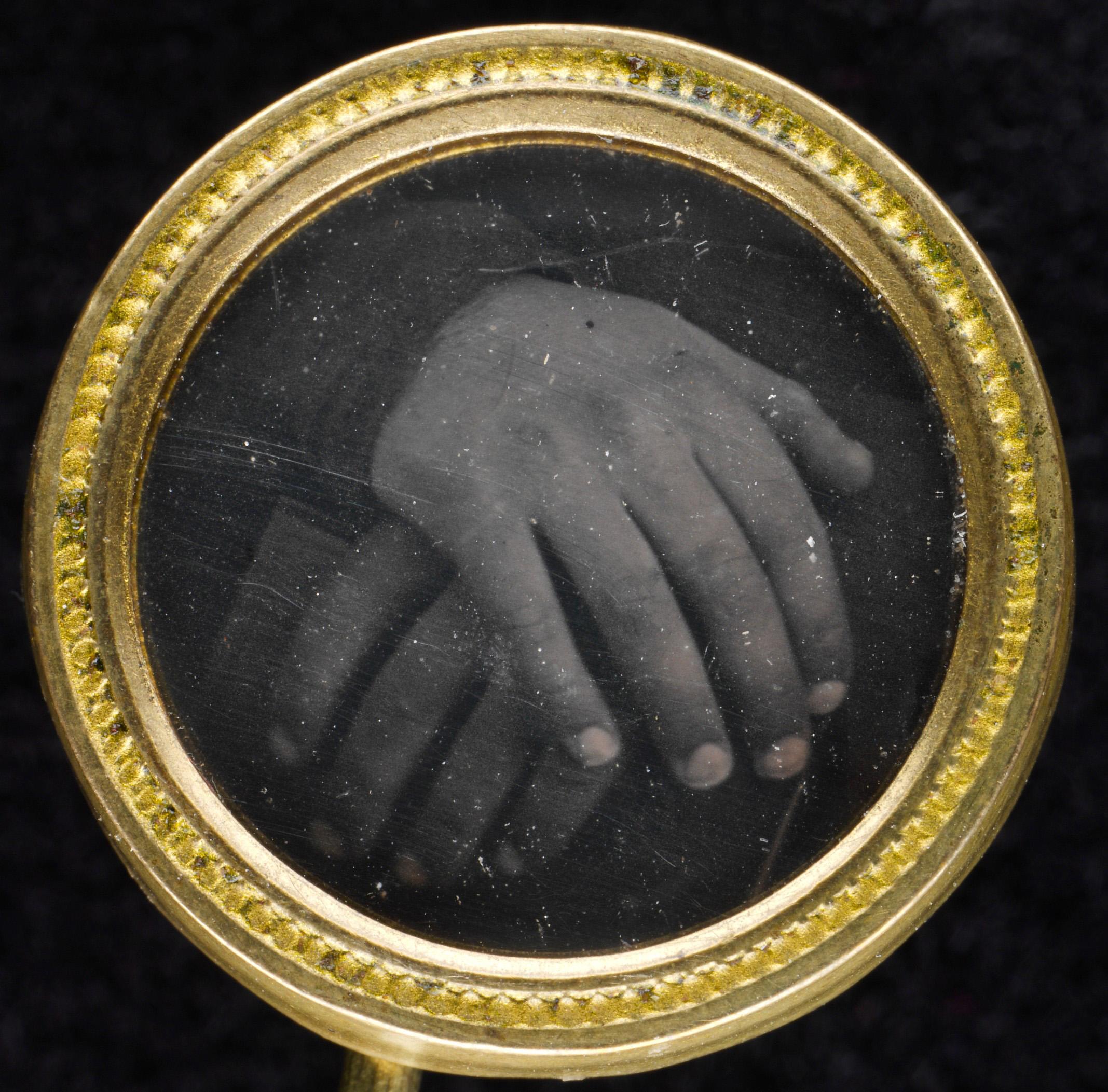
[Button], 1840s–50s. Artist unknown. Daguerreotype, 5/8 in. (1.6 cm). Gilman Collection, Purchase, Joyce F. Menschel Gift, 2005 (2005.100.78)
My name is Hank Willis Thomas. I am a photo-conceptual artist.
What I'm interested in as an artist is trying to bring some of those things that we've kind of packed away back out for us to discuss. I'm fascinated with how our history and our understanding of the world actually shifts, so I think of history as a moving target.
This is a daguerreotype button, and there were some longstanding questions about whether or not it was an abolitionist pin and that there appeared to be a white hand and a black hand holding a Bible. Now we believe that it was the same two hands and we're unsure as to whether or not it's holding a Bible. That's really fascinating to me because I made a replica inspired by the original definition.
I think the cropping is definitely a very intentional decision because the subject becomes anonymous: they become symbolic.
When a person wears a button they're basically wearing a question that they're waiting to activate in others. You'd have to be so close to them to even really see what it was. To get that level of detail that small really speaks to the daguerreotype, which is a nineteenth-century process which requires coating a piece of metal with emulsion. And when you look at it you're kind of looking both at the reflective metal and the image that kind of disappears before your eyes depending on at what angle of light you're holding it.
These look like young adult hands—someone who maybe worked manual labor for a living. The way in which they're clasping the book is really about intimacy and about protection and coveting the subject, and the photographer wanted us to know that this person reads, that they were engaged intellectually. So many photographs that were taken of African Americans in that era feature them holding books to contradict the mythology that was created of black people being inferior.
Today, where people wear pins and buttons to align themselves with political movements, I am really excited that these are long-held traditions. The fact that we don't know if it is a black person's hand or a white person's hand, or what happened to those hands later, is great because that means they're our hands. There is that magic of visibility/invisibility and meaning, and that ambiguity is what makes most art both legible and eternal.