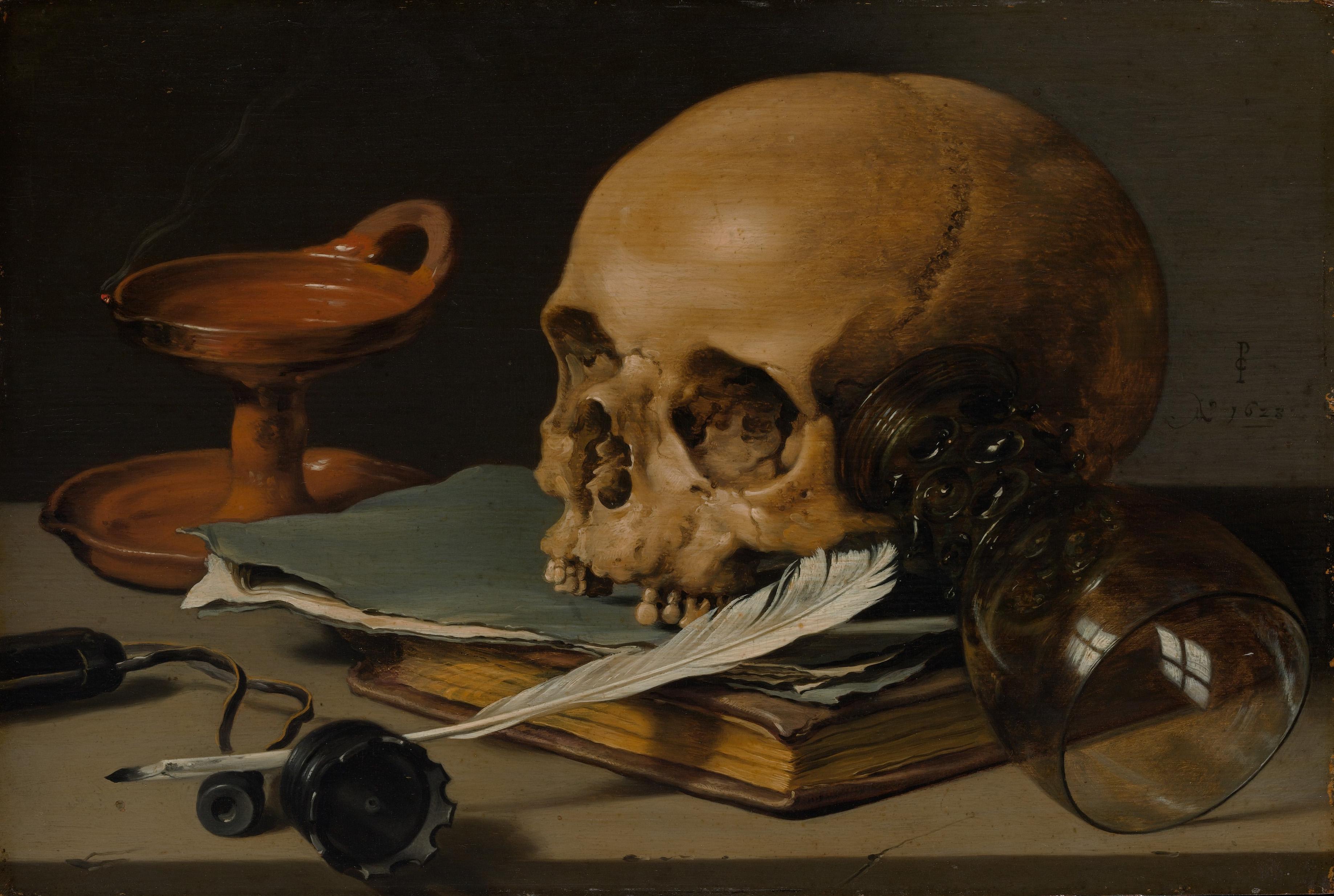
Pieter Claesz (Dutch, 1596/97–1660). Still Life with a Skull and a Writing Quill, 1628. Oil on wood, 9 1/2 x 14 1/8 in. (24.1 x 35.9 cm). The Metropolitan Museum of Art, New York, Rogers Fund, 1949 (49.107)
I'm Roland Flexner and I'm an artist.
I made a drawing after this painting when I was working on a series of drawings about vanitas. Vanitas is a genre of still-life painting that flourished in The Netherlands in the seventeenth century and was very popular.
It was previously painted on the back of portraits of people as a reminder of death. So this is the first known freestanding vanitas, but the artist, Jacques de Gheyn, is not well known.
Vanitas is a neutral approach. The painters never try to develop a personal style. It's conventional. It's very stiff. It's got all the classical symbols of the vanitas. The symbolic of the object is all pre-established. Everyone who went to church in the seventeenth century would have known the meaning of those objects, because they had biblical references.
The soap bubble is a different story because it's a total innovation. I thought, when I first saw that painting, that this vertical arrangement is very powerful. The thematic of the skull and the bubble is homo bulla: "man is a bubble." It addresses people's mortality. Actually, I made a collage with the skull inside the bubble—it fits perfectly!
The painting is not realistic. The bubble is levitating right in the middle of the niche, and there is a scary symmetry in the picture. Even the front teeth are symmetrically removed from that skull. The painting is very conceptual. You have the two philosophers at the top pointing at the globe, which is in that case a terrestrial globe.
The way you approach this painting as a contemporary viewer, you don't look for moralizing and theological meaning behind objects. If I make contemporary vanitas, they're certainly not about the symbolic. It's more about making the ephemeral happen in the material itself. The paradox of the vanitas is that you represent absence with an illusion of presence.
I think of it as a film noir: the tulip will wither, the smoke will disappear, the money will vanish, the bubble will burst, so nothing escapes death.
One aspect that I like a lot about this painting is that inside the bubble, the paint is very thin so a lot of it has disappeared. If the fragility happens in the material of painting, then painting is really the supreme vanity, in that case. The passage of time is at work.