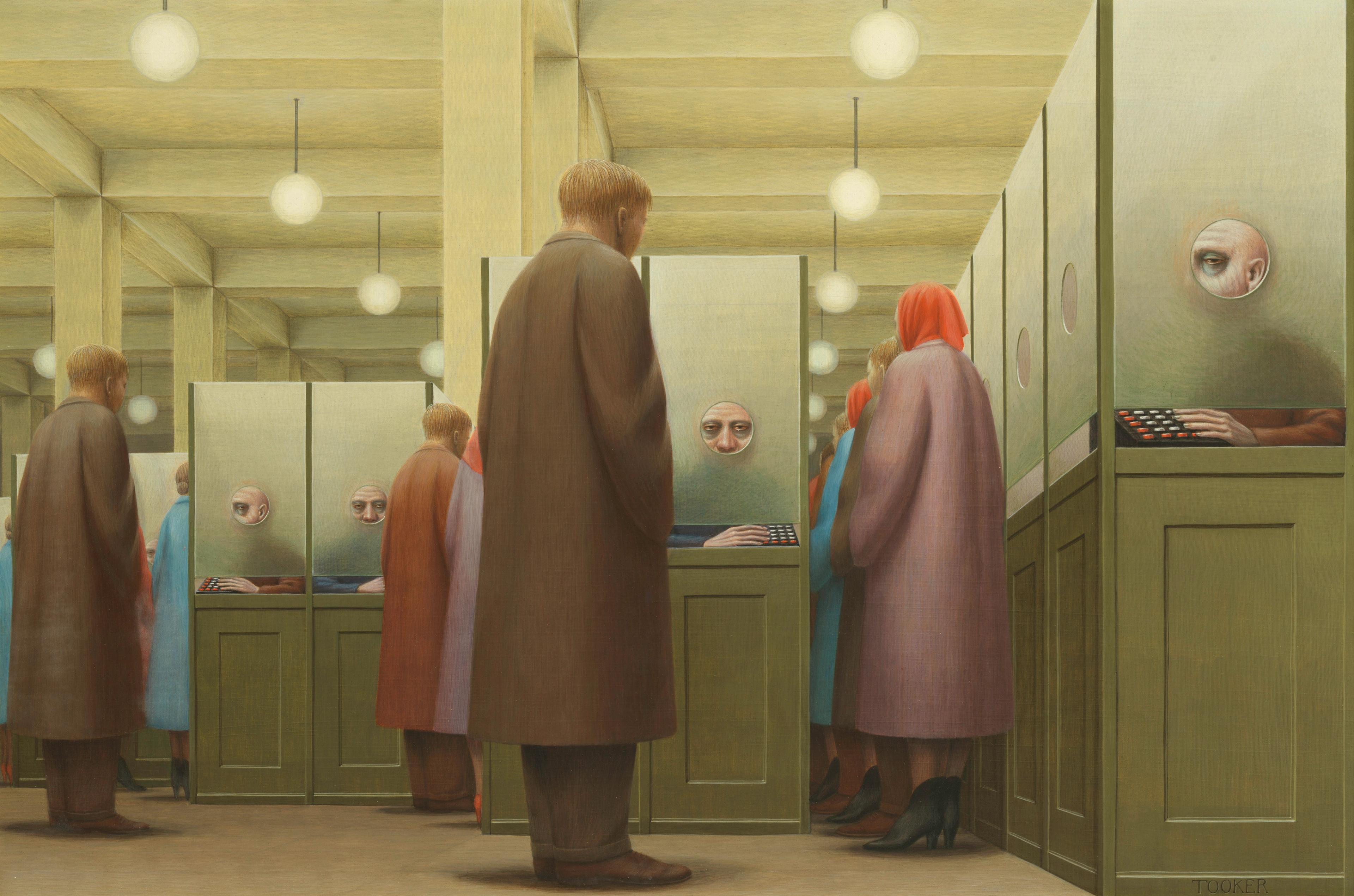
George Tooker (American, Brooklyn, New York 1920–2011 Hartland, Vermont). Government Bureau, 1956. Egg tempera on wood, 19 5/8 × 29 5/8 in. (49.8 × 75.2 cm). The Metropolitan Museum of Art, New York, George A. Hearn Fund, 1956 (56.78)
My name is Josephine Meckseper and my work is conceptual.
This painting, titled Government Bureau, from 1956 by George Tooker oddly stands out in its simplicity and understated presence. It feels oddly personal and creates a combination of familiarity and fear, like standing in line at the airport or at the DMV. At that time these big office building were just going up everywhere. It was new to people. They didn't really know what their place was anymore. He is capturing a moment of collective anxiety.
It's painted in a very peculiar, individualistic way to convey a sense of discomfort: sickly looking flesh under fluorescent light. And whose gaze is he following when he is painting this? Is it the innocent child looking at the perspective of what grown-ups are doing? Or is it us as the viewer who is being interrogated?
Tooker studied literature at Harvard and his paintings really bring to mind Franz Kafka's Trial: this kind of de-humanizing society where people are divided by architecture. You're not really confronted with a person anymore but you are becoming a number or a clone. His works show this kind of dark side, or the bleakness—what the human being is capable of.
Figurative painting opens the eye into something that is a lot more accessible to a viewer. It's almost like a snapshot of what reality was, but getting that kind of psychological interpretation through an artist is like a whole other dimension.
And how we look at his work now in times of global NSA surveillance, that there is this bigger power that is threatening us to justify imperialistic tendencies to control the world.
All this really makes me think about the narrative that we form to create a sense of ourself, and how we constantly create our own worlds within an outer world. And looking at art can really help to show you that there's a different reality.