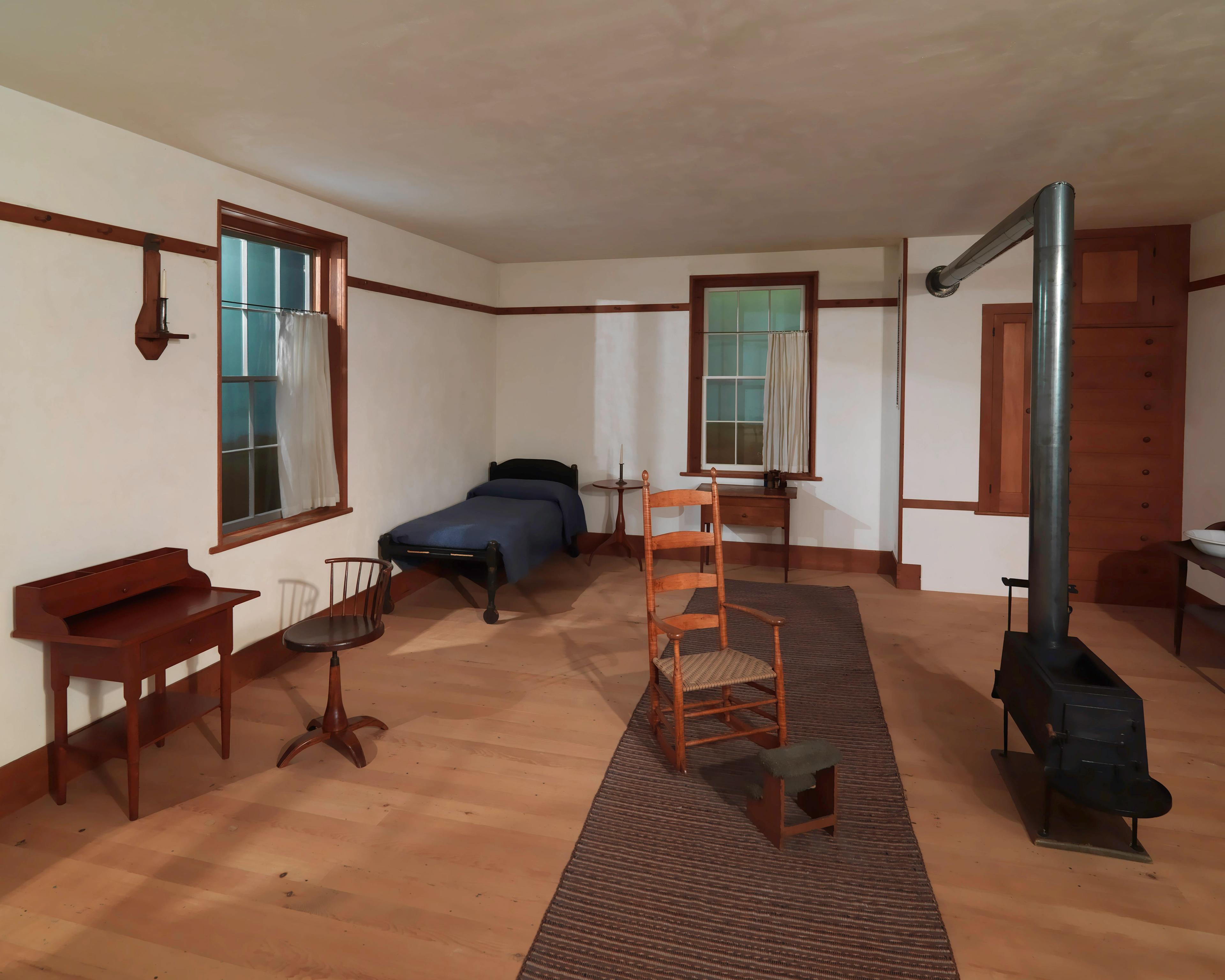
Architectural elements from a Retiring Room in the North Family Dwelling American, New Lebanon, New York, ca. 1830–40. United Society of Believers in Christ’s Second Appearing (“Shakers”) (American, active ca. 1750–present). Wood, dimensions unavailable. The Metropolitan Museum of Art, New York, Purchase, Emily Crane Chadbourne Bequest, 1972 (1972.187.1)
My name is Tom Sachs. I'm an American sculptor.
The more I build things, the more I develop different techniques and idiosyncrasies that I try to repeat that are, in a way, a reflection of me. I'm always feeling like I'm successful when it's a clear expression of my beliefs.
The Shakers' work is a clear expression of their ideology: the austerity and the dedication to work, and to work is to pray. That's something that I live for. I don't take vacation. I consider them to be a waste of resources. The only true resource that we have as human beings is time.
And look at every object in this space and imagine every object in your bedroom, and you see all the crap that you deal with. Everything in the room is only there for a purpose, there's no decoration. You hang your coat on a hook on the wall. You hang your chair on a hook on the wall. The bed: the wheels turn sideways, so that you can move it to clean it. These were people who, through the narrow focus of their beliefs, invented incredible things, like little tilters on the backs of the chairs, which always seemed ironic to me because the idea of even leaning back in a chair seems so decadent or indulgent.
The materials of the Shakers is as brilliant an innovation as the designs. Most of the furniture was made out of pine because it was abundant, it was cheap, it was very easy to cut. There's also a humility to pine. If you look at this furniture, much of it is unpainted. We have a saying in the studio: "never paint a ladder." That's a rule, because you can't see the cracks develop. It's also kind of you never cover up your past: embrace your road. And I think it's important in our time where we have things like iPhones, where there's no representation of how it's made, there's no evidence that a human being was there. Here you can see the joinery. You can see that someone wove cotton webbing for the seat and someone filed down the chair—very carefully—but you can see that it's handmade.
To me it's important to say, "hey, someone was here making this thing," when you look at the object—to embrace the individual. It's a very American idea, and it's interesting to say that in a sort of a communist society like the Shakers. I think that's the one real advantage that art has over industry, is it's an expression of the individual.