Handheld fans are nearly universal objects, though their designs and significations have varied across cultures. Beyond their basic functions of cooling the body, fanning flames, or swatting away insects, fans communicate through their style, material qualities, and the gestures of their users. Fans are made using organic materials—plant matter, birds’ feathers, mother-of-pearl, ivory, and wood—and manufactured ones, such as lacquer, textiles, and paper. A selection of fans and fan-related objects from The Met collection demonstrates the sophistication and skill of artists and artisans in manipulating these materials to craft fans imbued with meaning shaped by their cultural contexts.
These highlights reveal the diversity and commonalities of fan-making traditions around the globe. Flat, fixed fans appear here in the Japanese uchiwa tradition, Ijo society’s large cowhide fans of Nigeria, and a deel from the Marshall Islands. Brisé fans—folding fans consisting of only sticks held together by a cord or ribbon—are represented here by a circular cockade fan made in China for the European market and a Persian lacquer fan likely based on Cantonese export examples. All these examples beautifully express the rich transnational nature of many fan designs.
The fans assembled here convey the status of their owners and relationship dynamics when offered as gifts. Their social uses and significance range from subversively advertising a prohibition-era speakeasy to championing the women’s movement and the value of feminine craft. These works expand our appreciation for the cultural values fans carry across time and geography.
Fans in Ancient Egypt
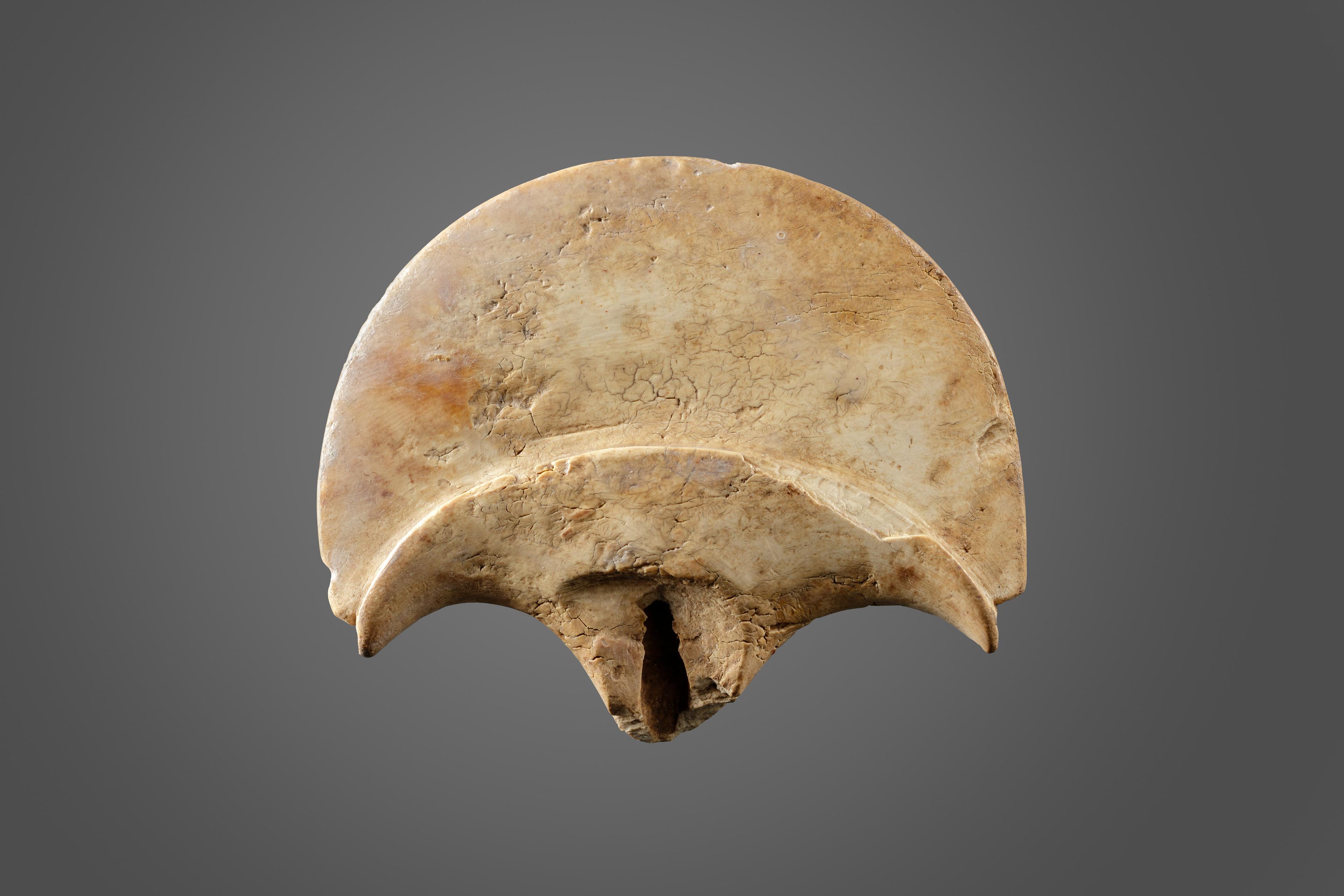
The upper portion from a palmiform-shaped fan, ca. 1900–1640 BCE. From Egypt, Memphite Region. Ivory, W. 5.4 (2 1/8 in.); H. 6.9 cm (2 11/16 in.). The Metropolitan Museum of Art, New York, Rogers Fund and Edward S. Harkness Gift, 1922 (22.1.149)
Fans and their larger counterpart, sunshades, are well documented by 3100 BCE, as illustrated in scenes decorating commemorative royal objects from the reigns of Scorpion and Narmer. On these objects, courtiers stand behind the king holding large semi-circular or palmiform fans. Other shapes were used in the Old and Middle Kingdoms, about 2649–1640 BCE, especially the lotiform—shaped like a lily pad—and a triangle-like form. A fan could even take the outline of a bird’s wing or a single feather.
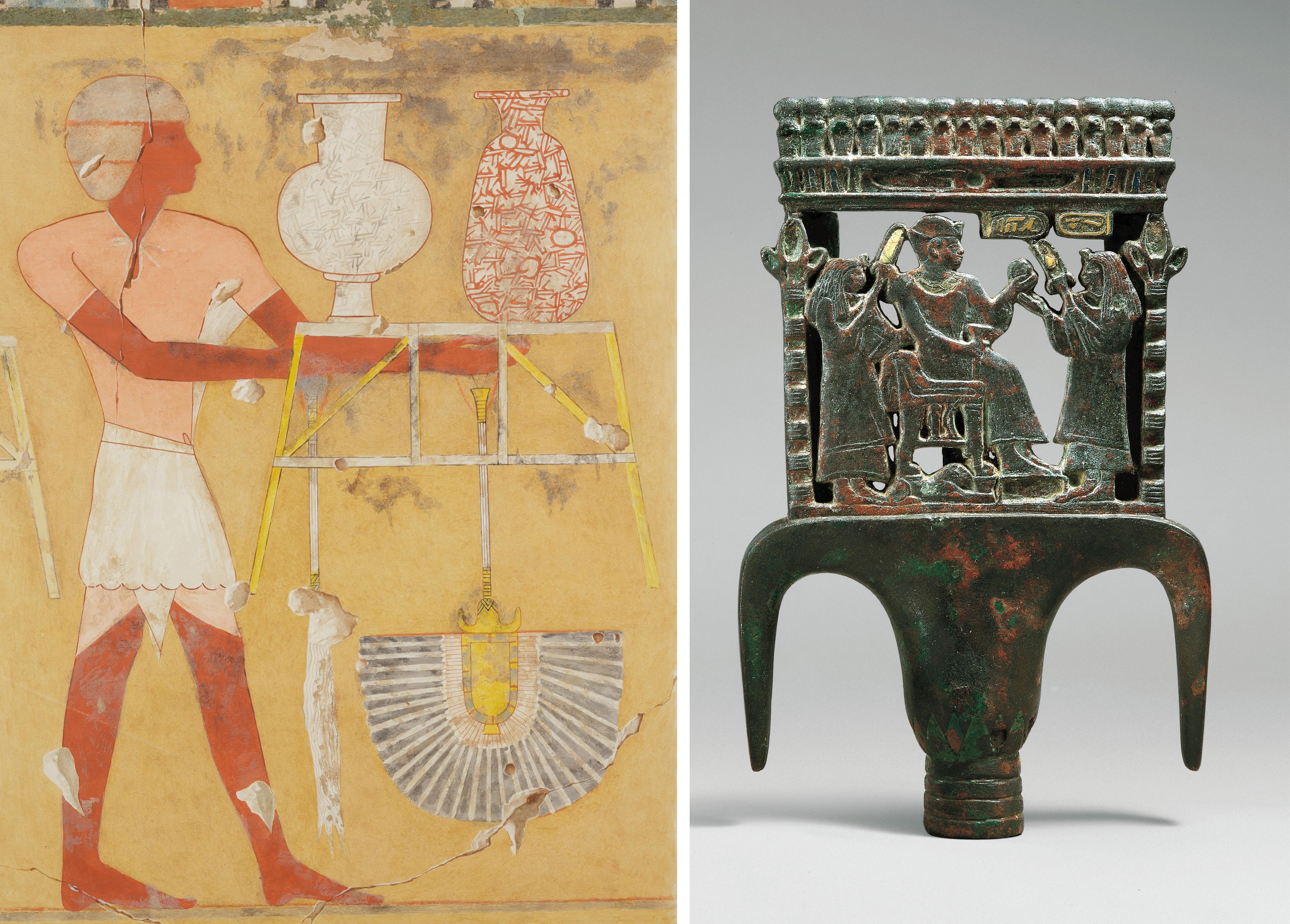
Left: Hugh R. Hopgood. Man Bringing New Year's Gifts, CE. 1914–1916; original ca. 1427–1400 BCE. Original from Egypt, Upper Egypt, Thebes, Sheikh Abd el-Qurna, Tomb of Qenamun (TT 93), MMA Graphic Section, 1914–16. Tempera on paper, facsimile: H. 53 cm ( 20 7/8 in); W. 39 cm ( 15 3/8 in), scale 2:9; framed: H. 56.5 cm (22 1/4 in); W. 42.5 cm (16 3/4 in). The Metropolitan Museum of Art, New York, Rogers Fund, 1930 (30.4.66). Right: Palm of a Ceremonial Fan, 1st–2nd century CE. From Egypt. Bronze inlaid with glass and gold, H. 12 cm (4 3/4 in.). The Metropolitan Museum of Art, New York, Purchase, Edward S. Harkness Gift, 1926 (26.7.841)
In addition to ceremonial use, fans were commonly owned equipment and were found depicted among funerary goods in tomb scenes. By the New Kingdom, there were many different ancient Egyptian words used to identify types of fans. Around 1327 BCE, King Tutankhamun was buried with eight fans in different styles and sizes. One special fan of ivory was capped with intact brown-and-white ostrich feathers and had a joint in its handle. The others, of varying lengths and styles, had either a palmiform or a vertical oval shape. Such fans had finials that frequently symbolized papyrus umbels, that is, the plant’s flower cluster.
During Tutankhamen’s lifetime, a courtier manipulated such fans to provide a small breeze or to protect the king from the sun. The title of fan bearer held by such individuals is well documented and became an important position for members of the court who had the king’s ear. When remains exist, the fan blades were often composed of ostrich feathers, taken from the large, fast but flightless bird hunted for sport. In addition to wood, ivory, and feathers, materials largely available to the wealthier members of Egyptian society, fans made of woven plant fibers were used by many Egyptians. In addition to cooling people, hand fans were also used to fan fires.
— Diana Craig Patch, Lila Acheson Wallace Curator in Charge of the Egyptian Art Department
Cantonese Ivory Cockade Fan
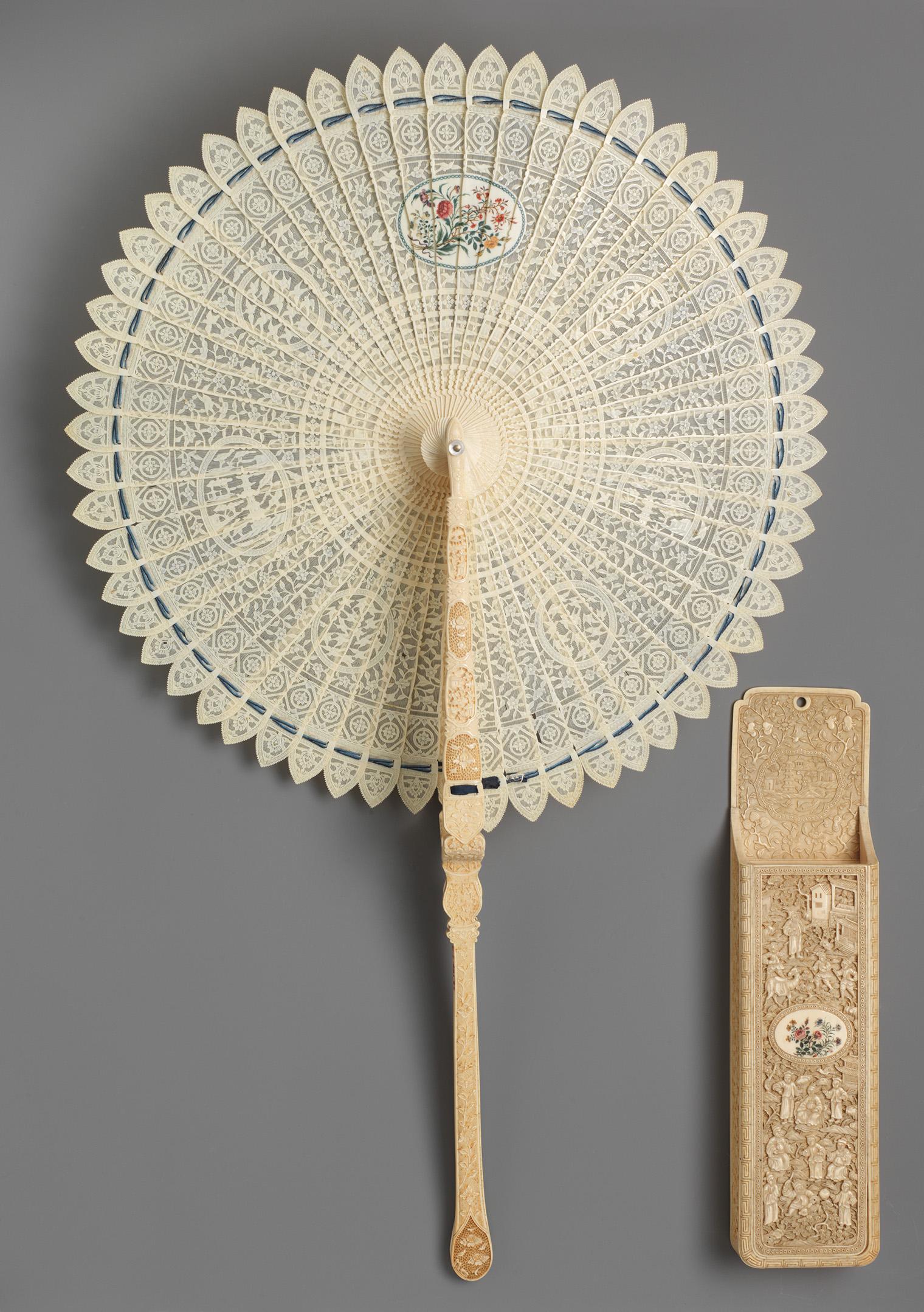
Brisé Cockade Fan, with Painted Floral Posy, ca. 1790. Chinese (Canton), for the European Market. Ivory, 22 1/4 in. (56.5 cm). The Metropolitan Museum of Art, New York, Gift of Mrs. Heyward Cutting, 1942 (42.150.4a)
Wealthy eighteenth-century Europeans were wildly enthusiastic for Chinese fans. This brisé cockade fan is a particularly beautiful example of Cantonese production, representing the epitome of high-quality execution and design—widely imitated in Europe, though with technically inferior results.
This cockade fan, which opens to a full 360-degree circle, has no pleated leaf but instead blade-like sticks made from paper-thin, carved, and pierced ivory. The sticks are ornamented with figurative scenes of flying cranes and pagoda landscapes set against scrolling foliage, on the handles springing from embellished urns. The fan’s lovely case is deeply carved with figures in a landscape that features hunting scenes.
This matching set was made for export to Europe. The wall case, for example, with its uppermost hole for suspension, was not a type used in China. As was customary for high-end export pieces, both the fan and case feature smooth cartouches, which were left blank for personalization in Europe. Sometimes these blanks were customized with heraldic motifs; here, instead, fine and colorful floral posies were added in enamel paint, likely in Britain. The fine detailing of the lace-like fretwork is unusually well-preserved, suggesting that this large fan was a presentation gift, not intended for use.
— Elizabeth Cleland, Curator, Department of European Sculpture and Decorative Arts
Hiroshige’s Chrysanthemum Fan Design
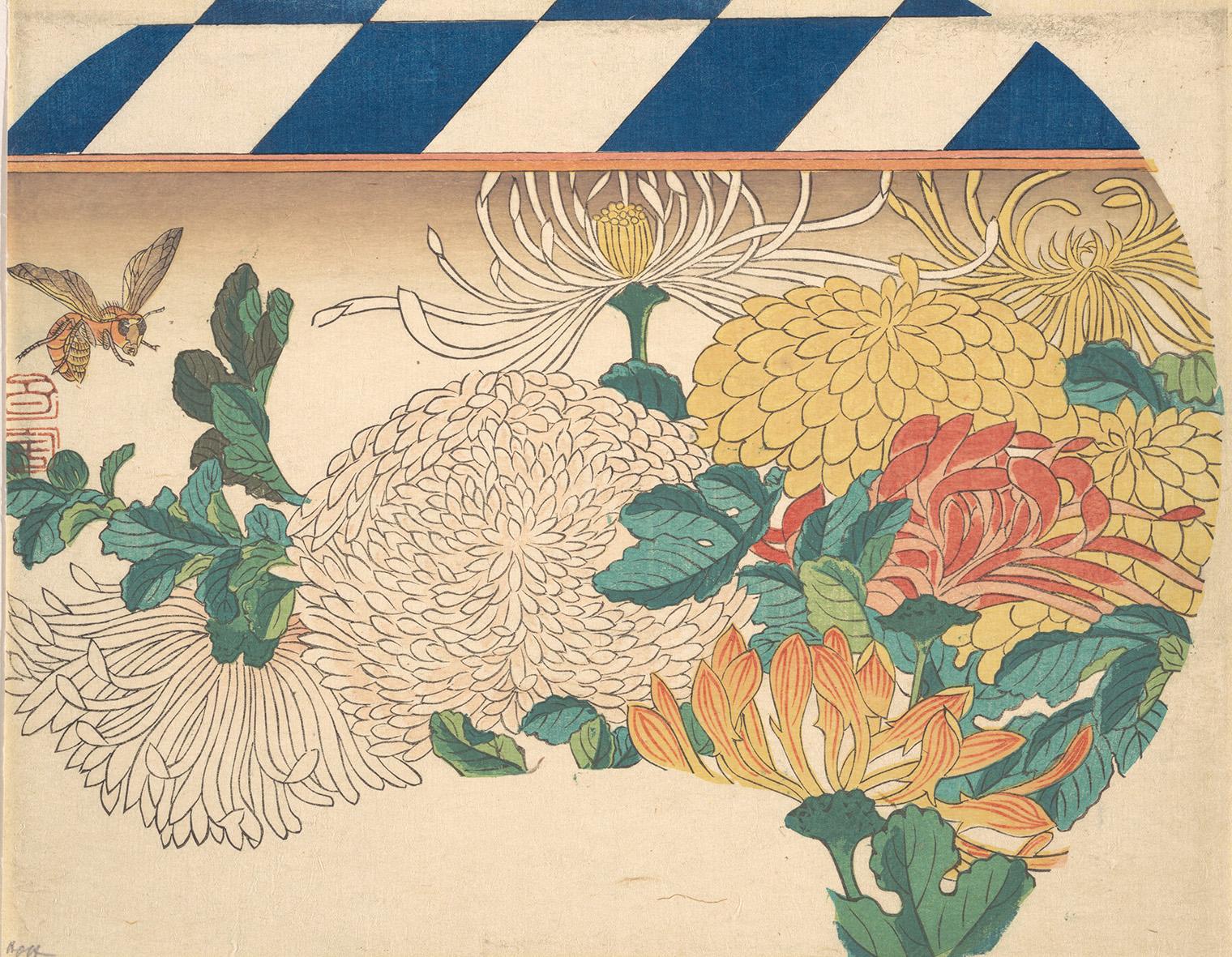
Utagawa Hiroshige (1797–1858). Chrysanthemums in Fan-shaped Design, 1840s. Woodblock print (nishiki-e), H. 8 15/16 in. (22.7 cm); W. 11 3/16 in. (28.4 cm). The Metropolitan Museum of Art, New York, H. O. Havemeyer Collection, Bequest of Mrs. H. O. Havemeyer, 1929 (JP1899)
Chrysanthemums have always been a prized theme in East Asian literature and art. Their bright colors and exuberant blossoms make them the favorite flowers of autumn, and they symbolize longevity, as they can withstand the first frosts before winter arrives. Japanese printmaker Utagawa Hiroshige (1797–1858) captures a spontaneous and unexpected, haiku-like moment when a bee approaches a cluster of flowers on view for the Chrysanthemum Festival, which occurred on the ninth day of the ninth month of the lunar calendar—now celebrated in October.
The checkered blue-and-white patterning at the top represents the actual appearance of the awnings that protected such displays. It seems impossible for such a diverse array of chrysanthemums to be juxtaposed and makes us speculate that Hiroshige was capturing the appearance of a single plant onto which various species were grafted. Other ukiyo-e print artists in the 1840s recorded a particularly remarkable example combining one hundred types of chrysanthemums on a single stem. In the 1830s and ’40s, Hiroshige and his rival, Katsushika Hokusai (1760–1849), vied to create colorful images of flowers, birds, and insects—sometimes in the shape of fans, as here, even though they would not be used that way.
— John T. Carpenter, Mary Griggs Burke Curator of Japanese Art
Poetic Qajar Lacquer Fan
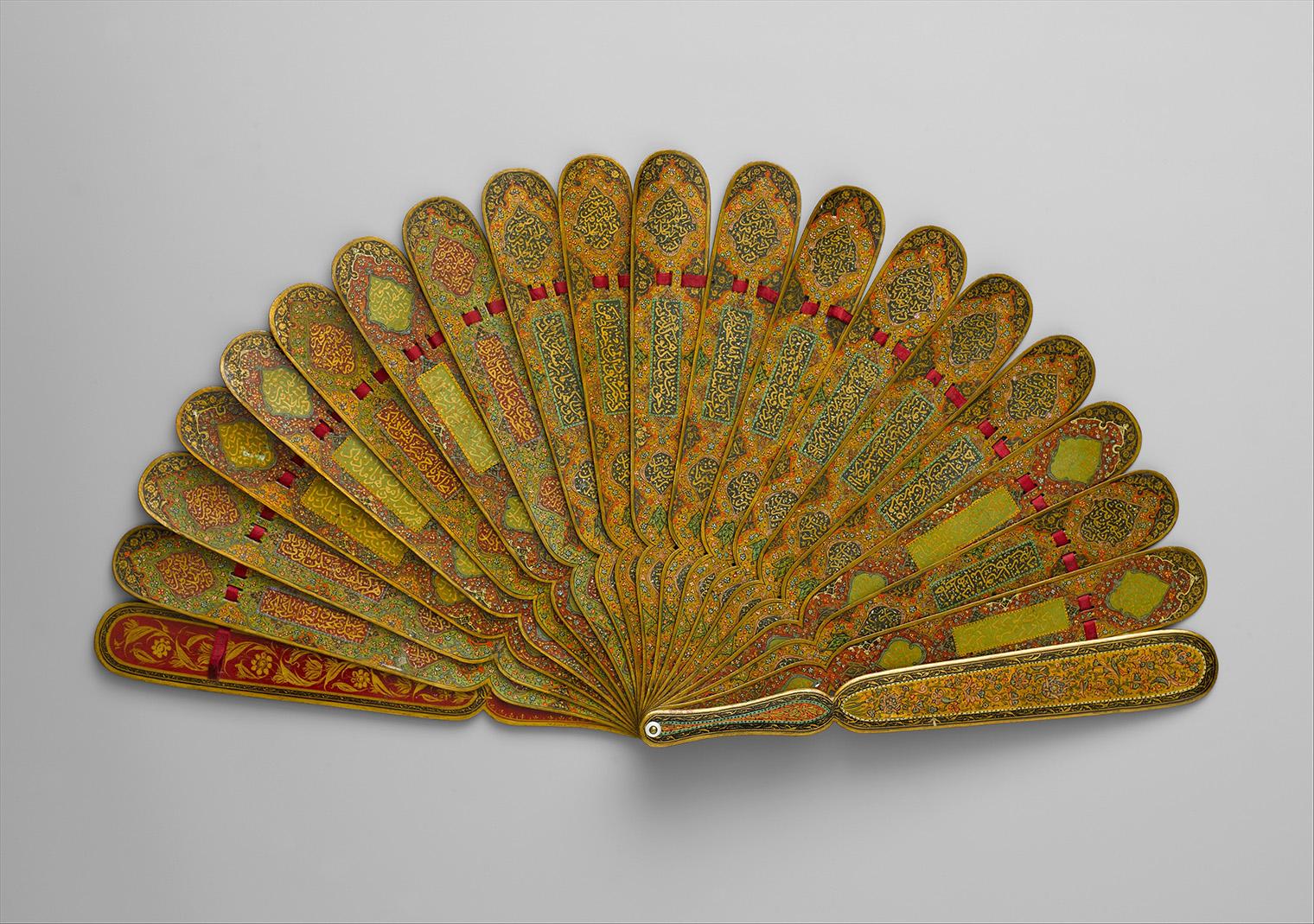
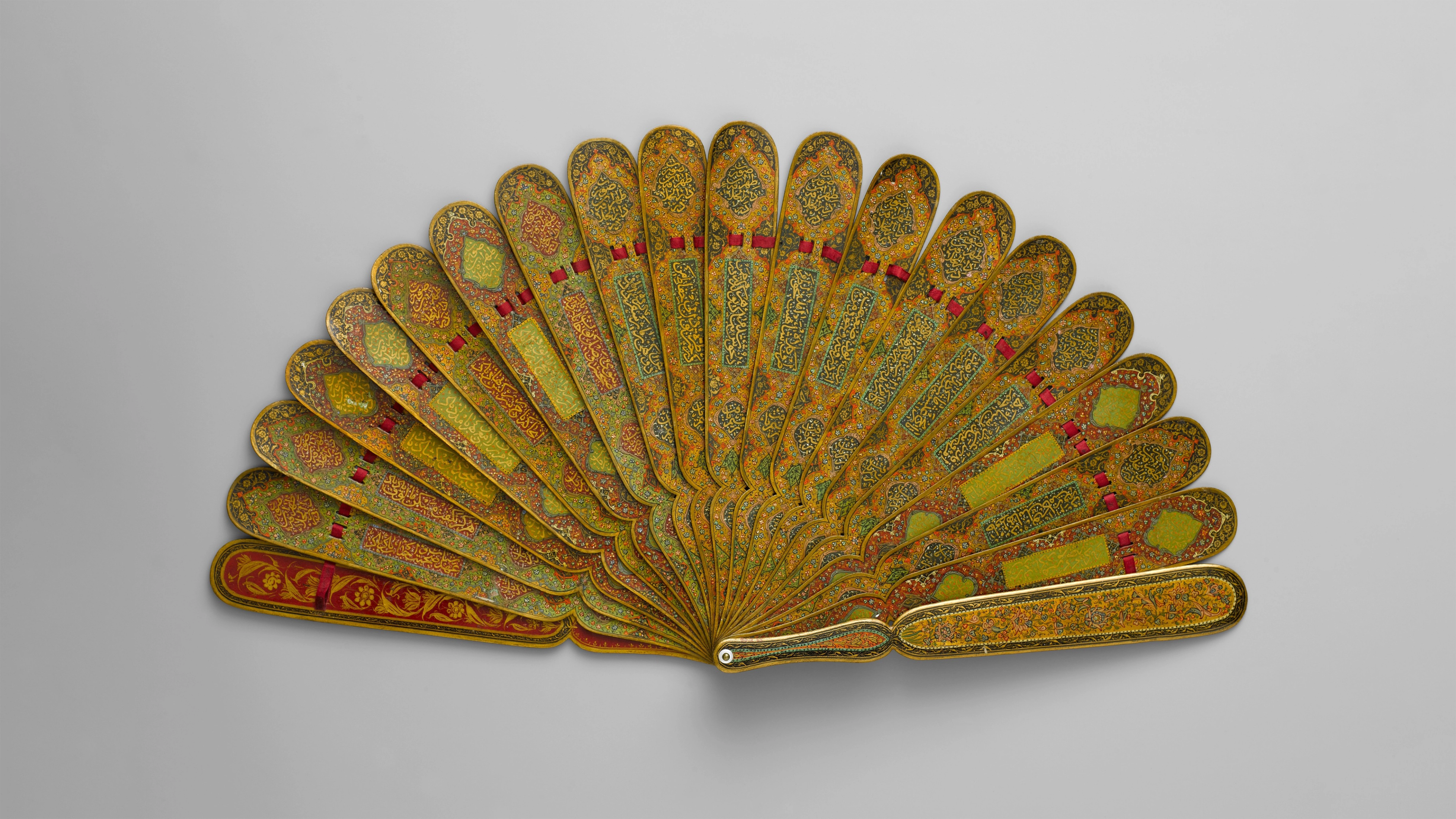
Fan with Poetic Verses, dated 1301 AH/1883–1884 CE. Made in Iran, Tehran. Wood; painted, gilded, and lacquered, H. 9 1/4 in. (23.5 cm) W. when open 18 1/2 in. (47 cm). The Metropolitan Museum of Art, New York, The Moses Lazarus Collection, Gift of Josephine and Sarah Lazarus, in memory of their father, 1888–95 1942 (90.2.65)
In nineteenth-century Iran, lacquerware production expanded to include a great variety of objects, including fans, although surviving examples of this type are very rare. An inscription repeated on the top of each of this fan’s twenty wooden blades states that it was made in Tehran in 1301 AH (1883–84 CE). The blades are decorated with floral and vegetal scrolls and poetic inscriptions in Persian naskh script and are held together with a metal-and-mother-of-pearl rivet and tied with a red ribbon.
Eighteen of the twenty blades bear verses from a ghazal (lyric poem) by the celebrated fourteenth-century Persian poet Hafez of Shiraz. The verses are not in the correct order, suggesting the blades were restrung incorrectly at a later date. Two verses of the ghazal conveying the mystical tone of the poetry read:
My heart bled, remembering you
Whenever the wind untied the cloak of the blooming rosebud in the meadow
My frail body had almost died
Before the wind rejuvenated it with the scent of reunion with you.
Although the fan follows a European design, its construction is based on Cantonese export examples that were produced in large numbers for the European market during this period. Lacquer objects were luxury goods, highly valued by both members of the Qajar elite in Iran and European collectors. Sumptuous objects like this fan were ideal gifts for special occasions like Nowruz, the Persian New Year, which marks the arrival of spring and the vernal equinox, or perhaps as a token of affection from a lover to a beloved.
— Maryam Ekhtiar, Patti Cadby Birch Curator, Department of Islamic Art
An Ijo Warrior’s Fan
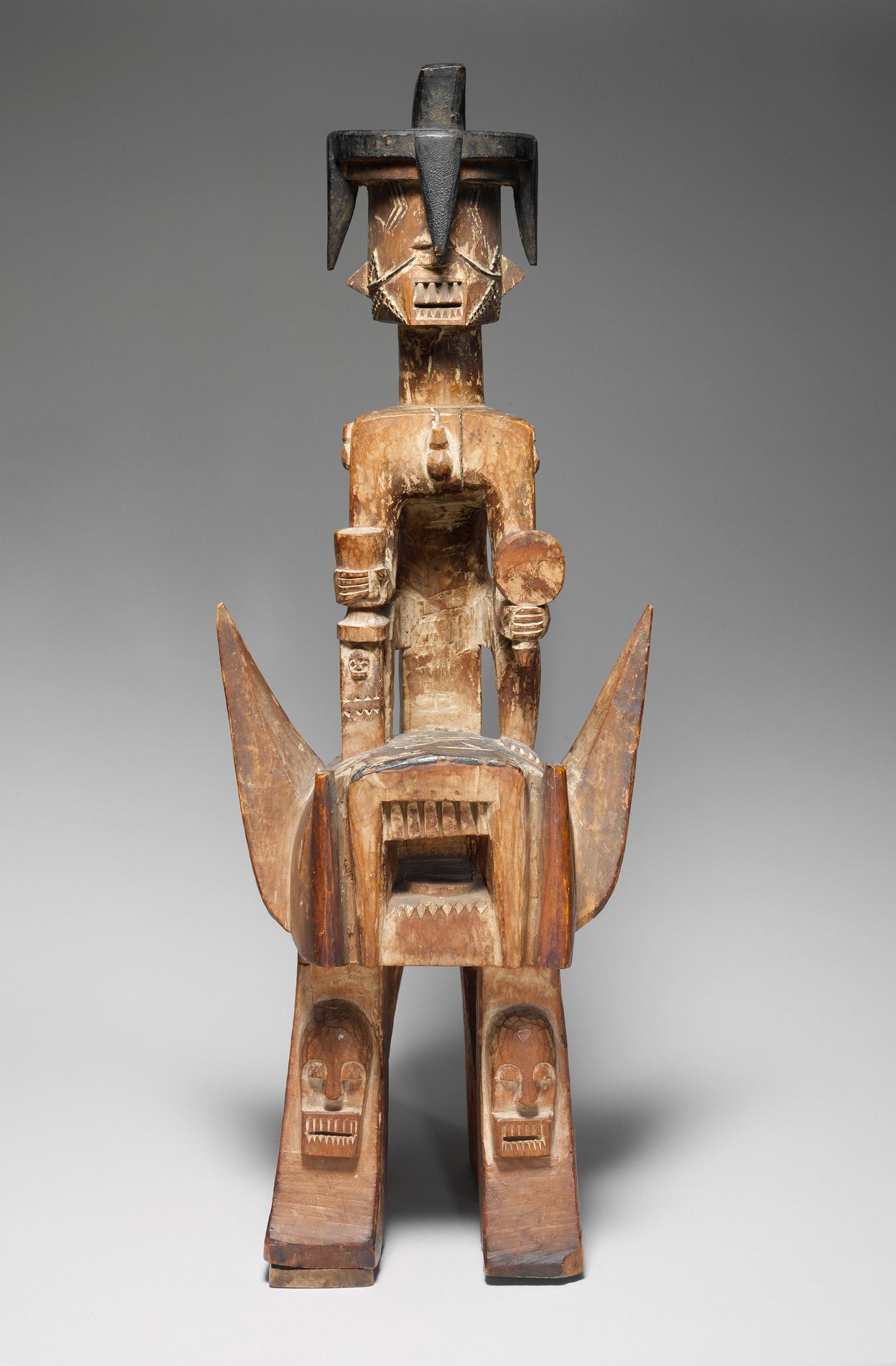
Ijo artist. Iphri shrine, 19th century. Wood, pigment, H. 25 7/16 x W. 9 3/4 x D. 10 1/8 in. (64.6 x 24.8 x 25.7 cm). The Metropolitan Museum of Art, New York, The Michael C. Rockefeller Memorial Collection, Purchase, Matthew T. Mellon Foundation Gift, 1960 (1978.412.404)
This warrior, mounted on a fantastical creature, grasps a fan in one hand and a beaker for offering libations of palm wine or gin in the other. In Ijo society, such large cowhide fans are a sign of wealth and of religious and political status. The work is a classic example of a sculptural genre known as ivri, designed to shield against violence. Once commissioned by men across much of southern Nigeria, ivri were conceived as a visual expression of their owners’ character, personifying intense inner drive and determination. In this example, the commanding male figure’s gesturing with the fan, astride a fearsome quadruped with bared teeth and fangs, asserts his mastery over and his ability to subdue unimaginable forces of aggression.
— Alisa LaGamma, Ceil and Michael E. Pulitzer Curator for African Art, Curator in Charge of The Michael C. Rockefeller Wing
Marshallese Woven Fan
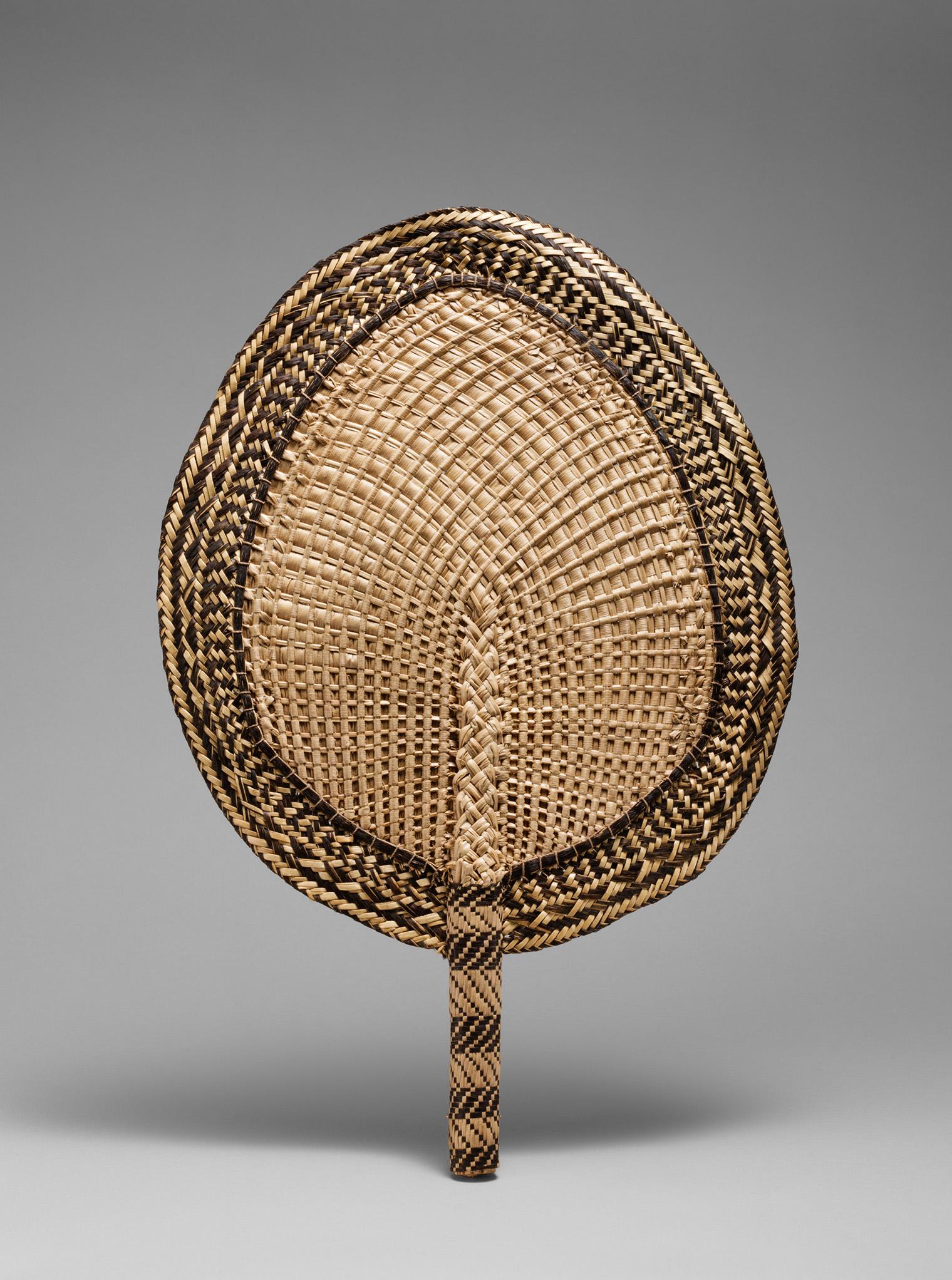
Marshall Islands artist. Deel (fan), late 19th–early 20th century. Pandanus leaves, hibiscus fiber, H. 16 1/2 × W. 11 × D. 7/8 in. (41.9 × 27.9 × 2.2 cm) H. 20 1/4 w/mount. The Metropolitan Museum of Art, New York, Gift of American Friends of the Israel Museum, 1983 (1983.545.5)
The women of the Marshall Islands are among the finest weavers in the Pacific. In addition to weaving fine mats (jaki-ed) and baskets, weavers express their skills through the creation of personal accessories such as fans. Fans can be simple, swiftly woven from coconut leaves, for practical functions like cooling the body and fanning embers to kindle a blaze. The more elaborate fans are woven from prepared pandanus strips. The pandanus plant (bõb) is deeply ingrained in the daily life of the Marshall Islands and central to spiritual life. Pandanus leaves were used in customary divination rituals, in which knots were tied to the leaves to seek answers from the spirit world.
Elders recount stories of survival in which families overcame hardship during times of famine by preparing and eating the pandanus fruit. According to one tradition, if the umbilical cord of a newborn girl is placed among pandanus leaves or other weaving materials, then she will grow up to be a talented weaver. Pandanus fans, such as this one, are often embellished with decorative designs using black hibiscus fiber. The bold contrast of the black, offset against the natural color of the fan, creates dynamic designs unique to each fan. Here, a central rib pattern radiates in serial arcs from the fan’s vertical “stem”—itself emulating the central stalk, or midrib, of a large palm leaf—and tapers at the tip. An elaborate patterned border surrounds the entire fan, and the handle is decorated with alternating registers of zigzag designs. The highest status fans might also incorporate an oval section of turtle shell, which was a family heirloom.
— Maia Nuku, Evelyn A. J. Hall and John A. Friede Curator for Oceanic Art
An Art Deco “Peeping” Fan
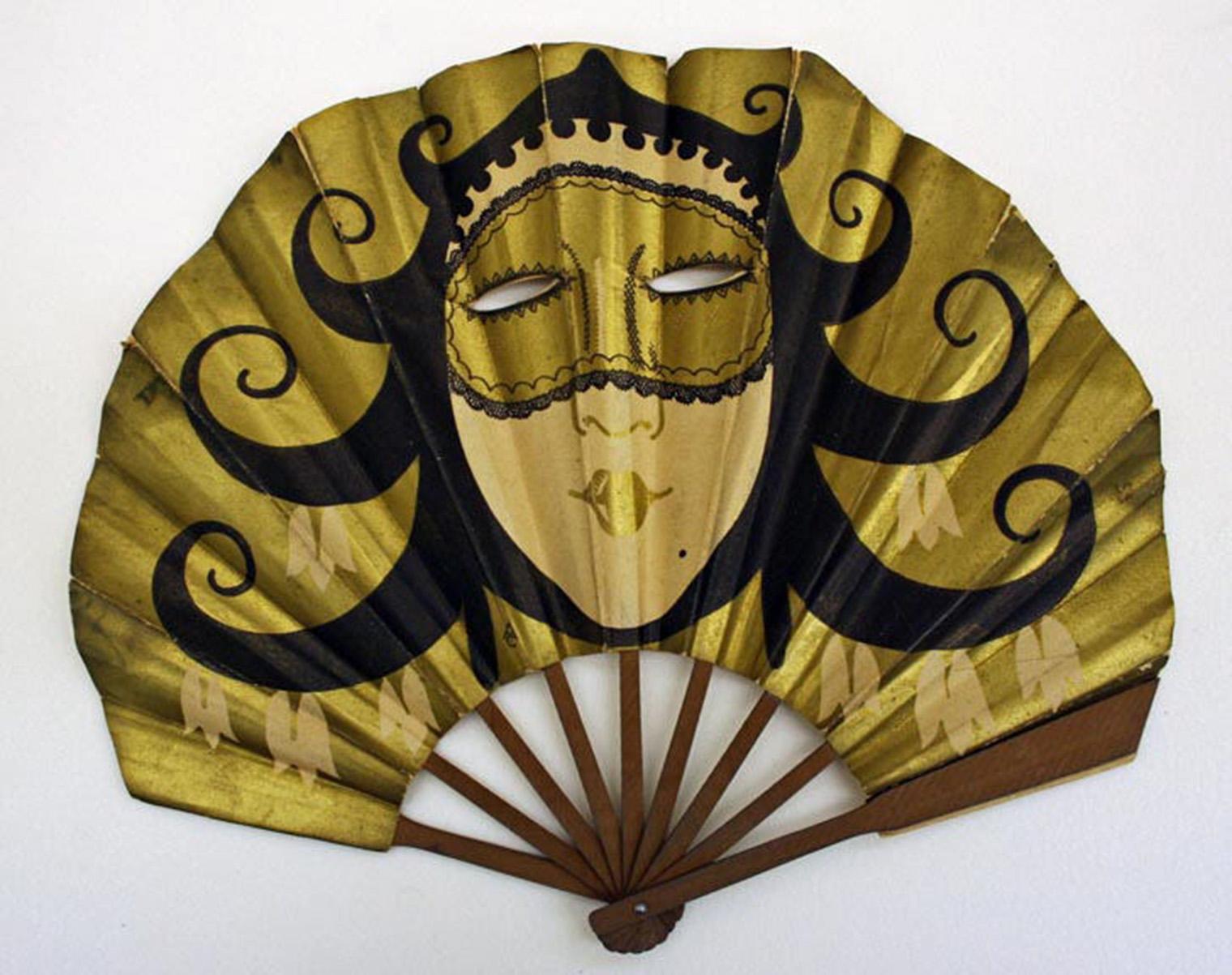
Fan, 1920s. French. Wood, paper. The Metropolitan Museum of Art, New York, Gift of Ms. Adele Gutman Nathan, 1977 (1977.119.3)
While many structural elements of handheld fans contain allusions to anatomy—varying nomenclature identifies the head, throat, shoulder, and ribs of a fan—the stylized feminine visage of this example makes the sartorial and corporeal connection explicit, amplifying the instrument’s gestural potential to reveal or conceal. Categorized as a “peeping” (or “mask”) fan with precedents in the eighteenth century, its perforated eyeholes would have allowed the holder to observe from behind its gilded surface, adopting both the anonymity and glamour rendered upon its mount.
Advertising fans promoted many items by the early twentieth century, including alcohol, fragrance, maisons de couture, and, as cited here, sites of entertainment and fashionability like hotels, restaurants, and nightclubs. This fan’s verso bears information for the Central Park Casino, a former restaurant that began as a ladies’ refreshment club and morphed into a prohibition-era speakeasy before its demolition in the 1930s. During this period, the Casino became known for hosting high-profile events ranging from charitable fundraisers and café-chantants to fashion shows and fêtes. By liberating the mask from the face and transforming this promotional souvenir into a handheld item, the club could have avoided the city permits required for masked balls.
— Mellissa Huber, Associate Curator, The Costume Institute
Bamboo as Material and Motif
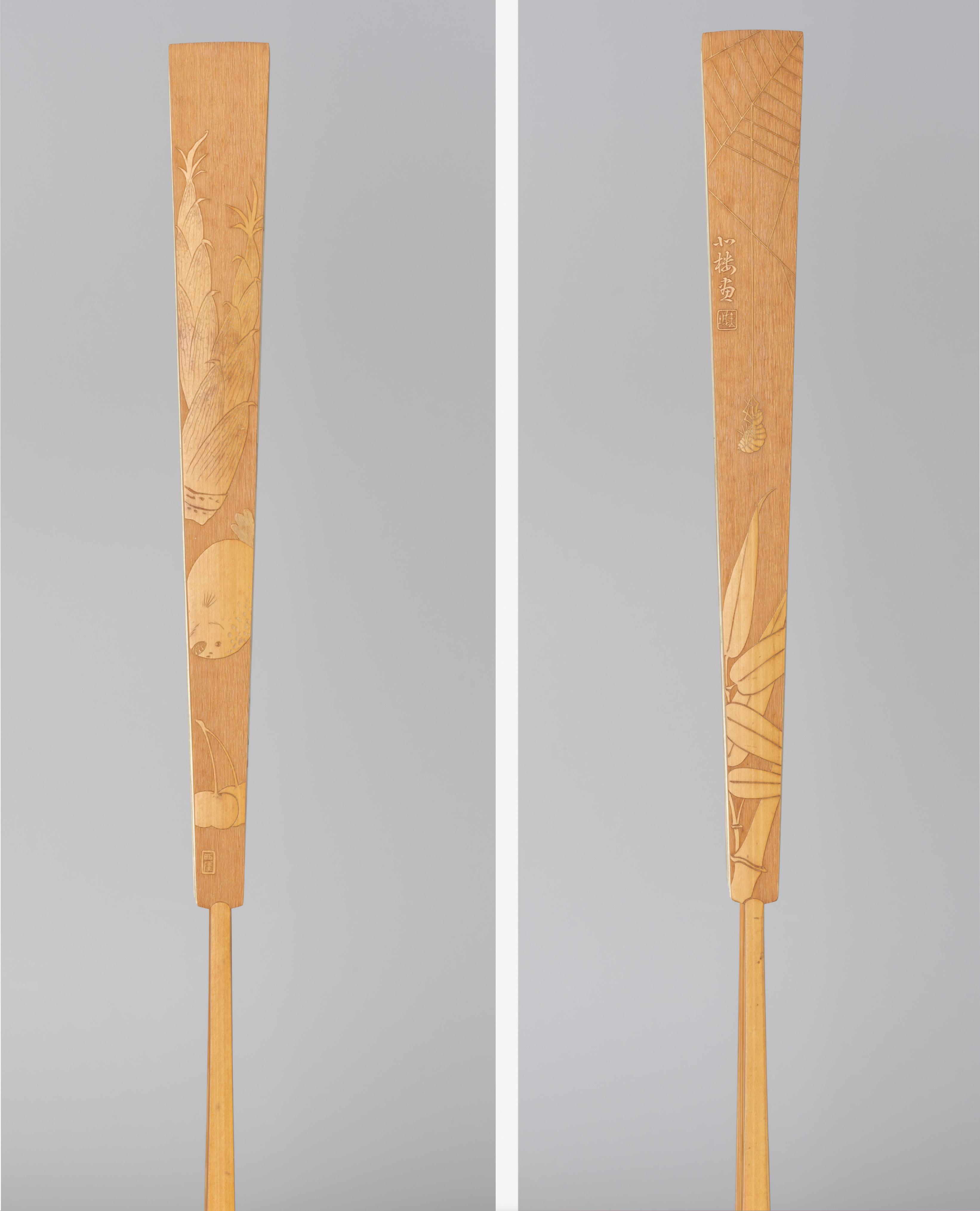
Jin Xiya (1890–1979). Bamboo frame carving for Carved fan, blossoming roses and excerpt from the Commentary on the Water Classic, 1933. Carved bamboo frame, 10 5/8 × 14 in. (27 × 35.6 cm). The Metropolitan Museum of Art, New York, Florence and Herbert Irving Acquisitions Fund for Asian Art, 2020 (2020.340) © Jin Xiya
Bamboo shoots and cherries are foods that signal the approach of summer, known in China as jianchun, or a farewell meal to spring. This subtle, unusual image is finely carved on one of the bamboo outer ribs of a folding fan by Jin Xiya (1890–1979), one of the most talented bamboo artists active in twentieth-century China. In addition to seasonal vegetables and fruits, the artist inserted a pufferfish in the center. Easily mistaken for a daikon radish at first glance, the fin, the eye, and the open mouth with sharp teeth make it unmistakable. Consuming these fish can be lethal without professional preparation, but it is a famous delicacy in China. Pufferfish mature and are served in late spring, making them a perfect match for the subject of a farewell to spring. The unconventional addition of the pufferfish was undoubtedly a playful surprise, highlighting the artist’s subtle sense of humor. Jin’s archival records indicate that this folding fan was a gift to his teenage daughter, Laiyu, who was born in 1919, which may explain why he selected such an amusing and personal design.
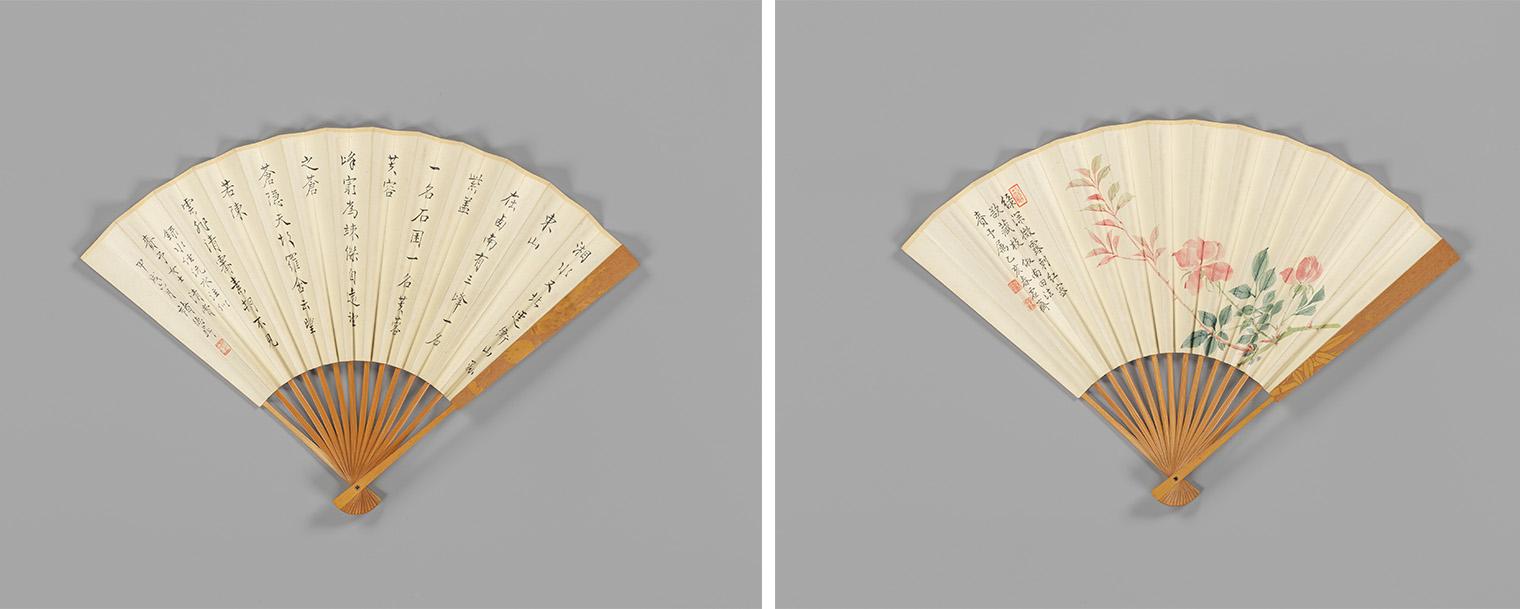
Left (verso): Chu Deyi (1871–1942). Right (recto): Pang Laichen (1864–1949). Carved fan, blossoming roses and excerpt from the Commentary on the Water Classic, 1934. Ink and color on paper with carved bamboo frame, 10 5/8 × 14 in. (27 × 35.6 cm). The Metropolitan Museum of Art, New York, Florence and Herbert Irving Acquisitions Fund for Asian Art, 2020 (2020.340) © Jin Xiya
The painting and calligraphy on this fan further reveal Jin’s central place in the cultural and artistic circles of his time. One side of the fan bears calligraphy dated 1934 by Chu Deyi (1871–1942), a prominent calligrapher, seal carver, and antiquarian. Chu was also a great supporter and researcher of bamboo carving. The other side of the fan features a painting of blossoming roses, dated 1935, by Pang Yuanji (1864–1949), a distinguished collector of Chinese paintings. Pang’s collection, now dispersed in various major museums worldwide, was the largest and finest in private hands of that time. Both the calligraphy and the painting were also dedicated to the artist’s daughter. Such a prestigious gift for a teenager is a clear indication of Jin’s singular importance in this rarefied social network. This small folding fan preserves a microcosm of the early twentieth-century world of Chinese literati figures and reveals the artist’s deep adoration for his daughter.
— Pengliang Lu, Brooke Russell Astor Curator of Chinese Art
A Feminist Fan
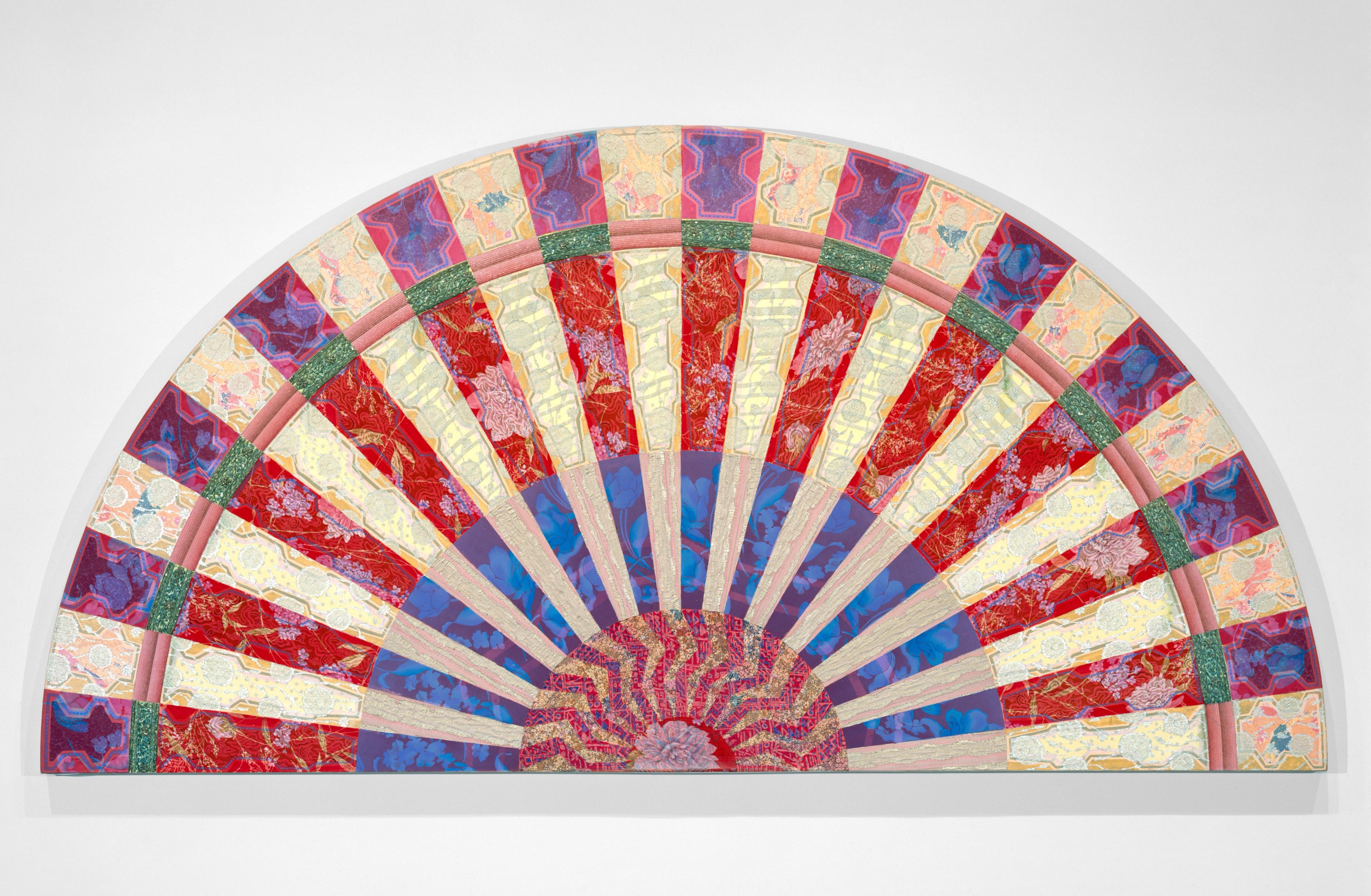
Miriam Schapiro (1923–2015). Barcelona Fan, 1979. Fabric and acrylic on canvas, 72 in. × 12 ft. × 2 5/8 in. (182.9 × 365.8 × 6.7 cm). The Metropolitan Museum of Art, New York, Gift of Steven M. Jacobson and Howard Kalka, 1993 (1993.408) © The Estate of Miriam Schapiro
Miriam Schapiro is indelibly associated with the Pattern and Decoration movement, which emerged in the early 1970s and peaked in the mid-’80s. Artists such as Schapiro embraced forms, materials, and techniques explicitly associated with feminine labor, the domestic sphere, craft-based production, and the decorative arts. They expanded the boundaries of modernist abstraction and tested the rigid hierarchy dividing “high” and “low” as well as the fine and applied arts. Schapiro, who co-founded the Feminist Art Program at the California Institute for the Arts in 1971, sought to create "art out of women’s lives" and to validate "the traditional activities of women," a gesture equal parts aesthetic and political.
Barcelona Fan (1979) represents a period when Schapiro started experimenting with fabric, lace, and handkerchiefs, combining them with hand-painted patterns to create what she called "femmage," a variation on collaging. Although taking the shape of a traditional handheld, folding fan, Schapiro’s adaptation is monumentalized—the canvas measures twelve feet across—with a bold, patchwork structure of layered colors and syncopated rhythms, reclaiming this object for feminism, and deliberately endowing it with strength and authority. According to Schapiro, the fan as a motif serves as "an appropriate symbol for all my feelings and experiences about the women’s movement. That’s a very ambitious notion: to choose something considered trivial in the culture and make it into a heroic form."
— Abraham Thomas, Daniel Brodsky Curator of Modern Architecture, Design, and Decorative Arts


