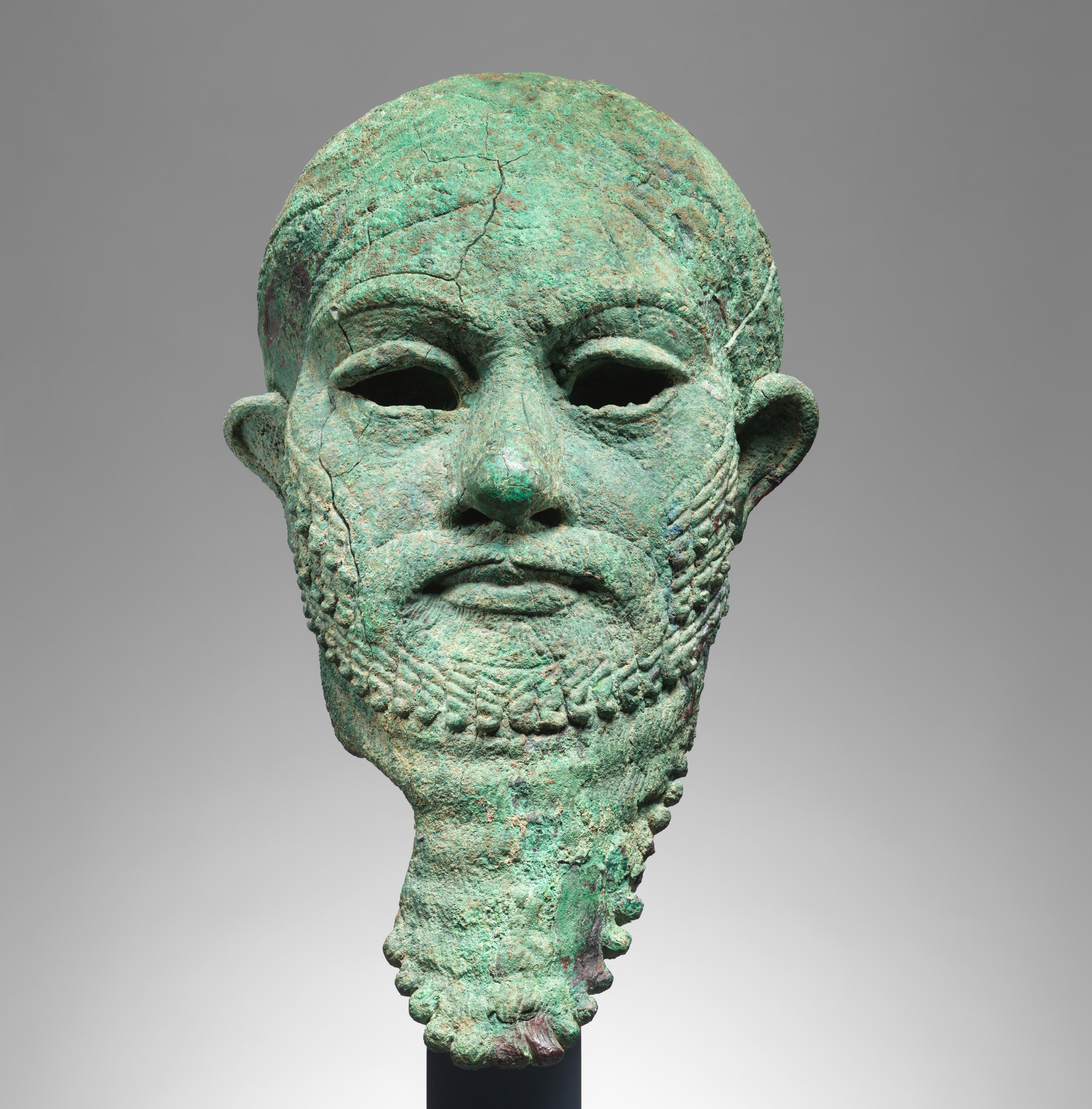
Head of a ruler, ca. 2300–2000 BCE. Early Bronze Age. Mesopotamia. Copper alloy, 13 5/8 × 8 3/8 × 9 1/4 in. (34.4 × 21.3 × 23.3 cm). The Metropolitan Museum of Art, New York, Rogers Fund, 1947 (47.100.80)
My name is Dorothea Rockburne. I think of myself primarily as a painter.
I have always had an interest in ancient civilization, so it was natural for me to come to The Met when I came to New York. I saw this head and I felt some magnetic energy between it and me. We all come with our prejudices to art, and mine is not for the large and rambunctious. And I think the thing that struck me is there is a kindness to this face. It shows the majesty of a true ruler.
I find the eyes—even blank—have a gentle containment, but nothing weak. If hollow eyes can be piercing, these are piercing. There’s a projection. They look at you. There’s something about the upper line of the mustache, the way it falls. There is something about these lips, the line that is caused by the way they join: it’s giving. Nobody likes to have protruding ears and this sculptor made these as the ears of the personality that he was portraying. And that’s unusual; usually things are cleaned up a whole lot. Most ancient art are styles. And this is a portrait of somebody. But art does not exist in singular units. It is a part of its culture. I have to think, “now where the hell did you come from?”
This head aroused this curiosity that I have about everything. I mean, if I hadn’t been an artist, I would have been a scientist. I’m asking myself the same question: where do I come from? I was never interested in the latest thing in art. I’m interested in the historicity of art.
I realized a long time ago that art is not like science, it’s not like mathematics. It doesn’t improve. The work that was done in 2000 B.C. is as relevant as art today. And that’s a fascinating thing to me; that’s a conundrum. There is no new invention. You can make abstract art, you can use modern materials; it doesn’t compete with ancient art. Not that ancient art is better, but this work is valid, and that makes me itch in my soul. It makes me want to work.