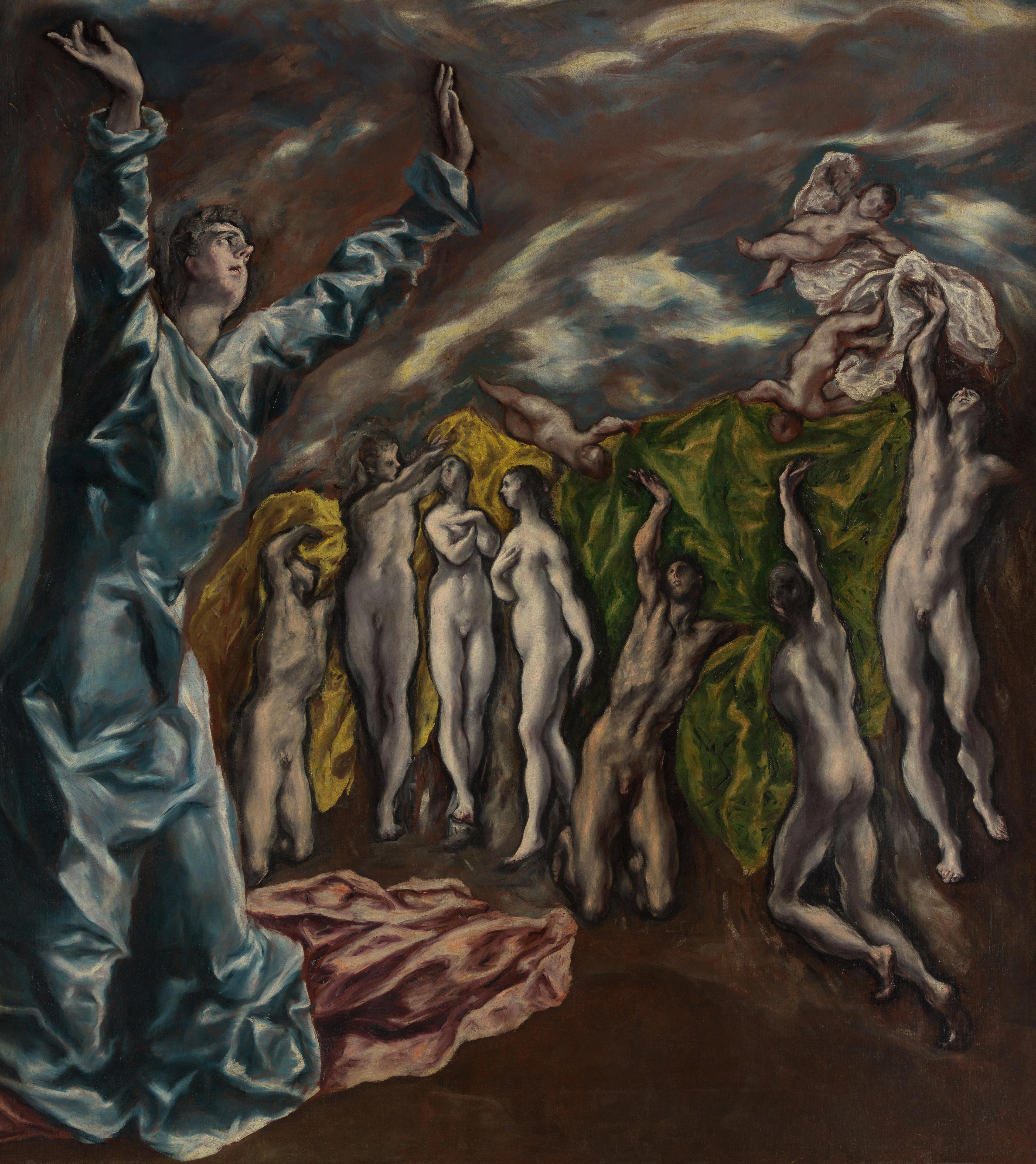
El Greco (Domenikos Theotokopoulos) (Greek, Iráklion (Candia) 1541–1614 Toledo). The Vision of Saint John, ca. 1608–14. Oil on canvas, 87 1/2 x 76 in. (222.3 x 193 cm); with added strips 88 1/2 x 78 1/2 in. (224.8 x 199.4 cm) [top truncated]. The Metropolitan Museum of Art, New York, Rogers Fund, 1956 (56.48)
My name is Zhang Xiaogang and I'm a painter.
Many artists have inspired my work: some with their techniques, some with their ideas, and some with their artistic language. I feel like at every stage of an artist's development he or she finds an artist of particular interest to them. El Greco—from the beginning he's the one artist I haven't been able to let go. There's a kind of spiritual power to his work.
Living as he did in a strict theocratic society he portrayed people's pain, their yearning, their fear—all sorts of deeply complicated emotions. His works seem to convey a kind of despair about the world that he lived in, an almost neurotic longing for God.
The Vision of St. John: this is a really difficult angle to paint because the perspective is so exaggerated. He always places his vantage point at the bottom of the composition, as if looking up at the sky. These figures all hover above as if they're in the process of rising, so he's always looking up from below. His vantage point, for that reason, is different from most other artists'. It seems to me that this is an embodiment of the artist's own wishes: the hope to leave this world for something higher up.
And his palette, they're not like colors we see in real life. There's a very strong subjectivity. In his use of light he seems to prefer a kind of backlit effect, sometimes giving the impression like he's looking at the world under water, the light being a kind of transparent reflection. This makes his sense of light very special; it makes you feel as if it's coming from multiple sources. This is a sacred light.
He found a common language in portraying drapery folds, clouds, the sky, even the setting. It's like something that twists, empowered by something spiritual. I see a kind of madness in his work. The drapery folds he paints aren't really indications of physical folds or creases. Rather, he uses them to express a kind of inner psychological reaction.
He had already started to pay attention to human psychology—something that otherwise didn't appear in art until the nineteenth and twentieth centuries. And this might be another reason why I find him appealing, because when I was a student in China art was all about Socialist Realism. Nobody studied or suggested how to express psychological idiosyncrasies. When I saw his works I felt that he expressed something terribly important—namely that art should express what is inside someone. It should express a person's unique perspective. This was really difficult at that time in China, this goal of expressing a person's interiority.
His perceptions and his unique way of expressing them through art went beyond his own time. I feel something different every time I look at them and they continue to move me.