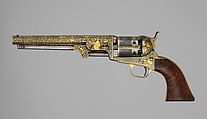
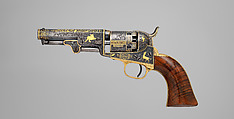
Третья модель револьвера Кольта «Dragoon Percussion», серийный номер 12406
Artwork Details
- Название: Третья модель револьвера Кольта «Dragoon Percussion», серийный номер 12406
- Художник: Сэмюэл Кольт, США, 1814–1862 гг.
- Дата: около 1853 г.
- Материал: Сталь, золото, дерево (ореховое)
- Размер: Длина 35,6 см; калибр 11 мм
- Благодарность: Передано в дар Джорджем и Баттон Репэр, 1995
- Номер объекта: 1995.336
- Curatorial Department: Arms and Armor
Audio
4414. Colt Third Model Dragoon Percussion Revolver, Serial Number 12406
LAROCCA: The Colt revolver is what people think of as sort of the gun that won the West.
NARRATOR: Donald LaRocca.
LAROCCA: And Samuel Colt certainly was very famous for his inventions, and he’s the first one to really patent a functional type of revolver that could be mass-produced. We take for granted the fact that things that we have machines and so on all have interchangeable parts, but that was a radical notion in the early nineteenth century. Colt revolvers were really the first weapons to have fully interchangeable parts. So, Colt was a real pioneer in that sense.
He was also a great showman and a great businessman, and one of the things he did to drum up business was to have these very elaborate, very beautifully decorated pistols made by a specialized group of craftsmen in his factory in Hartford Connecticut, and then present them to various heads of state or to other important people, politicians, and so on. This particular pistol is one of a set that Colt had made during the Crimean war. And as a good businessman he tried to drum up business from both sides in that conflict, so he presented pistols to the King of England, he presented pistols to the Czar of Russia, and pieces to the Sultan of Turkey—all the major powers that were involved in that particular conflict.
This particular gun was the one that was presented to the Sultan of Turkey, and it’s very patriotic, very American decoration on it of a bust of George Washington, the American flag, the American eagle—all beautifully inlaid in gold on a blued background. The decorator was Gustav Young who was a German craftsman who, at that period, was responsible for the most elaborate guns coming out of the Colt factory. Colt would show off not only the beauty of the mechanism and the way the gun functioned, but by making them very attractive to the eye, he then hoped to get commissions from the various heads of state that he gave them to, and it frequently worked.
More Artwork
Related Content

Research Resources
The Met provides unparalleled resources for research and welcomes an international community of students and scholars. The Met's Open Access API is where creators and researchers can connect to the The Met collection. Open Access data and public domain images are available for unrestricted commercial and noncommercial use without permission or fee.
To request images under copyright and other restrictions, please use this Image Request form.
Feedback
We continue to research and examine historical and cultural context for objects in The Met collection. If you have comments or questions about this object record, please contact us using the form below. The Museum looks forward to receiving your comments.
Content Notice
The Metropolitan Museum of Art presents over 5,000 years of art from around the world, and our online collection reflects ongoing work conducted over the course of our more than 150-year history. You may encounter objects or images that may be inappropriate for some viewers or information that may be outdated.