Bannerstone
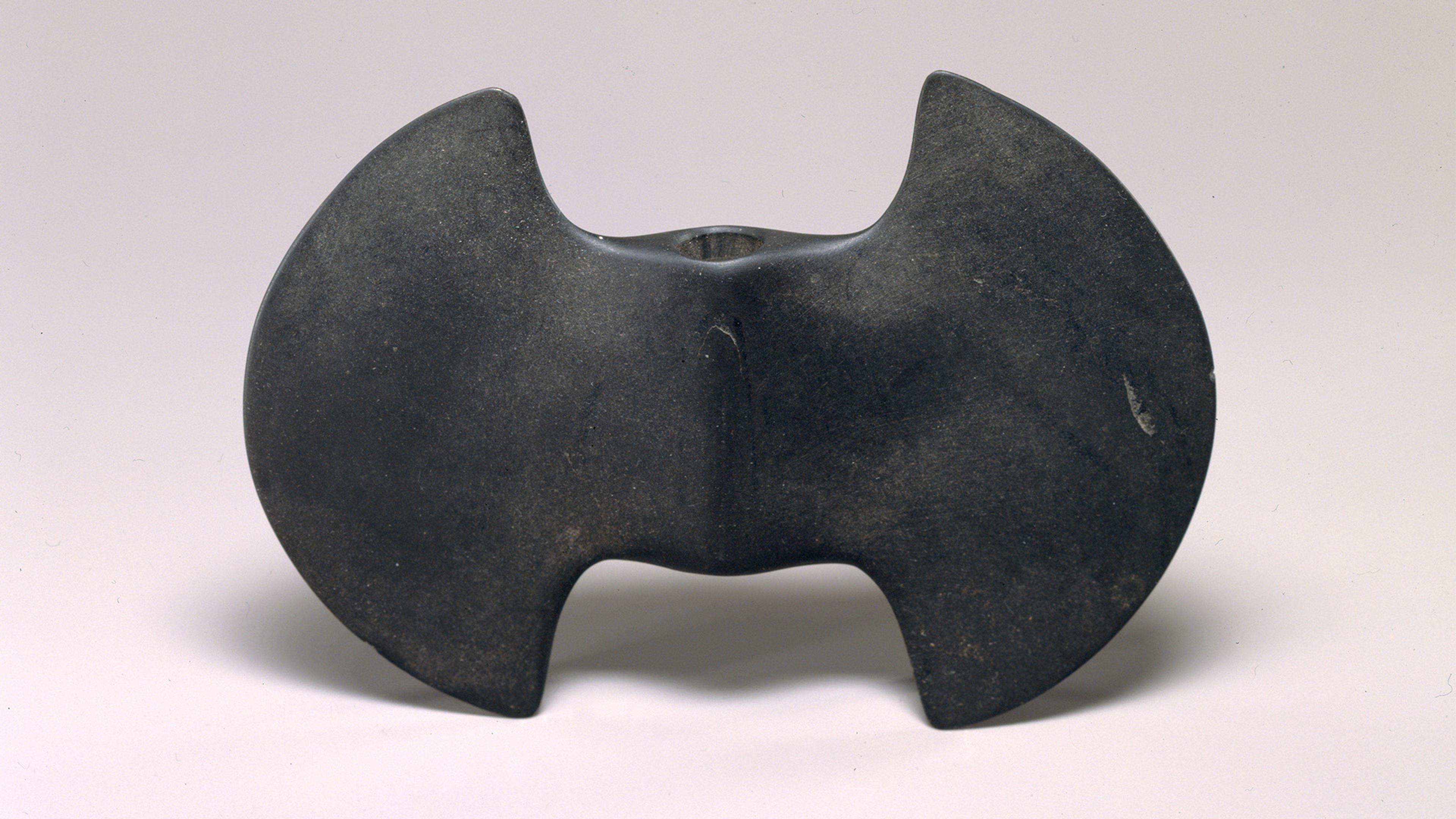
Indigenous sculptors often chose to create bannerstones out of ferruginous quartz due to its high contrast of milky white intermixed with iron minerals in shades of deep saturated oranges, reds, or pinks. This particular bannerstone is larger than most and may have been singled out for special, perhaps ceremonial performances or display. Along the edges and perforation there are little to no signs of wear, further indicating that this was a unique and particular bannerstone similar to ceremonial axes or celts made by ancient artists of North and Central America including the Olmec and Maya. On one side of the stone Fulton Co Ill. is written in black on a white label. This refers to Fulton County in Illinois, presumably where this bannerstone was found. 2011.154.15 is written in red on one end above the perforation.
Anna Blume, Professor of the History of Art, Fashion Institute of Technology, State University of New York 2023
References and Further Reading
Knoblock, Byron. Bannerstones of the North American Indian. LaGrange: LeGrange: Bryon Knoblock, 1939.
Lutz, David L. The Archaic Bannerstone: Its Chronological History and Purpose From 6000 B.C. to 1000 B.C. Newburg: David L. Lutz, 2000.
Sassaman, Kenneth. “Craftworks of Structure.” The Eastern Archaic Historicized. New York: AltaMira Press, 2010, pp. 97-142.
Bannerstone Project. Fashion Institute of Technology, https://bannerstone.fitnyc.edu/
Artwork Details
- Title: Bannerstone
- Date: 6000–1000 BCE
- Geography: United States, Illinois
- Culture: Archaic
- Medium: Ferruginous quartz
- Dimensions: H. 5 1/4 × W. 3 × D. 2 in. (13.3 × 7.6 × 5.1 cm)
- Classification: Stone-Ornaments
- Credit Line: Ralph T. Coe Collection, Gift of Ralph T. Coe Foundation for the Arts, 2011
- Object Number: 2011.154.15
- Curatorial Department: The Michael C. Rockefeller Wing
More Artwork


Related Content
Research Resources
The Met provides unparalleled resources for research and welcomes an international community of students and scholars. The Met's Open Access API is where creators and researchers can connect to the The Met collection. Open Access data and public domain images are available for unrestricted commercial and noncommercial use without permission or fee.
To request images under copyright and other restrictions, please use this Image Request form.
Feedback
We continue to research and examine historical and cultural context for objects in The Met collection. If you have comments or questions about this object record, please contact us using the form below. The Museum looks forward to receiving your comments.
Content Notice
The Metropolitan Museum of Art presents over 5,000 years of art from around the world, and our online collection reflects ongoing work conducted over the course of our more than 150-year history. You may encounter objects or images that may be inappropriate for some viewers or information that may be outdated.