Bannerstone, Double-Notched Ovate
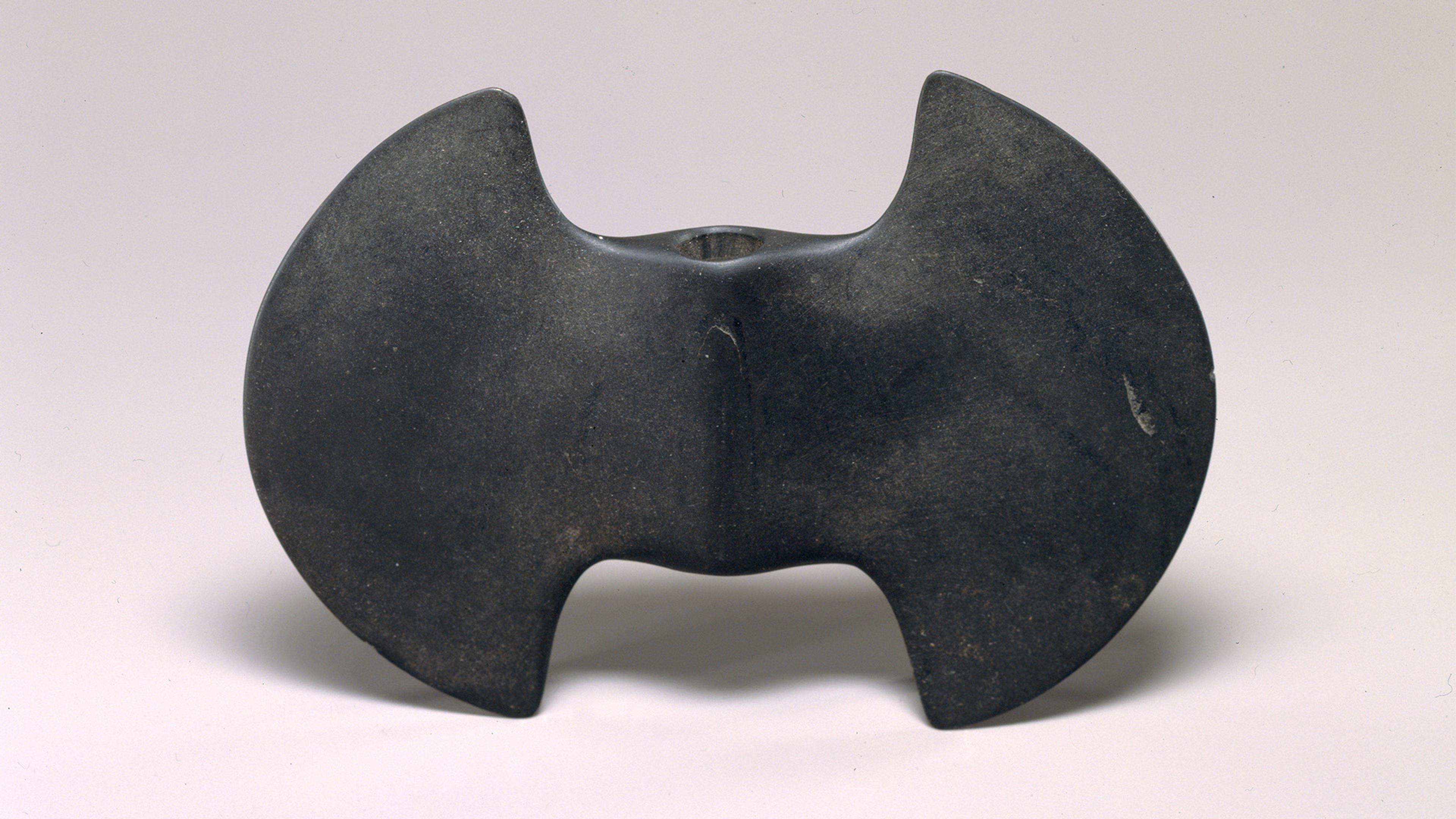
The slate of this Double-Notched Ovate Bannerstone has been carefully oriented so that the natural dark banding moves diagonally across the sculpted composition of the stone, echoing and in visual play with the curved sculpting shape. The top and bottom notches are angled inward, and the sculptor has carved a subtle ridge on one side of the stone parallel to the perforation. The entire surface has thin scratch marks from the peck and grind technology used to shape and polish the stone. Other than a few small chips along the edges, this bannerstone shows little or no signs of wear. Its is twice the weight of most bannerstones, suggesting that this pristine carving may have been used in performances or ceremonies. Branch Co. Mich B-41 is written in black on one side, presumably indicating where this bannerstone was found in south-central Michigan.
Anna Blume, Professor of the History of Art, Fashion Institute of Technology, State University of New York 2023
References and Further Reading
Knoblock, Byron. Bannerstones of the North American Indian. LaGrange: LeGrange: Bryon Knoblock, 1939.
Lutz, David L. The Archaic Bannerstone: Its Chronological History and Purpose From 6000 B.C. to 1000 B.C. Newburg: David L. Lutz, 2000.
Sassaman, Kenneth. “Craftworks of Structure.” The Eastern Archaic Historicized. New York: AltaMira Press, 2010, pp. 97-142.
Bannerstone Project. Fashion Institute of Technology, https://bannerstone.fitnyc.edu/
Artwork Details
- Title: Bannerstone, Double-Notched Ovate
- Date: 6000–1000 BCE
- Geography: United States, Michigan
- Culture: Archaic
- Medium: Banded slate
- Dimensions: H. 6 × W. 5 × D. 2 in. (15.2 × 12.7 × 5.1 cm)
- Classification: Stone-Ornaments
- Credit Line: Ralph T. Coe Collection, Gift of Ralph T. Coe Foundation for the Arts, 2011
- Object Number: 2011.154.14
- Curatorial Department: The Michael C. Rockefeller Wing
More Artwork


Related Content
Research Resources
The Met provides unparalleled resources for research and welcomes an international community of students and scholars. The Met's Open Access API is where creators and researchers can connect to the The Met collection. Open Access data and public domain images are available for unrestricted commercial and noncommercial use without permission or fee.
To request images under copyright and other restrictions, please use this Image Request form.
Feedback
We continue to research and examine historical and cultural context for objects in The Met collection. If you have comments or questions about this object record, please contact us using the form below. The Museum looks forward to receiving your comments.
Content Notice
The Metropolitan Museum of Art presents over 5,000 years of art from around the world, and our online collection reflects ongoing work conducted over the course of our more than 150-year history. You may encounter objects or images that may be inappropriate for some viewers or information that may be outdated.