Пшеничные поля
Artwork Details
- Название: Пшеничные поля
- Художник: Якоб ван Рейсдал, Нидерланды, 1628/29–1682 гг.
- Дата: около 1670 г.
- Материал: Масло, холст
- Размер: 100 x 130,2 см
- Благодарность: Завещание Бенджамина Альтмана, 1913
- Номер объекта: 14.40.623
- Curatorial Department: European Paintings
Audio
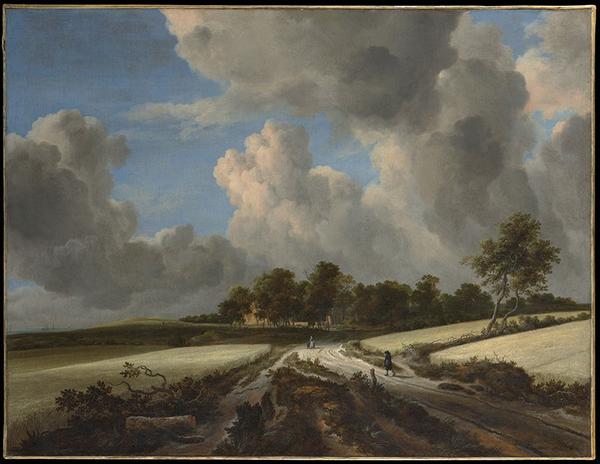
5245. Jacob van Ruisdael, Wheat Fields
NARRATOR: When he works behind the camera, cinematographer Gavin Finney tells stories by using film to capture movement. But what if you’re a seventeenth-century landscapist, Jacob van Ruisdael, and instead you have a paintbrush? Finney and curator Adam Eaker discuss.
ADAM EAKER: So he conveys the ordinariness of the Dutch landscape, and at the same time, he transfigures it through light—through the depiction of the sky—into something really dramatic and extraordinary.
GAVIN FINNEY: He’s picked the moment you’d want to press the shutter on a camera, which is this gap in the clouds illuminating the woman and the child. And they’re right on the edge of a shadow of a cloud. We know these clouds are moving. And in my mind, they’re moving towards us, and I think there’s a spotlight racing towards the viewer. And in the next second, the lady and the child will be in darkness.
NARRATOR: The painted scene, like a moving shot in a film, serves a larger story. It invites us to speculate.
GAVIN FINNEY: The man’s carrying a bag. They’re standing still, the woman and the child—so are they waiting for the man? He’s carrying a bag—has he come off a ship? Is he father, or brother, or husband? What’s the story here? It’s not just figures put in for scale; there’s a human narrative going on here as well, enveloped in this great landscape.
NARRATOR: On the far left, the landscape opens to the sea.
ADAM EAKER: I like to think that Ruisdael included this glimpse of the sea as a way of expanding the horizon—both literally and figuratively—to show a kind of interconnectedness between this humble path and some world outside the frame.
GAVIN FINNEY: When you stand in front of it, you can almost imagine it coming to life.
Listen to more about this artwork
More Artwork
Related Content

Research Resources
The Met provides unparalleled resources for research and welcomes an international community of students and scholars. The Met's Open Access API is where creators and researchers can connect to the The Met collection. Open Access data and public domain images are available for unrestricted commercial and noncommercial use without permission or fee.
To request images under copyright and other restrictions, please use this Image Request form.
Feedback
We continue to research and examine historical and cultural context for objects in The Met collection. If you have comments or questions about this object record, please contact us using the form below. The Museum looks forward to receiving your comments.
Content Notice
The Metropolitan Museum of Art presents over 5,000 years of art from around the world, and our online collection reflects ongoing work conducted over the course of our more than 150-year history. You may encounter objects or images that may be inappropriate for some viewers or information that may be outdated.