Throne of Njouteu
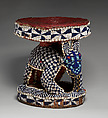
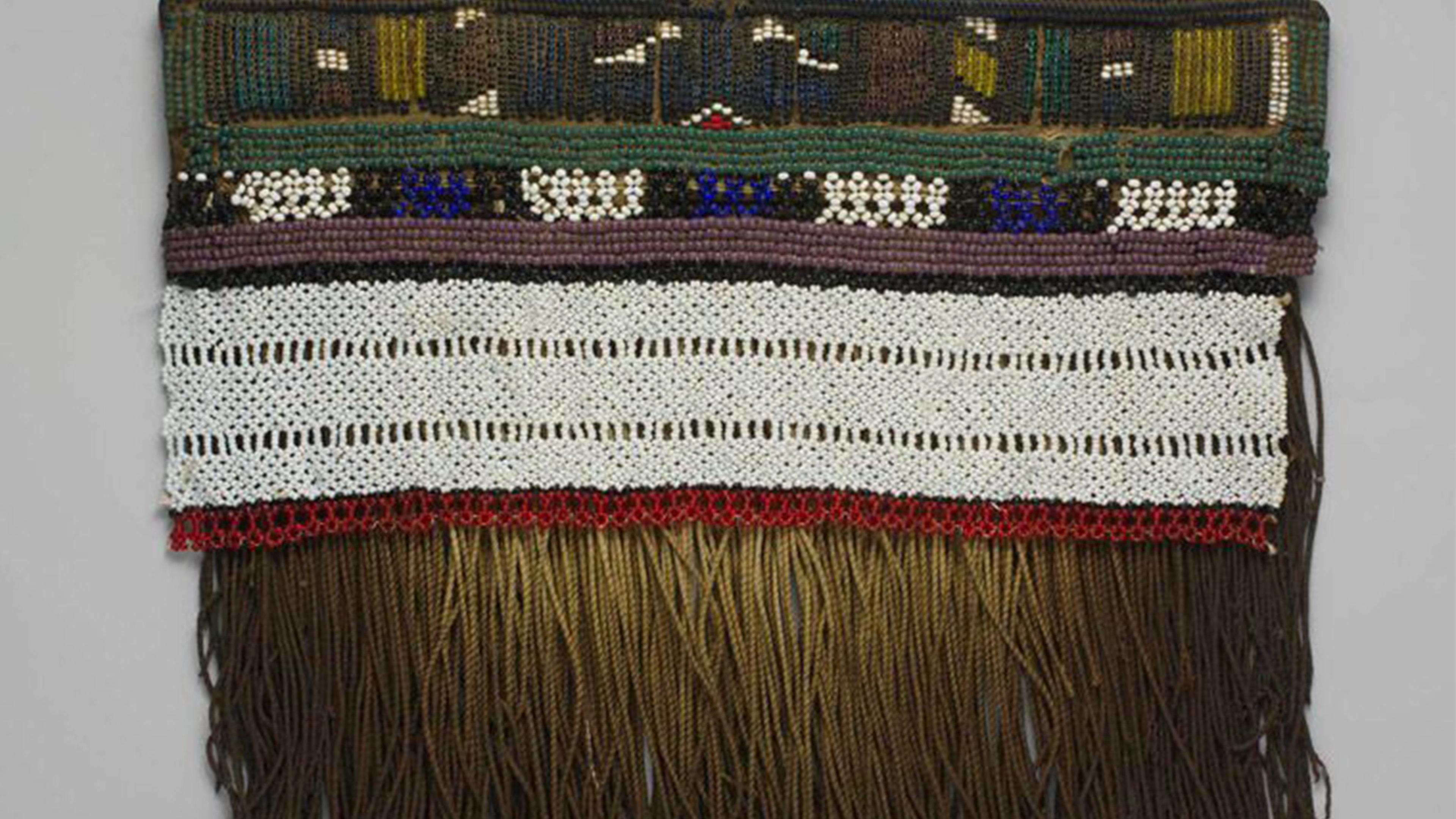
This throne served as the visual focus of rites establishing the legitimate transfer of power as well as continuity in leadership. It was documented in Bansoa in 1957 by the French researcher Pierre Harter, who recorded the name of the late nineteenth-century ruler credited with its creation: Njouteu. The sculpture of a king and his consort standing at the back of a circular seat supported by a leopard was carved from a single piece of wood wrapped in a fine layer of locally woven fabric. Upon this three-dimensional canvas, a master beader applied thousands of glass beads—a luxury good created in Venice and Prague for export to this region of West Africa. The emphatic use of blue underscores the elite status of the subjects, who hold insignia of leadership: a buffalo- horn drinking vessel and a calabash receptacle for palm-wine offerings.
Artwork Details
- Title: Throne of Njouteu
- Artist: Grassfields carver and master beader
- Date: Late 19th–early 20th century
- Geography: Cameroon, Bamileke region, Bansoa
- Culture: Bamileke peoples
- Medium: Wood, glass beads, cloth, cowrie shells
- Dimensions: H. 64 × W. 29 1/4 × D. 26 1/2 in. (162.6 × 74.3 × 67.3 cm)
- Classification: Wood-Sculpture
- Credit Line: Purchase, Rogers Fund, Andrea Bollt Bequest, in memory of Robert Bollt Sr. and Robert Bollt Jr., and Laura and James J. Ross and Anonymous Gifts, 2014
- Object Number: 2014.256
- Curatorial Department: The Michael C. Rockefeller Wing
More Artwork
Related Content
 Free to download
Research Resources
The Met provides unparalleled resources for research and welcomes an international community of students and scholars. The Met's Open Access API is where creators and researchers can connect to the The Met collection. Open Access data and public domain images are available for unrestricted commercial and noncommercial use without permission or fee.
To request images under copyright and other restrictions, please use this Image Request form.
Feedback
We continue to research and examine historical and cultural context for objects in The Met collection. If you have comments or questions about this object record, please contact us using the form below. The Museum looks forward to receiving your comments.
Content Notice
The Metropolitan Museum of Art presents over 5,000 years of art from around the world, and our online collection reflects ongoing work conducted over the course of our more than 150-year history. You may encounter objects or images that may be inappropriate for some viewers or information that may be outdated.