English
DonateMembershipTickets

One Hundred Chinese Boys

18th century
Not on view
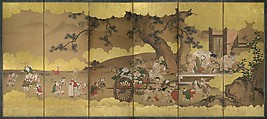
A sumptuous estate, including a bridge and pavilion over a lake, is set off by a shimmering gilded background and golden clouds and enlivened by cavorting children. The conventional motif of One Hundred Children has obvious auspicious connotations in the Chinese tradition. Here, the ancient subject is combined with the moralizing theme of the Four Gentlemanly Accomplishments (calligraphy, painting, music, and the game of go), which engage the children. One Hundred Children became one of the most popular themes among the Kano painters, the official artists who worked for the shoguns and their vassals during the Edo period. The anonymous painter of this screen seems to have based it on a readily available model. The dry, mannered execution of the landscape elements points to a date in the eighteenth century for this work.

Artwork Details

Object Information
  • Title: One Hundred Chinese Boys
  • Period: Edo period (1615–1868)
  • Date: 18th century
  • Culture: Japan
  • Medium: Six-panel folding screen; ink, color, and gold on gilded paper
  • Dimensions: Image: 49 in. × 9 ft. 3 1/2 in. (124.5 × 283.2 cm)
  • Classification: Paintings
  • Credit Line: Gift of Susan Dillon, 2004
  • Object Number: 2004.505
  • Curatorial Department: Asian Art
More Artwork
Helmet (<i>Zukinnari Kabuto</i>), Iron, lacquer, Japanese
Japanese
16th century
Seven Gods of Good Fortune and Chinese Children, Kano Chikanobu  Japanese, Six-panel folding screen; ink, color, and gilt on paper; Reverse side: ink, color, and gold on paper, Japan
Kano Chikanobu
17th–18th century
Armor (<i>Gusoku</i>), Saotome Ietada  Japanese, Iron, lacquer, silk, gilt copper, Japanese
Armorer Helmet bowl signed Saotome Ietada
Armorer Breastplate inscribed inside, Myōchin Munesuke
16th and 18th centuries
Whose Sleeves? (Tagasode), Pair of six-panel folding screens; ink, color, and gold on gilt paper, Japan
Japan
(right screen) late 16th–early 17th century; (left screen) early to mid-17th century
Koto (箏), Metalwork by Goto Teijo, 9th generation Goto master, Japan  Japanese, Various woods, ivory and tortoiseshell inlays, gold and silver inlays, metalwork, cloth, laquer, paper,, Japanese
Metalwork by Goto Teijo, 9th generation Goto master, Japan
Workshop of Gotō Yūjō
early 17th century

Research Resources

The Met provides unparalleled resources for research and welcomes an international community of students and scholars. The Met's Open Access API is where creators and researchers can connect to the The Met collection. Open Access data and public domain images are available for unrestricted commercial and noncommercial use without permission or fee.

To request images under copyright and other restrictions, please use this Image Request form.

Feedback

We continue to research and examine historical and cultural context for objects in The Met collection. If you have comments or questions about this object record, please contact us using the form below. The Museum looks forward to receiving your comments.

Send feedback

Content Notice

The Metropolitan Museum of Art presents over 5,000 years of art from around the world, and our online collection reflects ongoing work conducted over the course of our more than 150-year history. You may encounter objects or images that may be inappropriate for some viewers or information that may be outdated.