Dish
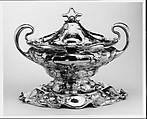
These innovative enamel wares were created in Gorham’s New York shop under the direction of Count Gyula de Festetics (b.1847/48), an award-winning enamellist who was born in Hungary, trained in Europe, and emigrated to the United States around 1867. At a time when most artists and artisans working at Gorham and other such firms were men, it is noteworthy that de Festetics hired women to design and execute enamel work at Gorham. In a publication on Gorham’s exhibit at the Columbian Exposition, contemporary art historian and teacher Julia Osgood highlighted the role "young women, mostly American, chosen for their artistic tendencies" played in the creation of the celebrated enamel wares. Prior to this date, there were very few opportunities for women in America to support themselves as artists or artisans. Gorham’s enamel shop is a bellwether of change; in the ensuing decades increasing numbers of women worked as metalsmiths, enamellers, and jewelers. Gorham records indicate the firm made around 16 unique ‘samples’ of this plique-à-jour enamelware, half of which were shipped directly from the shop to the Chicago fair. The labor and materials required to produce the dish totaled over $155, a sizable sum in 1893 that is roughly equivalent to $5,000 today. This jewel-like dish is a rarified luxury good that both attests to the artistic and technical skills of the artists who created it and signals the affluence, taste, and sophistication of its owner.
Artwork Details
- Title: Dish
- Manufacturer: Gorham Manufacturing Company (American, Providence, Rhode Island, 1831–present)
- Date: 1893
- Geography: Made in New York, New York, United States
- Culture: American
- Medium: Plique-à-jour enamel, silver gilt
- Dimensions: 2 3/4 × 6 1/4 in. (7 × 15.9 cm)
- Credit Line: Gift of Mark F. McHugh and Spencer Gordon, in honor of Beth Carver Wees, 2022
- Object Number: 2022.361
- Curatorial Department: The American Wing
More Artwork
Research Resources
The Met provides unparalleled resources for research and welcomes an international community of students and scholars. The Met's Open Access API is where creators and researchers can connect to the The Met collection. Open Access data and public domain images are available for unrestricted commercial and noncommercial use without permission or fee.
To request images under copyright and other restrictions, please use this Image Request form.
Feedback
We continue to research and examine historical and cultural context for objects in The Met collection. If you have comments or questions about this object record, please contact us using the form below. The Museum looks forward to receiving your comments.
Content Notice
The Metropolitan Museum of Art presents over 5,000 years of art from around the world, and our online collection reflects ongoing work conducted over the course of our more than 150-year history. You may encounter objects or images that may be inappropriate for some viewers or information that may be outdated.