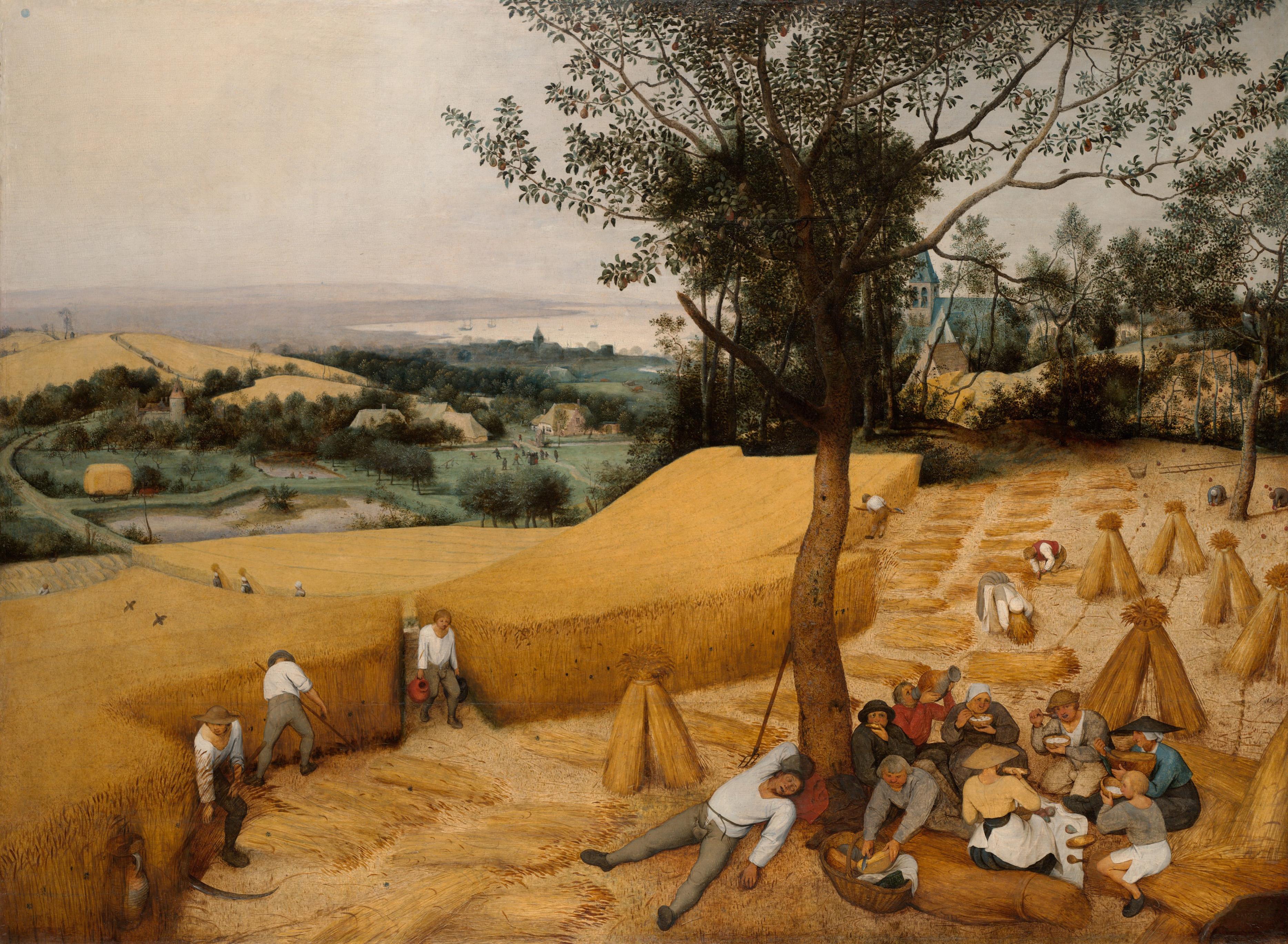
Pieter Bruegel the Elder (Netherlandish, ca. 1525–1569). The Harvesters, 1565. Oil on wood, 46 7/8 x 63 3/4 in. (119 x 162 cm). The Metropolitan Museum of Art, New York, Rogers Fund, 1919 (19.164)
My name is Laura McPhee and I am a photographer.
My work is landscape, primarily. I work with a large format 8x10 Deardorff camera.
The Harvesters by Pieter Bruegel anticipates photography. It is as if you’re out there with an 8x10 view camera and the world is unfolding. He lets that tree be right on the edge of the frame and the road, as it moves away from you into the landscape, just kisses the edge of the frame. That feels very photographic: he’s making a decision about where to put that edge. Also the resolution, the way that sharpness is sustained throughout the frame. This is a precise second, it’s a 60th of a second, because everything’s still: the people in the foreground having lunch, eating cheese and bread, one guy with the spoon to his mouth, the woman picking up the sheaf of hay.
The peasants are working hard. The one man coming toward us, he’s carrying that jar in a way that reveals fatigue. You’re aware that all this wheat is not just for this little village, that it’s being taken down the hill and it’s put on the cart that’s heavily laden, and the cart is moving off in the direction of the ships, which will then take the hay to other parts of the world. So you know that these laborers are laboring in the interest of someone else.
Often when I’m thinking about photography I am thinking about the paradoxical nature of the world: that it’s so intensely beautiful and, at the same time, there’s so many problems and many are self-inflicted. We’re in concert with the land and we exploit it and we protect it. What interests me is trying to comprehend that complexity and then communicate that. This painting is such an organized place where, literally, the pears fall off the tree and the people are eating them. But it’s so complex. There are so many moments that build on each other.
Bruegel understands the idea of simultaneity and that these things are all seemingly disconnected: the people in the foreground are totally unaware of what the people in the middle ground or on the ships are doing, but he’s drawing the links. To have this whole symphony occurring in one image, that’s fantastic.