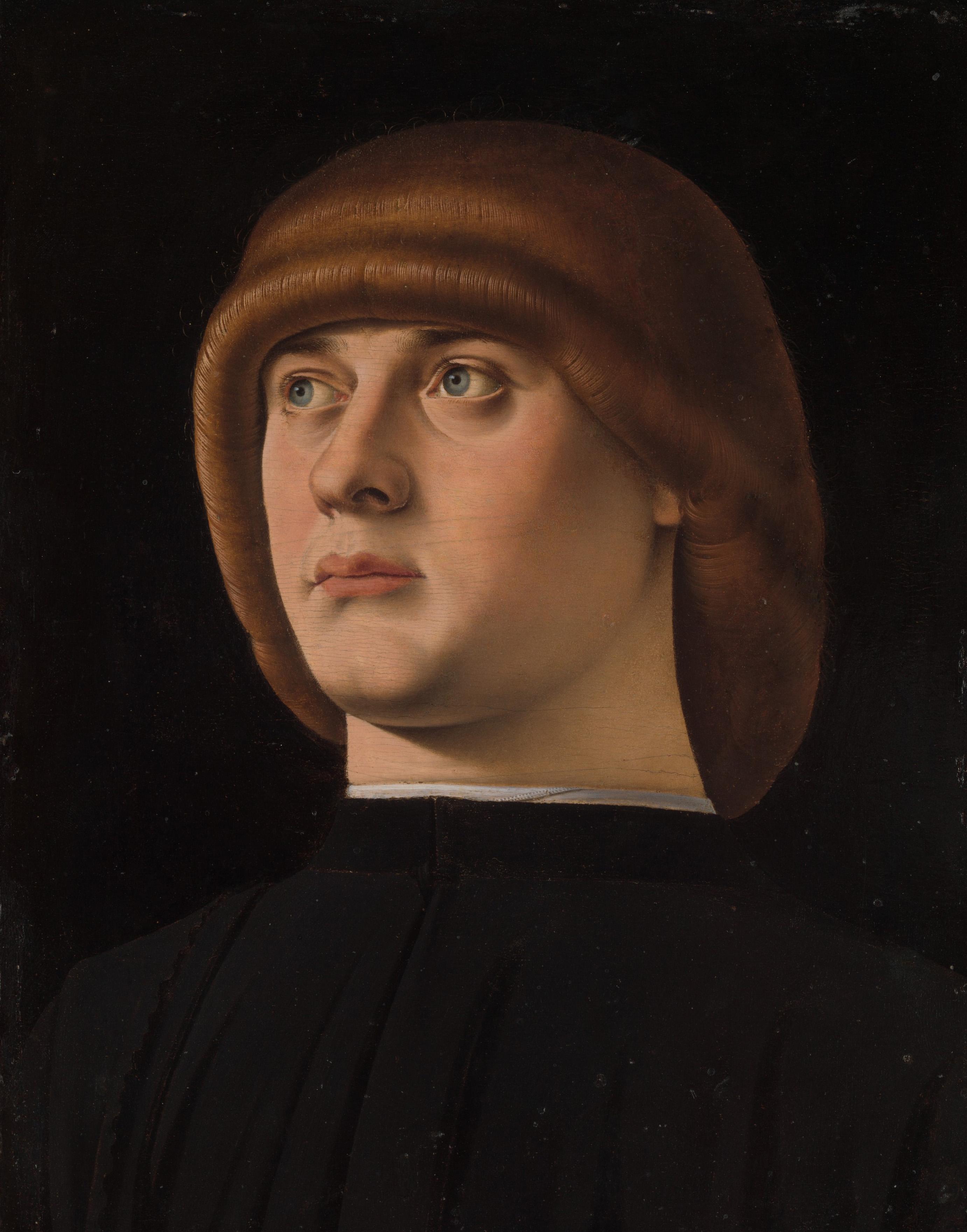
Jacometto (Jacometto Veneziano) (Italian, active Venice by ca. 1472–died before 1498). Portrait of a Young Man, 1480s. Oil on wood, 11 x 8 1/4 in. (27.9 x 21 cm). The Metropolitan Museum of Art, New York, The Jules Bache Collection, 1949 (49.7.3)
My name is Liliana Porter. I am a visual artist.
I work through different techniques—printmaking, painting, video, even theater—but the important thing to me is the subject matter, because I’m really interested in that ambiguous space between reality and representation. I’m always very moved about these types of portraits from the last part of the fifteenth century: that they are very, very precise.
It’s very difficult to see things the way they were in the initial context. For instance, we see those dresses and the hats and everything, and for us it’s impossible not to romanticize it, because it’s so foreign that it belongs to a fairytale. In this case, because the face seems so very familiar, it makes it more intriguing. And then you say, “what is he doing with that hairdo?” It’s a detail that informs you that this is not somebody from the present, right? I read that it was very fashionable in Venice in the end of the fifteenth century.
But at the same time, it could be your neighbor. We seem to know the person. He looks like a super average, normal person. Even the lips are not totally perfect. It makes it more human. He’s not a prince. It doesn’t matter who he is. The fact that it doesn’t have a narrative makes it open to all kinds of perceptions.
I like the idea of how it’s possible to have something so close and yet so far, so familiar and unknown. It makes me more aware that actually everything is like that, even the things we think we know. There is no description that completes the meaning of anything. For instance, for me, the dictionary is a super moving object, because it has the pretense of knowing the meaning of each word, and so it looks like something that is true, that is objective, and that we have the explanation of everything. And it’s not true. It’s almost a joke.
So you can take, let’s say, a person, and count all the hairs, measure everything, and I think the more precise, for some reason it’s less real. There is something magical about this young man that is young after six hundred years. It makes you aware of the distance between the painting and the painter and the subjects that were real at one point, and that the concept of reality is such an ungraspable thing.