English
DonateMembershipTickets

Cope

first half 17th century (velvet)
Not on view
Armenian merchants played an important role in facilitating trade in and outside Iran, so when the Safavid ruler Shah 'Abba' (r. 1587–1629) planned to revitalize Iran's economy, he resettled a community of Armenians from the city of Julfa to his new capital, Isfahan. From there, the Armenians helped Iran's famous silk reach markets around the world. This cope probably comes from an Armenian church in Isfahan, as suggested by the presence of Armenian bishop-saints and Armenian inscriptions on the orphrey attached to its long straight edge. The cope was pieced together from robes (the seams are still visible) of a type of costly, popular seventeenth-century Persian velvet.

Artwork Details

Object Information
  • Title: Cope
  • Date: first half 17th century (velvet)
  • Geography: Attributed to Iran
  • Medium: Silk, cotton, metal wrapped thread; cut and voided velvet, brocaded, embroidered, with engraved metal fittings
  • Dimensions: Textile: Max. L. 44 1/2 in. (113 cm)
    Max. W. 103 in. (261.6 cm)
    D. 1/4 in. (0.6 cm)
  • Classification: Textiles
  • Credit Line: Rogers Fund, 1914
  • Object Number: 14.67
  • Curatorial Department: Islamic Art
More Artwork
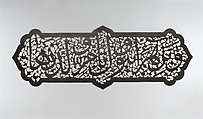
Calligraphic Plaque, Steel; forged and pierced
probably late 17th century
Cope with an Orphrey and a Hood, Cope:  silk warp-float faced 4/1 satin weave with linen plain weave lining.<br/>Orphrey:  linen plain weave with silk and gilt- and silvered- metal strip wrapped silk in satin and split stitches, laid work, couching, and padded couching.  Fringe:  silk, gilt-metal-strip-wrapped silk.  Lining: cotton plain weave.<br/>Hood:  linen plain weave embroidered with silk, gilt- and silvered- metal-strip-wrapped silk, and silvered-metal strips and coils , couching and couching padded with hemp; metal spangles.  Fringe: silk plain weave.  Lining: linen plain weave., Italian, German, Dutch, Spanish
Italian, German, Dutch, Spanish
15th–16th century
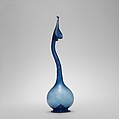
Swan-Neck Glass Bottle, Glass, blue; dip-molded, blown, folded foot
19th century
Cope with an Orphrey and a Hood, Cope-silk, <br/>Lining-linen, cotton weave<br/>Orphrey- linen plain weave embroidered with silk, gilt-animal-substrate-wrapped linen and gilt-metal-strip-wrapped linen<br/>Hood-linen plain weave appliquéd with linen plain weave and embroidered with silk and gilt-metal-strip-wrapped silk, Italian, Spanish, or German
Italian, Spanish, or German
mid-15th–17th century
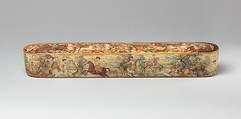
Pen Box (Qalamdan) Depicting Shah Isma'il in a Battle against the Uzbeks, Papier-maché; painted and lacquered
early 19th century

Research Resources

The Met provides unparalleled resources for research and welcomes an international community of students and scholars. The Met's Open Access API is where creators and researchers can connect to the The Met collection. Open Access data and public domain images are available for unrestricted commercial and noncommercial use without permission or fee.

To request images under copyright and other restrictions, please use this Image Request form.

Feedback

We continue to research and examine historical and cultural context for objects in The Met collection. If you have comments or questions about this object record, please contact us using the form below. The Museum looks forward to receiving your comments.

Send feedback

Content Notice

The Metropolitan Museum of Art presents over 5,000 years of art from around the world, and our online collection reflects ongoing work conducted over the course of our more than 150-year history. You may encounter objects or images that may be inappropriate for some viewers or information that may be outdated.