English
DonateMembershipTickets

"Three Trees of India", Folio from a Baburnama (Autobiography of Babur)

late 16th century
Not on view
The Baburnama, one of the most important texts of the Mughal period, provides insight into the literary, intellectual, and cultural world of Babur (1483–1530), founder of the Mughal empire. The Baburnama is especially celebrated for its observations of India's natural world, an aspect of the text most pleasingly captured in the subject matter here. The page depicts three trees: one on the recto (jackfruit) and two on the verso (monkey jack and lote). Interspersed among the images are texts in nasta'liq Persian script describing the trees and their fruits. During the reign of Babur's grandson Akbar (1556–1605), four imperial copies of the Baburnama were created, each illustrated by leading artists of the royal atelier. This folio comes from the earliest of these copies, the 1589 manuscript, which was likely a model for the later versions. It is thought originally to have contained 191 illustrations, many of which were dispersed in 1913, with a substantial portion remaining in the Victoria and Albert Museum, London. The collaboration between two or more artists, as seen here, was typical of early Mughal workshop practice.

Artwork Details

Object Information
  • Title: "Three Trees of India", Folio from a Baburnama (Autobiography of Babur)
  • Date: late 16th century
  • Geography: Country of Origin India
  • Medium: Ink, opaque watercolor, and gold on paper
  • Dimensions: H. 9 13/16 in.(25 cm)
    W. 5 1/8 in. (13 cm)
  • Classification: Codices
  • Credit Line: Purchase, Louis E. and Theresa S. Seley Purchase Fund for Islamic Art, Anonymous Gift, in honor of Amy Poster, and Friends of Islamic Art Gifts, 2013
  • Object Number: 2013.576
  • Curatorial Department: Islamic Art
More Artwork
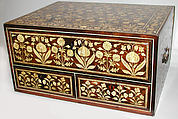
Flower-Style Box with Drawers, Wood (poplar); overlaid with ebony inlaid with wood and incised, stained ivory
17th century
Folio from a Mu'nis al-ahrar fi daqa'iq al-ash'ar (The Free Man's Companion to the Subtleties of Poems) of Jajarmi, Muhammad ibn Badr al-Din Jajarmi  Iranian, Ink, opaque watercolor, and gold on paper
Author Muhammad ibn Badr al-Din Jajarmi
dated 741 AH/1340–41 CE
"Akbar With Lion and Calf", Folio from the Shah Jahan Album, Govardhan, Ink, opaque watercolor, and gold on paper
Painting by Govardhan
Calligrapher Mir 'Ali Haravi
verso: ca. 1630; recto: ca. 1530–50
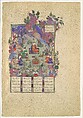
"The Feast of Sada", Folio 22v from the Shahnama (Book of Kings) of Shah Tahmasp, Abu'l Qasim Firdausi  Iranian, Opaque watercolor, ink, silver, and gold on paper
Author Abu'l Qasim Firdausi
Painting attributed to Sultan Muhammad
ca. 1525
Pierced Window Screen (Jali), Red sandstone; pierced, carved
second half 16th century

Research Resources

The Met provides unparalleled resources for research and welcomes an international community of students and scholars. The Met's Open Access API is where creators and researchers can connect to the The Met collection. Open Access data and public domain images are available for unrestricted commercial and noncommercial use without permission or fee.

To request images under copyright and other restrictions, please use this Image Request form.

Feedback

We continue to research and examine historical and cultural context for objects in The Met collection. If you have comments or questions about this object record, please contact us using the form below. The Museum looks forward to receiving your comments.

Send feedback

Content Notice

The Metropolitan Museum of Art presents over 5,000 years of art from around the world, and our online collection reflects ongoing work conducted over the course of our more than 150-year history. You may encounter objects or images that may be inappropriate for some viewers or information that may be outdated.