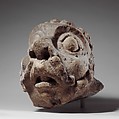
Foliate Corbel
Notre-Dame-de-la-Grande-Sauve, the church from which these corbels come, was situated on one of the routes to the shrine of Santiago de Compostela in northern Spain. Set next to a great forest (the silva major from which its name comes) and dominating a hill overlooking the Gironde River, its community grew from seven monks at its founding in 1079 to some 300. The abbey benefited from donations from famous patrons, including a gift from Eleanor of Aquitaine, and Henry II king of England, in 1156.
In the aftermath of the French Revolution, the monastic buildings served as a prison. The church vaults collapsed in 1809, and a fire in 1910 further compromised the site. Still, some related corbels survive on the church exterior.
Artwork Details
- Title: Foliate Corbel
- Date: ca. 1150–1200
- Geography: Made in Aquitaine, France
- Culture: French
- Medium: Limestone
- Dimensions: Overall: 28 1/8 x 11 1/2 x 18 1/2 in. (71.4 x 29.2 x 47 cm)
- Classification: Sculpture-Architectural
- Credit Line: Gift of George Blumenthal, 1934
- Object Number: 34.21.4
- Curatorial Department: Medieval Art and The Cloisters
More Artwork
Research Resources
The Met provides unparalleled resources for research and welcomes an international community of students and scholars. The Met's Open Access API is where creators and researchers can connect to the The Met collection. Open Access data and public domain images are available for unrestricted commercial and noncommercial use without permission or fee.
To request images under copyright and other restrictions, please use this Image Request form.
Feedback
We continue to research and examine historical and cultural context for objects in The Met collection. If you have comments or questions about this object record, please contact us using the form below. The Museum looks forward to receiving your comments.
Content Notice
The Metropolitan Museum of Art presents over 5,000 years of art from around the world, and our online collection reflects ongoing work conducted over the course of our more than 150-year history. You may encounter objects or images that may be inappropriate for some viewers or information that may be outdated.