The Palace of Nine Perfections
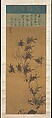
This screenlike set of scrolls depicts an eighth-century imperial retreat in the hills north of the Tang capital, Chang’an (present-day Xi’an). Destroyed by the end of the Tang dynasty (618–907), the Palace of Nine Perfections is remembered as one of the most splendid residences ever built, with grounds so vast that it was necessary to travel between halls by horseback.
Royal palaces have always been likened to Daoist paradises, and Yuan’s vision plays on this theme, with Qing-style palatial buildings set in a fantastic landscape that suggests the enchanted realm of the immortals. But Yuan may have had another model in mind. Executed just two years after the Kangxi emperor (r. 1662–1722) visited Yangzhou on his second southern inspection tour, the painting, which includes a regal entourage—with the emperor and his parasol-bearer prominently featured in the foreground—was undoubtedly also inspired by the ceremonial processions and lavish gardens created to celebrate the imperial visit. Combining legend and architectural fantasy with thinly veiled references to contemporary events, Yuan’s painting is a celebration of the grandiose materialistic lifestyle to which the high society of Yangzhou aspired.
Artwork Details
- 清 袁江 九成宮圖 屏
- Title: The Palace of Nine Perfections
- Artist: Yuan Jiang (active ca.1680–ca.1730)
- Period: Qing dynasty (1644–1911)
- Date: 1691
- Culture: China
- Medium: Set of twelve hanging scrolls; ink and color on silk
- Dimensions: Image: 81 1/2 in. × 18 ft. 5 3/4 in. (207 × 563.2 cm)
Overall with mounting: 94 1/4 in. × 19 ft. (239.4 × 579.1 cm) - Classification: Paintings
- Credit Line: Purchase, The Dillon Fund Gift, 1982
- Object Number: 1982.125a–l
- Curatorial Department: Asian Art
Audio
7640. The Palace of Nine Perfections
More Artwork
Related Content
Research Resources
The Met provides unparalleled resources for research and welcomes an international community of students and scholars. The Met's Open Access API is where creators and researchers can connect to the The Met collection. Open Access data and public domain images are available for unrestricted commercial and noncommercial use without permission or fee.
To request images under copyright and other restrictions, please use this Image Request form.
Feedback
We continue to research and examine historical and cultural context for objects in The Met collection. If you have comments or questions about this object record, please contact us using the form below. The Museum looks forward to receiving your comments.
Content Notice
The Metropolitan Museum of Art presents over 5,000 years of art from around the world, and our online collection reflects ongoing work conducted over the course of our more than 150-year history. You may encounter objects or images that may be inappropriate for some viewers or information that may be outdated.