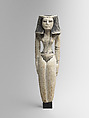
Head from a statuette
In fact, it has long been discussed whether this head represents a non-royal male or a royal female. The subject wears a type of wig popular among royal women, but not exclusively so - it is also found on officials. The red skin color would point to a male, but skin color may not be a reliable indicator of sex in the Amarna Period. If a female were represented, it should be a princess forming part of a group and would be be placed in a shrine to the royal family at some home. But the preserved group statues all depict the princesses as young children - whatever their actual age. Given these considerations, it seems more likely the head is that of a male.
Artwork Details
- Title: Head from a statuette
- Period: New Kingdom, Amarna Period
- Dynasty: Dynasty 18
- Reign: reign of Akhenaten
- Date: ca. 1347–1330 BCE
- Geography: From Egypt, Middle Egypt, Amarna (Akhetaten), House no. 68 (T36.68), Egypt Exploration Society excavations, 1930–31
- Medium: Limestone, paint
- Dimensions: H. 3.5 cm (1 3/8 in.); W. 3.1 cm (1 1/4 in.); D. 3.2 cm (1 1/4 in.)
- Credit Line: Gift of Mrs. John Hubbard and Egypt Exploration Society, 1931
- Object Number: 31.114.1
- Curatorial Department: Egyptian Art
More Artwork
Related Content

 Free to download
Research Resources
The Met provides unparalleled resources for research and welcomes an international community of students and scholars. The Met's Open Access API is where creators and researchers can connect to the The Met collection. Open Access data and public domain images are available for unrestricted commercial and noncommercial use without permission or fee.
To request images under copyright and other restrictions, please use this Image Request form.
Feedback
We continue to research and examine historical and cultural context for objects in The Met collection. If you have comments or questions about this object record, please contact us using the form below. The Museum looks forward to receiving your comments.
Content Notice
The Metropolitan Museum of Art presents over 5,000 years of art from around the world, and our online collection reflects ongoing work conducted over the course of our more than 150-year history. You may encounter objects or images that may be inappropriate for some viewers or information that may be outdated.