Doorboards (Jovo or Tale)
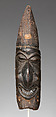
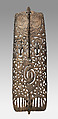
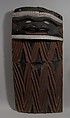
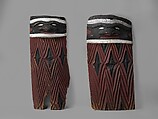
In the past, each village had a large chief's house, which was an important focus of Kanak art. Its entrance, roof finial, and supporting posts were adorned with images of chiefs, ancestors, and protective spirits. Much of the carving centered on the lintel and doorjambs of the single doorway. The imposing doorjambs, known as jovo or tale, that stood on either side of the door were carved in male-female pairs. Each doorjamb simultaneously represents a recently deceased individual and the ancestral lineage of which he or she is a part. The imagery is highly conventionalized, depicting the individual as a corpse with the head exposed and the body wrapped in woven matting.
Artwork Details
- Title: Doorboards (Jovo or Tale)
- Date: late 19th–early 20th century
- Geography: New Caledonia, Grande Terre
- Culture: Kanak people
- Medium: Wood, paint
- Dimensions: Each (approximate): H. 75 1/2 in. × W. 36 in. × D. 12 in. (191.8 × 91.4 × 30.5 cm)
- Classification: Wood-Architectural
- Credit Line: The Michael C. Rockefeller Memorial Collection, Bequest of Nelson A. Rockefeller, 1979
- Object Number: 1979.206.1758, .1759
- Curatorial Department: The Michael C. Rockefeller Wing
More Artwork

Research Resources
The Met provides unparalleled resources for research and welcomes an international community of students and scholars. The Met's Open Access API is where creators and researchers can connect to the The Met collection. Open Access data and public domain images are available for unrestricted commercial and noncommercial use without permission or fee.
To request images under copyright and other restrictions, please use this Image Request form.
Feedback
We continue to research and examine historical and cultural context for objects in The Met collection. If you have comments or questions about this object record, please contact us using the form below. The Museum looks forward to receiving your comments.
Content Notice
The Metropolitan Museum of Art presents over 5,000 years of art from around the world, and our online collection reflects ongoing work conducted over the course of our more than 150-year history. You may encounter objects or images that may be inappropriate for some viewers or information that may be outdated.