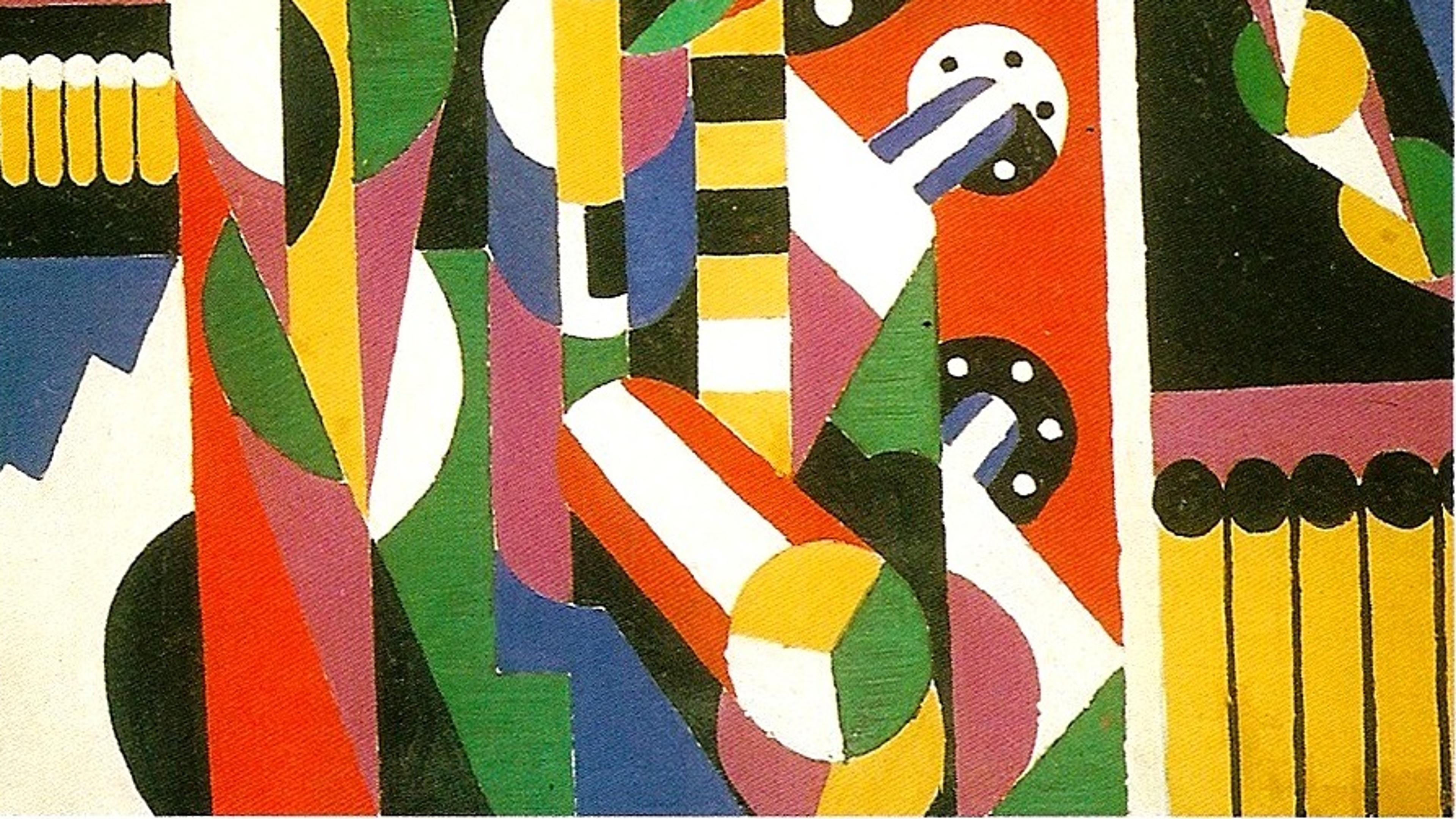
This essay is part of La Fin du monde: A Modernist Book, a research project from the Leonard A. Lauder Research Center for Modern Art.
For a publication that began life as a cinema screenplay, La Fin du monde filmée par l’Ange N-D (1919) is surprisingly tied to its identity as a printed and bound set of pages. Its narrative strikingly begins with a book: not a livre d’artiste (artist’s book), as we might class La Fin du monde itself, or even a religious tome, such as we might expect of the figure of God the Father opening a “Grand Livre” (its title capitalized for effect), but a ledger, in which our divine businessman searches before noting down some figures with a pencil on his notepad. This is not a book that is treated with respect, but rather one between the pages of which God is content to drop ashes from his cigar, suggesting that it comprises functional but poor-quality papers—like the cheap paper on which most copies of La Fin du monde were printed in 1919 and sold for twenty francs through Editions de la Sirène. Throughout the text of Cendrars’s pseudo-apocalyptic tale, we find references to books, many of which seem to feed into a parodic religiosity that pervades La Fin du monde but, in interpretations of the text, is often sidelined in favor of a focus on modernity. This essay will examine these two strands: first, La Fin du monde (and specifically The Met’s copy) as a textual and material object in the context of the livre d’artiste; and second, the ways in which its concern with the written word speaks to its position in relation to the sacred. In many respects, the luxury edition now owned by The Met, bound with Léger’s annotated proofs in an extraordinary leather cover, is quite a different material object from the 20-franc editions, and this tension will also be important.
The written word
Editions de la Sirène was a relatively young publishing house when it produced La Fin du monde. Founded by Paul Laffitte in 1917, its productions ranged from books by emerging and established modern French writers (including Jean Cocteau, Max Jacob, and Guillaume Apollinaire), sometimes with illustrations by renowned artists, as for La Fin du monde; translations or reeditions (including works by Edgar Allen Poe, Robert Louis Stevenson, and Jerome K. Jerome); and even music (including scores by Georges Auric, Darius Milhaud, and Eric Satie). By 1923 it was managed by the larger Editions Crès and was eventually taken over in 1937 due to financial instability. Its existence was short but incredibly fertile, often placing in dialogue figures who would go on to be long-term collaborators. Other major names in the production of artists’ books include Ambroise Vollard, who often worked with new artists to publish reeditions of existing texts, such as Picasso’s illustrations for Ovid’s Metamorphoses (1931), and Daniel-Henry Kahnweiler, who worked with emerging artists to produce luxury first editions. Editions de la Sirène might be seen by comparison as more multi-media, experimental, and (in terms of cost), accessible. Such is the nature of La Fin du monde, with its innovative approach to illustration as a practice, for example its images dispersed across pages rather than as separate plates.

Pablo Picasso (Spanish, 1881–1973). Illustration for Metamorphoses by Ovid, with additional suite of thirty etchings with remarques. Book (unbound) and thirty etchings with pen and brown ink on paper, 13 × 10 1/2 × 2 1/2 in. (33 × 26.7 × 6.4 cm). Each etching: 12 3/4 × 10 1/4 in. (32.4 × 26 cm). The Metropolitan Museum of Art, New York. Purchase, Anne Cox Chambers Gift, 2003 (2003.422a-uuuuuu). © 2026 Estate of Pablo Picasso / Artists Rights Society (ARS), New York
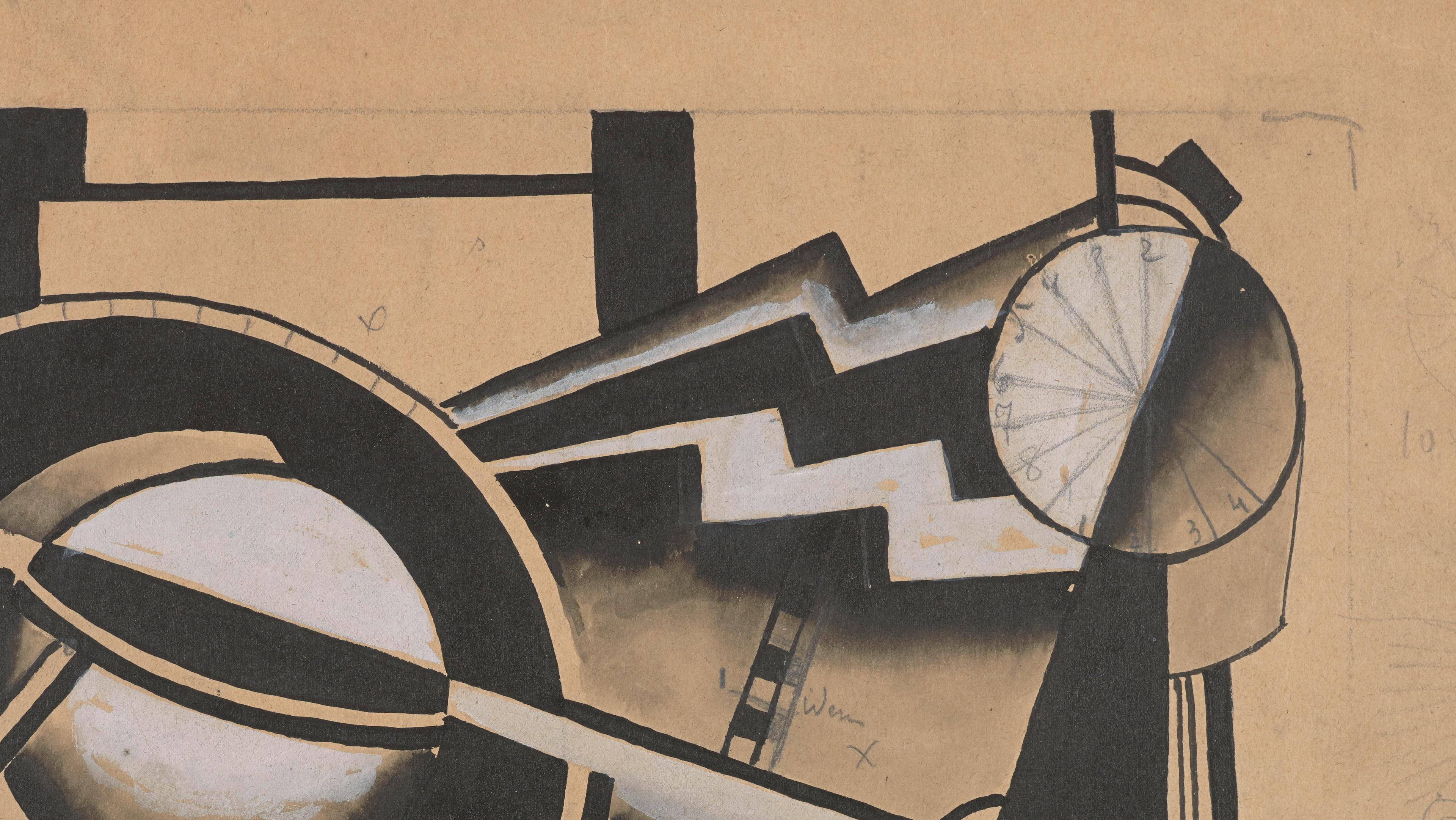
The tone of its narrative very much reflects the material characteristics of the book. In the general hubbub of modern Paris, Cendrars notes “cars at Place de l’Etoile, darting around like pen strokes.” This fascinating turn of phrase suggests that the automobiles perform an act of writing on the surface of the city. Elsewhere, illuminated signs flash in the dusk, telegrams and encrypted messages convey summons and information, and religious figureheads wear ministerial insignia and queue up to claim God’s countersignature on their account books. Writing of every conceivable sort—handwritten or typed—is evoked in the pages of La Fin du monde, in the narrative and the illustrations. David Rosand has written about handwriting and mark-making as phenomenological gestures—markers of the movement of the artist-writer’s hand in time as well as an articulation of space or language. The image of cars as pen strokes evocatively combines the gesture of handwriting with the potentially balletic but nonetheless mechanical motion of the car—a combination that would be the overt subject of Léger’s later film Le Ballet mécanique (1924). The relationship between words and the paper on which they are inscribed or printed is an important one, and, in particular when viewing the maquette alongside the printed edition, the presence of handwritten, stenciled, and typographical markings on the same surface makes for an additional layer in this dynamic exchange. It is as though the maquette itself takes the place of the city with its range of textual interfaces.
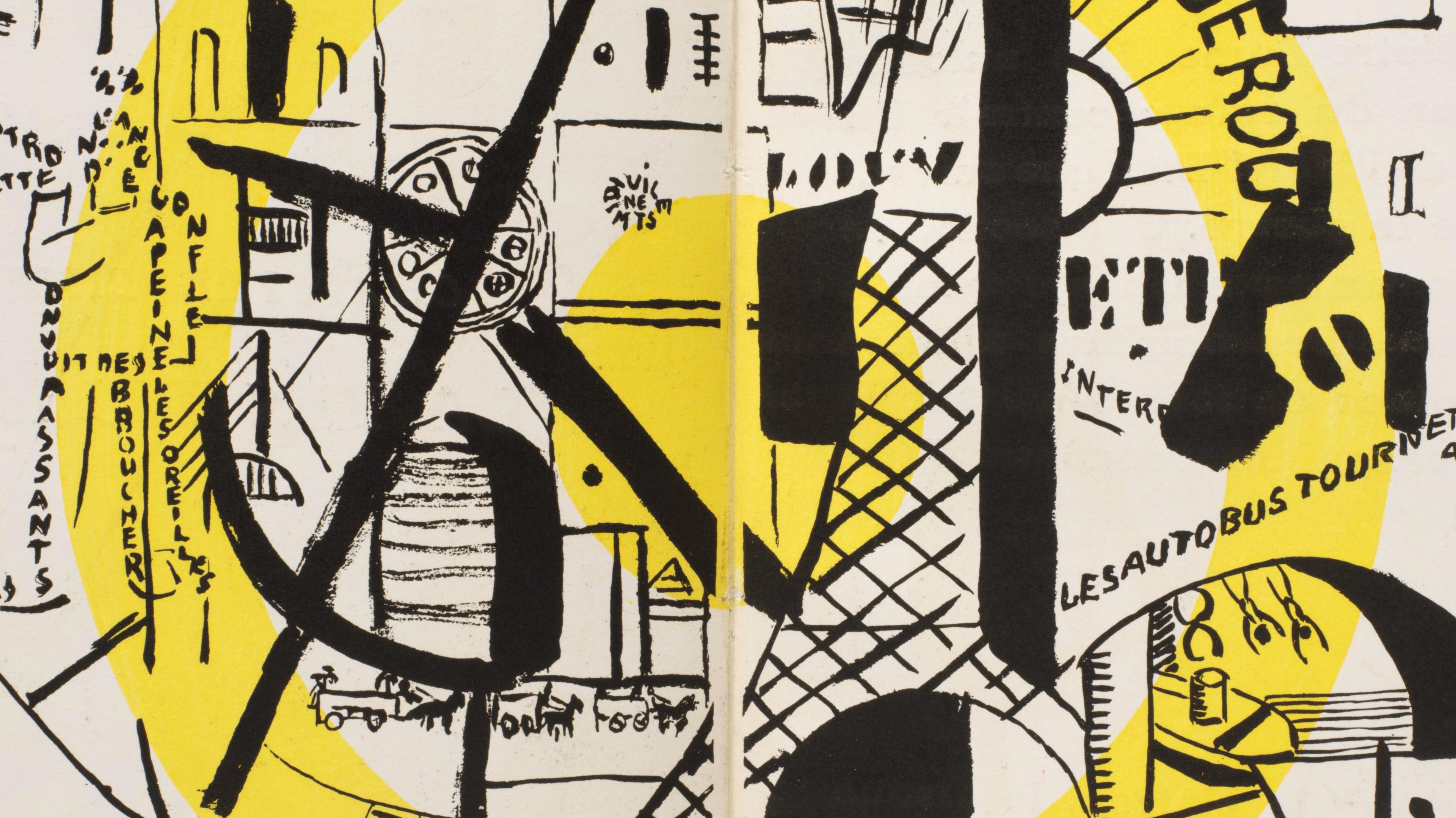
The double-page spread that marks the end of chapter 6 and the start of chapter 7 in the published edition is a case in point. The image of the map of France on the left has migrated in the final version from its placement at the end of chapter one in the maquette, meaning that the image that sits next to it also changes. The tentatively drawn blue lines that in the maquette mark out both the capital city and the Mediterranean coastline on the map seem to be tracing the individual reader or writer’s position as well as drawing attention to these key sites of avant-garde activity. The hand-drawn lettering is replaced in the printed version with a stenciled font, rendered along a straight rather than a curved line and with a dot above the ambiguously upper-case “I” indicating (inaccurately) the location of Paris; in the final design the crisp white edge of the coastline has been corrected to the position of the blue lines in the maquette. The marks of the paintbrush in the yellow and purple background of the maquette version give way to evenly-colored stripes in the final edition, and the evidently hand-rendered circle that surrounds the title for chapter 2 (and which therefore appears opposite the map in the maquette, but not in the published version) is transformed from something that looks rather like a careless stain from a coffee cup placed on the page into a precise and perfect circle. Perhaps, given the reference to Barnum and the chapter that follows, it recalls the circus ring or otherwise anticipates the larger yellow circle that will appear—zoomed in, as it were—in the double-page spread that introduces chapter 5. In the published edition, the map sits next to the stenciled frontispiece depicting the words “SI PARLA ITALIANO” (yes, Italian is spoken), which Christopher Green convincingly reads as a glimmer of internationalist hope—an interpretation less readily available to us in the maquette because of the plate’s placement. The transferability of images from one chapter to another reinforces the fact that Léger’s images are not straightforwardly narrative or illustrative; it also presents the possibility that they, like the characters who populate the book (including God the Father), are not held by a fixed understanding of either time or space but can be brought to mind at different moments in the reader’s experience. While the published book is a multiple, the reader will always remain an individual, with the potential to move back and forth through the book at will. It is conventionally held that reading takes place across time, whereas images (and especially sculpture) exist in space, the two-dimensional image asserting itself as an instantaneous and non-linear entity. However this assumption does not take into account the fact that viewing images also takes place in time; nor does it allow for the deviant reader who flicks through a book sometimes even backwards, creating an effect that mirrors cinematic techniques such as rewinding and speeding up the action, both of which the narrative of La Fin du monde exploits. As Marien Macken has put it in her consideration of the book as a spatial practice in relation to architecture: “The reader’s pacing through the book may be manipulated through inflection, repetition, rhythm and omission. . . . The seeming double-page stasis co-exists with a cinematic potential.”
Because the work is published in book form, paper is the surface on which these various shifts are able to take place. In his essay “Paper or Me, You Know,” the philosopher Jacques Derrida reflects wryly on the status of paper in a digital age and in particular notes the irony of the inherently physical language such as “cut and paste” that is deployed in computerized word processing. He also insists, however, on paper as more than mere surface, claiming it as an agent in the process of production: through its physical ability to fold, fade, and be felt, “it mobilizes both time and space,” he says, and as such the écrit (written) has something in common with the écran (screen). Derrida is thinking here of the computer screen, and the commonality is reinforced in the digital era when the screen—onto which words appear as one types—stands in for the sheet of paper and may in fact replace it. In terms of narrative, however, the cinematic screen is also an equivalent for paper as the site where action takes place, and by which the action is framed and mediated: this is especially relevant in the context of La Fin du monde, teetering as it does between film script and book. For Derrida it is the physicality of paper that ties it to a particular era and that therefore gives it an authority or agency in recording history and narrative.
In the penultimate scene of La Fin du monde, Cendrars chooses the very physical, paper-based noun “déchirure” (tear) to represent a lacuna, a break in both time and space. In the context of a narrative that purports to be about the apocalypse, this might recall the tearing of the Temple curtain at the moment of Christ’s death—an act that, by removing a divide that had existed for generations, theologically ruptures history and fundamentally shifts the way in which the Christian God relates to his people. In the context of Léger’s cubist aesthetic, it might also suggest collage. The language of the tear—with its messy edges and connotation of either force or accident—seems to have been chosen quite deliberately, then, to suggest a fibrous physicality that belongs to paper or fabric and not film (celluloid being cut not torn in the process of montage). As the narrative—and perhaps the surface of the city—is “torn,” so everything gradually returns to the beginning. The cars are once again circulating (like pens), and God the Father once again sits at his desk, surrounded by books and papers, and smoking his cigar—perhaps about to drop ash on them. The sincerity of the book’s approach to the sacred here is debatable. In one sense, the déchirure has done exactly what the tear of the curtain does biblically: it has returned the world to “the beginning” (theologically speaking, an Edenic state that will be fulfilled at the second coming). On the other hand, the status quo of La Fin du monde, with its financially-motivated Almighty, was hardly Edenic, and the final word of the text—“etc.”—implies a casually notated endlessness and perpetuity. It is as though nothing of consequence has actually happened in the preceding pages, and all will now continue as it was; but it also suggests that the events might yet be repeated ad infinitum in a cyclical fashion without any fundamental change—a sense of existential futility that represents a more parodic version of the sacred.
People of the book
While the place of religion—and in particular religious longing—has been written about in relation to Cendrars’s trilogy of poems “Les Pâques à New York” (1912), “Le Prose du Transsibérien” (1913), and “Le Panama ou l’aventure de mes sept oncles” (1914), remarkably little has been said about this aspect of La Fin du monde. Perhaps it is too obvious to state—after all, it is an overtly apocalyptic narrative, and the image of the Angel blowing a trumpet to mark and catalyze the end of time can be found in centuries of artworks and illuminated manuscripts before Léger and Cendrars took it on. We might view La Fin du monde as an illuminated text in its own right, the images shedding light on the writing both physically, by enlivening them with color, and figuratively, by suggesting interpretations (albeit not straightforwardly didactic ones).
We have seen that the written word pervades the narrative of La Fin du monde. However, it is not just present: it has both authority and a direct connection to the book’s presentation of religion.The account books held by the religious representatives in paragraph 2 are replacements of sorts for their holy books, such that they wittily retain their status as “people of the book.” In paragraph 13, the prophets of the Old Testament are summoned by telegram, and the notion of “realizing the prophecies” suggests that what has been written in one moment has become a series of charged events that can then be triggered and enacted in another; it is on this same premise that the angels open their scrolls in the Biblical apocalypse, and on which St John is instructed to literally digest one in Revelation 10. The scholar Jean Khalfa begins his introduction to the catalogue of an exhibition of livres d’artistes with Dürer’s version of this very theme, sparking a discussion of the ways in which words and images propose different mechanisms of “reading” and throw into relief different aspects of a narrative. In paragraph 15 of La Fin du monde, it is by coded message, again presented as physical type through Léger’s depiction of the numbers, that the Angel is instructed to set the end of the world in motion. Words hold weight, recalling the designation of Christ as “Word” in the Prologue of John’s Gospel.
Critics have assumed, however, that the approach of both Cendrars and Léger to the religious side of the narrative is wholly ironic. Where the simultaneous chronology of Cendrars’s earlier poems has been related to the atemporality of a Christian God, the varying speeds and references to time in La Fin du monde have been accredited rather to its interest in recalling cinematic effects. Recently, critics have been paying renewed attention to the productive relationship between modernity and the sacred or spiritual. They were bedfellows rather than enemies in the work of several other key writers of Cendrars’s time. Guillaume Apollinaire’s “Zone” (Alcools, 1913), declaring the Pope the most modern European and Christ the greatest of aviators, and Max Jacob’s titular converted Metro worker in Saint Matorel (1911) are cases in point, and both publications would have been known to Cendrars and Léger. Both texts were illustrated: Jacob’s by Pablo Picasso for the original Kahnweiler publication and Apollinaire’s by Louis Marcoussis, first in gouache and watercolor on top of an existing copy over the course of the years 1919–31, and then as a set of etchings in 1934. Marcoussis’s painted annotations constituted a personal project that unfolded over a period of time, and the result is a unique object; the etchings were intended for publication. Whereas Apollinaire’s Alcools predates La Fin du monde, Marcoussis’s illustrations come after it. They are nonetheless revealing here for the way they bring out certain visual qualities of Apollinaire’s text, and in particular biblical motifs, in ways that recall and can offer another perspective on Léger’s and Cendrars’s practice.
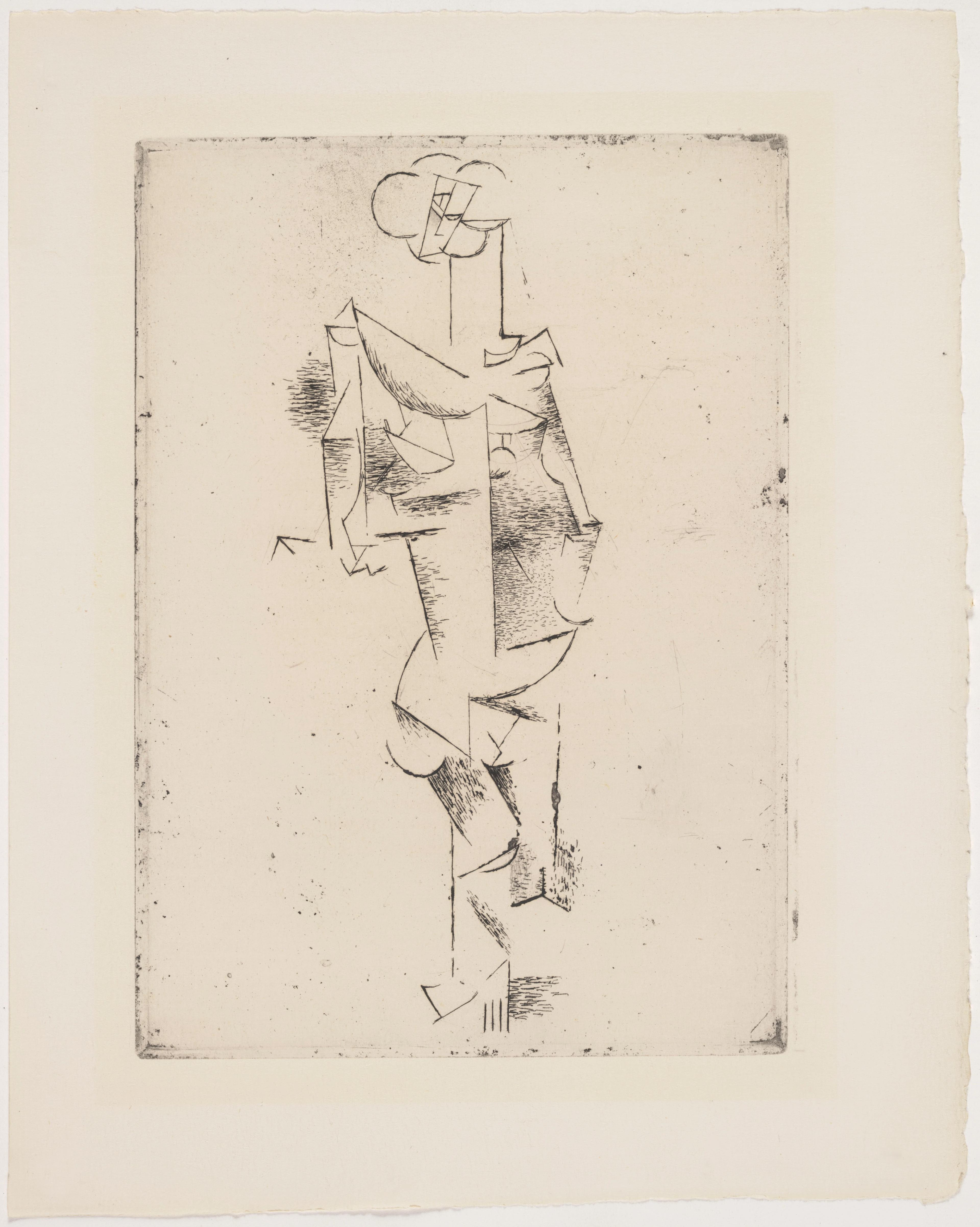
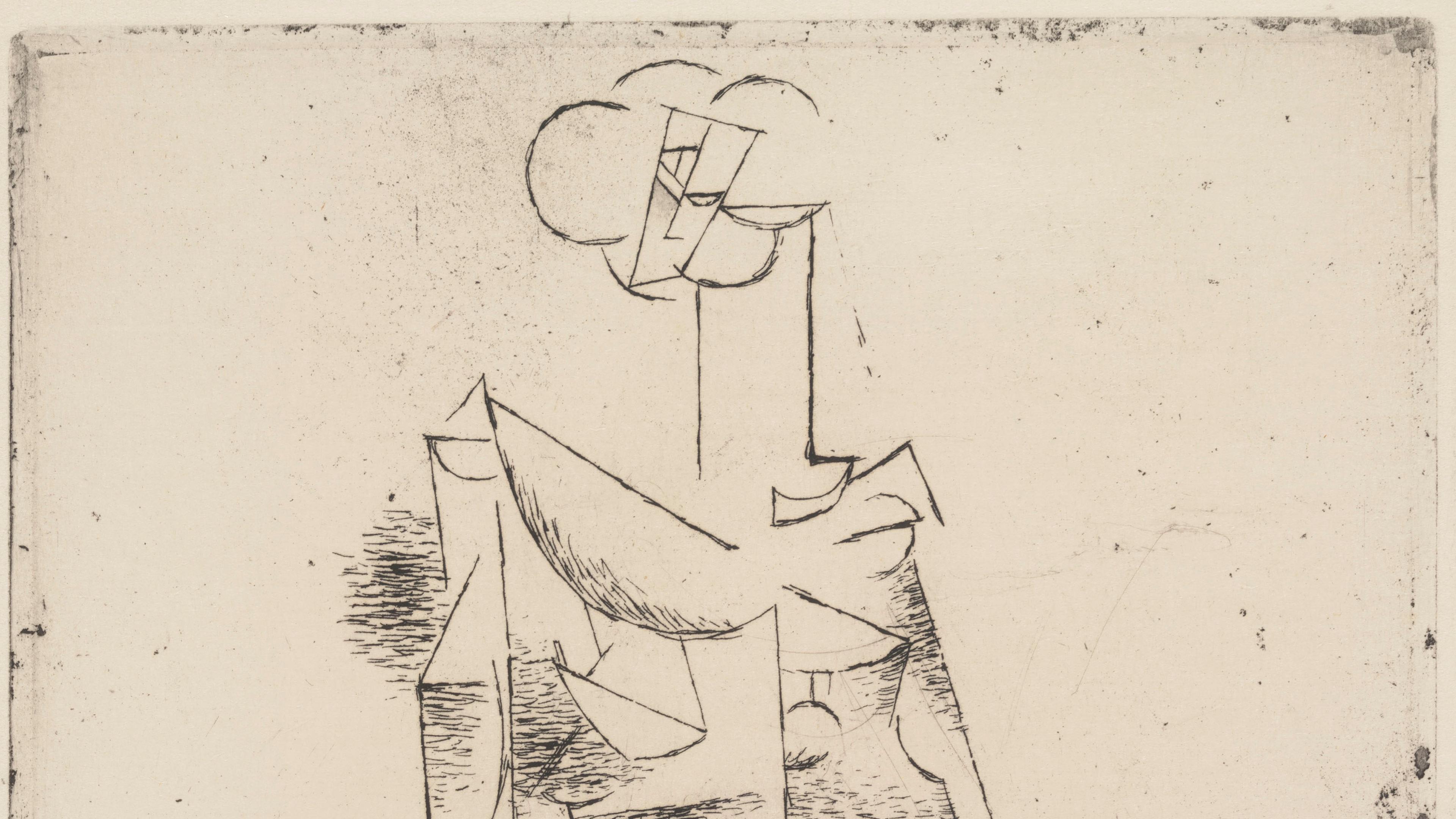
Pablo Picasso (Spanish, 1881–1973). Mademoiselle Léonie from Saint Matorel, 1910. Etching (plate, folio 10) from an illustrated book by Max Jacob (1911) with four etchings, one with drypoint, sheet: 10 1/4 x 8 9/16 in. (26 x 21.7 cm). Publisher: Henry Kahnweiler Editeur, Paris. Museum of Modern Art, New York. The Louis E. Stern Collection (507.1949.1) Digital Image © The Museum of Modern Art/Licensed by SCALA / Art Resource, NY. © 2026 Estate of Pablo Picasso / Artists Rights Society (ARS), New York
Jacob’s Saint Matorel was an important early illustrated book in Kahnweiler’s editorial output, and yet remarkably little has been written about it. Its documented writing conditions—in forty-eight hours, at Kahnweiler’s request, and in a semi-visionary state following Jacob’s own dramatic conversion to Catholicism—mirror Cendrars’s claim that he wrote La Fin du monde in a single night. André Derain, who had recently illustrated Kahnweiler’s debut livre d’artiste, Apollinaire’s L’Enchanteur pourrissant(1909),was originally intended as its illustrator, but he shied away from the ambiguity of its genre, and instead Picasso supplied several plates, which, although not integrated with the text in the way that Léger’s are for La Fin du monde, relate to specific characters or locations. Matorel’s girlfriend Mlle Léonie and the Lazarist monastery in Barcelona, where he resides after becoming a monk, are both depicted and are unsurprising choices for Picasso, who at the time was engaged in the cubist analysis of figures and landscapes; the Barcelona connection surely also appealed to him.
Jacob’s narrative flits constantly between past, present, and future, and an explanation for this is given in the prologue:
It would perhaps have been better to save this prologue for the epilogue. . . . But forms are immobile and mobile eternally in heaven and there is no chronological order for God. Now, we are in our works as Jehovah is in his. There is no chronological order for us. . . . So, prologue.
Thus from the start the reader is constantly reminded of the ending: that Matorel (Frère Manassé) dies. Before this, though, he encounters an angel, who both guides and encourages him in his visions and comically chides him for the way he expresses them; demons who taunt him; and a pantheon of figures from various belief systems, including Mohammed, Osiris, Artémis, Endymion, Buddha, and—gods of a different type—Berlioz and Beethoven. The Lazarist monks, we are told, “did not understand why Diane was followed in her hunt by twenty-eight Pierrots and twenty-two monks.” The miscellaneous circus of characters in this parade, including the angel in a key role, are remarkably similar to the cast that Cendrars would include eight years later. Finally, in “les temps sont venus” (the times have come), the unexpected plural form of the phrase once again throws into relief the issue of multiple chronologies. In Jacob’s Saint Matorel, as in Cendrars’s poems of 1912–14, the atemporality of the narrative is attributable to the fact that God exists outside of time, which in turn is capable of collapsing such that the prologue can bookend the narrative: the final chapter is entitled “La Fin du prologue”—the end of the prologue that seemed so unsure of its place at the start. The presence of Picasso’s illustrations allows for another possibility, which is not mutually exclusive: that the multiple viewpoints of cubist drawing are as analogous to a phenomenological and oscillating experience of time as Léger and Cendrars’s filmic aesthetic.
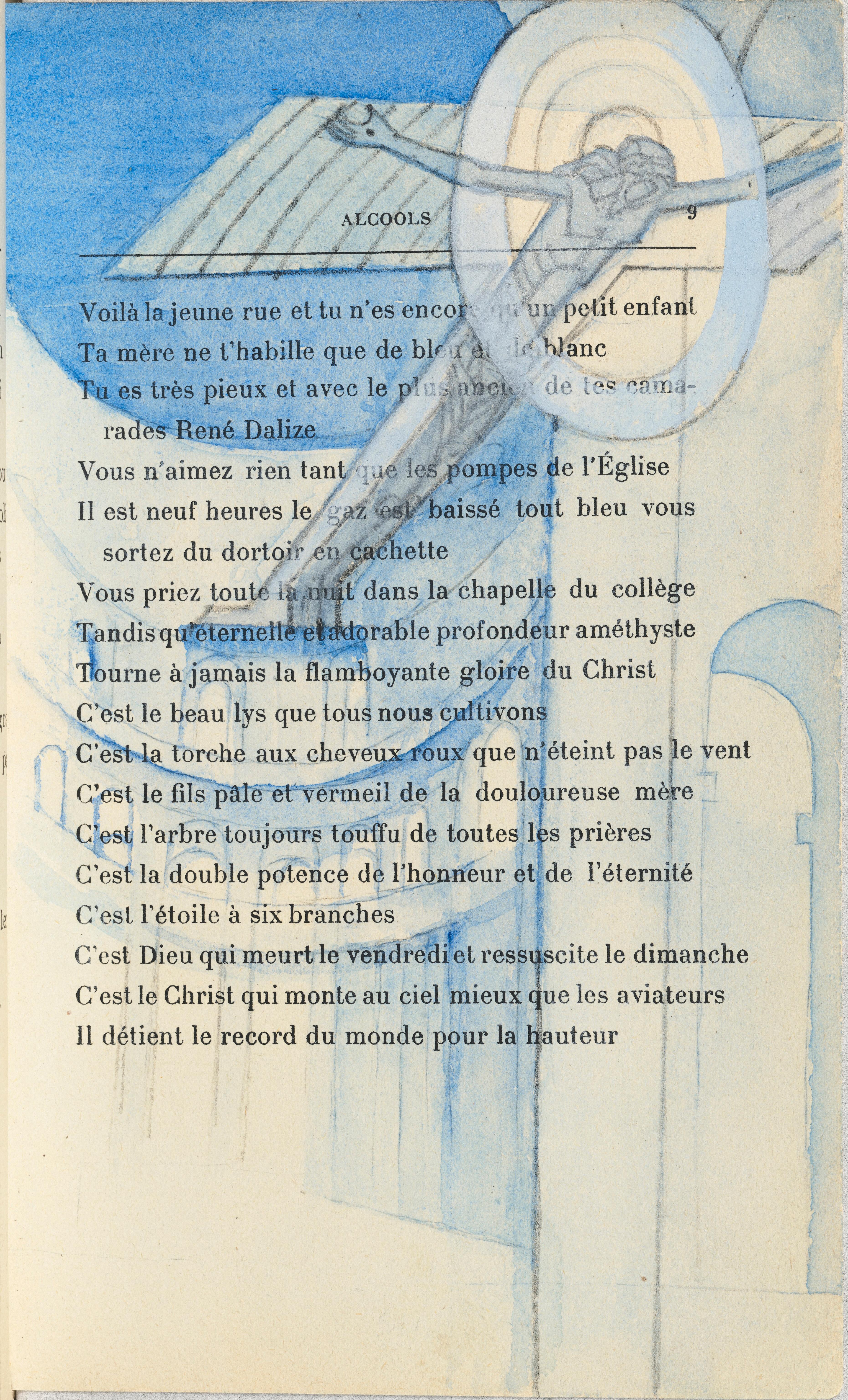
Louis Marcoussis (Warsaw 1883-1941 Cusset), illustration for Guillaume Apollinaire's Zone, published in a unique edition of Alcools. Watercolor. Bibliothèque nationale de France, RES P-YE-1354 (1) © 2026 Artists Rights Society (ARS), New York.
Apollinaire’s “Zone” is far better known than Jacob’s pseudo-autobiographical novel. With its references to the Parisian streets filled with daily workers, newspapers, posters, doorplates that “twitter like parakeets,” and newspapers and dime detective novels as literature, it has become an emblematic poem of modernity. Alongside these images of the ephemera of the modern city, however, the most sustained passages are nods to the eternal and to the spiritual longing of the individual. Marcoussis’s illustrations, by contrast, are very little known, perhaps in part because the Polish-born Marcoussis is not the most celebrated cubist artist, but also because they were never in the end published as part of an edition of Alcools. The unique copy, lovingly embellished with the gouaches and watercolors, is extremely fragile, specifically because of the illustrations. Marcoussis renders several pertinent images from the poem quite literally. In watercolor, over the surface of the relevant text, he gives us in pale blues, soaring above an image of what looks like the Pantheon, “the Christ who takes to the skies better than the aviators” and who “holds the world record for height,” his arms stretched wide to resemble both the crucifix and the wings of an airplane, and his feet forming a tail fin.
![First image is of Louis Marcoussis, illustrations for Guillaume Apollinaire's Zone, Louis Marcoussis, illustrations for Guillaume Apollinaire's Zone, third etching.Louis Marcoussis, illustrations for Guillaume Apollinaire's Zone, second etching, third image is of first etching. Le voyageur : [planche 13]. 15 x 9.5 cm, second image is of](https://cdn.sanity.io/images/cctd4ker/production/cdcf7f61affed8ea730626f001a213b1a37220fc-12882x6100.jpg?w=3840&q=75&fit=max&auto=format)
Left: Louis Marcoussis (Warsaw 1883-1941 Cusset), Le voyageur, illustration for Guillaume Apollinaire's Zone (first etching), 1934. 5 9/10 x 9 1/2 in. (15 x 9.5 cm). Bibliothèque nationale de France, reserve TA-162-4 © 2026 Artists Rights Society (ARS), New York. Center: Louis Marcoussis (Warsaw 1883-1941 Cusset), Poème lu au mariage d'André Salmon, illustration for Guillaume Apollinaire's Zone (second etching), 1934. 5 9/10 x 9 1/2 in. (15 x 9.5 cm). Bibliothèque nationale de France, reserve TA-162-4. © 2026 Artists Rights Society (ARS), New York. Right: Louis Marcoussis (Warsaw 1883-1941 Cusset), Merlin et la vieille femme, illustration for Guillaume Apollinaire's Zone (third etching), 1934. 5 9/10 x 9 1/2 in. (15 x 9.5 cm). Bibliothèque nationale de France, reserve TA-162-4. © 2026 Artists Rights Society (ARS), New York
On the final page of the poem, deep brown paint depicts a wooden cross on which is carved a figure from Oceania or Guinea, the combination effectively creating “a Christ of another form and another belief system.” In the later etchings, Marcoussis offers three separate plates for “Zone.” The first combines the shadow of a cross in the sky above the Sacré Coeur, conflated with the Eiffel Tower, with a pair of praying hands, patterned with the tower’s characteristic criss-cross girders, at bottom right. The second gives us a more fragmented image of various emblems from the text of “Zone,” and some that seem to have crept in from a different poem, “La Santé”: several six-pointed stars, some Hebrew letters, a bird (perhaps the lyre-bird of the poem), and a clock face with its numbers in reverse order, its hands set to twenty-seven minutes past four. While Marcoussis must have etched the clock the right way around on the printing plate to achieve the reverse image, this in fact visualizes the clock in the Jewish quarter that turns backwards in Apollinaire’s text and that causes the poet’s life to feel as though it, too, is moving slowly backward. Once again, the image reinforces the effect of temporal simultaneity that poems like “Zone” create through the evocation of different eras in memory. The clock recalls one of Apollinaire’s most famous calligrams, “La Cravate et la montre,” at the center of which the hands read “Il est moins 5 enfin et tous sera fini” (it is 5 to at last, and all will be finished). Apollinaire’s phrase itself is suggestive of a further Christian reference: the final words of Christ as recorded by the Gospel of John—“It is finished”—spoken, according to the synoptic Gospels, on the cusp of the hour. The jarring exactitude of marked time against the shifting eras of the narrative is also present in La Fin du monde. In chapter 5, with its double-page spread of the city, Léger’s typographic interventions tell us that the yellow circle superimposed over the surface of Notre Dame is at once observation wheel, turning sun, and clock, striking one minute past midday as it does in paragraph 25 of the text. As Christopher Green also notes, the image quite explicitly recalls again the style of Apollinaire’s Calligrammes. In Marcoussis’s third etching for “Zone,” the combined crucifix-fetish that appeared in the watercolors stands as though lurking in the shadows of a dark street, lined with lampposts, that perspectively draw the eye along, perhaps—as per the final stanza of the poem—home, to Auteuil. In all these examples, the sacred seems to lurk in the margins of modernity and the city, not always very subtly, effecting what Willard Bohn describes as a “tug of war with Christianity.” The conflation of the technological and the divine is, on the one hand, parodic and amusing, and, on the other, allows for a deeply significant and sincerely spiritual experience of the modern world that has often been understated.
Binding interpretation
If time is a pervading presence in the content of these works, it is also a factor in the physical object now owned by The Met. With the maquette and a luxury edition of La Fin du monde bound in together, two different moments are represented: one when the book was still provisional, open to change, and the other when it became definitive, at the point of publishing. Two different types of object are also present: the provisional proofs are unique, whereas the definitive version is a multiple. As one of the luxury editions, The Met’s copy is one of only twenty-five, rather than one of the twelve hundred 20-franc editions, and so, with its laid paper and resultant clarity of printing, it sits apart from the type of mass-publication evoked within its own pages and the intended accessibility of the Editions de la Sirène project. It also sits at one remove from the typical format of the French livre d’artiste, usually presented loose-leaf within its cover so that individual plates could be framed, bound, or re-ordered at will by their collector. Even the luxury editions of La Fin du monde were bound when first published, defying this possibility. The unique binding of The Met’s copy adds a further temporal layer, dating as it does from over fifty years after the initial publication: neither Cendrars nor Léger were alive to see it. The exquisite leather cover was sculpted by the binder Georges Leroux and is one of several of the same design, although it seems to be the only one that is in relief rather than flat. It was included in an exhibition of luxury bindings at the Bibliothèque Nationale, Paris, in 1978 along with a number of others by Leroux. He belongs to a moment of revival for twentieth-century livres d’artistes, which were being widely rebound as luxury editions in the 1960s and 70s. As the Bibliothèque Nationale’s curator Georges Le Rider put it, they were considered an important entity in public collections “because the library, whose wealth of old bindings is justly famous, constitutes the national center for research on the history and techniques of original binding and must therefore also have a representative series of contemporary art bindings.”
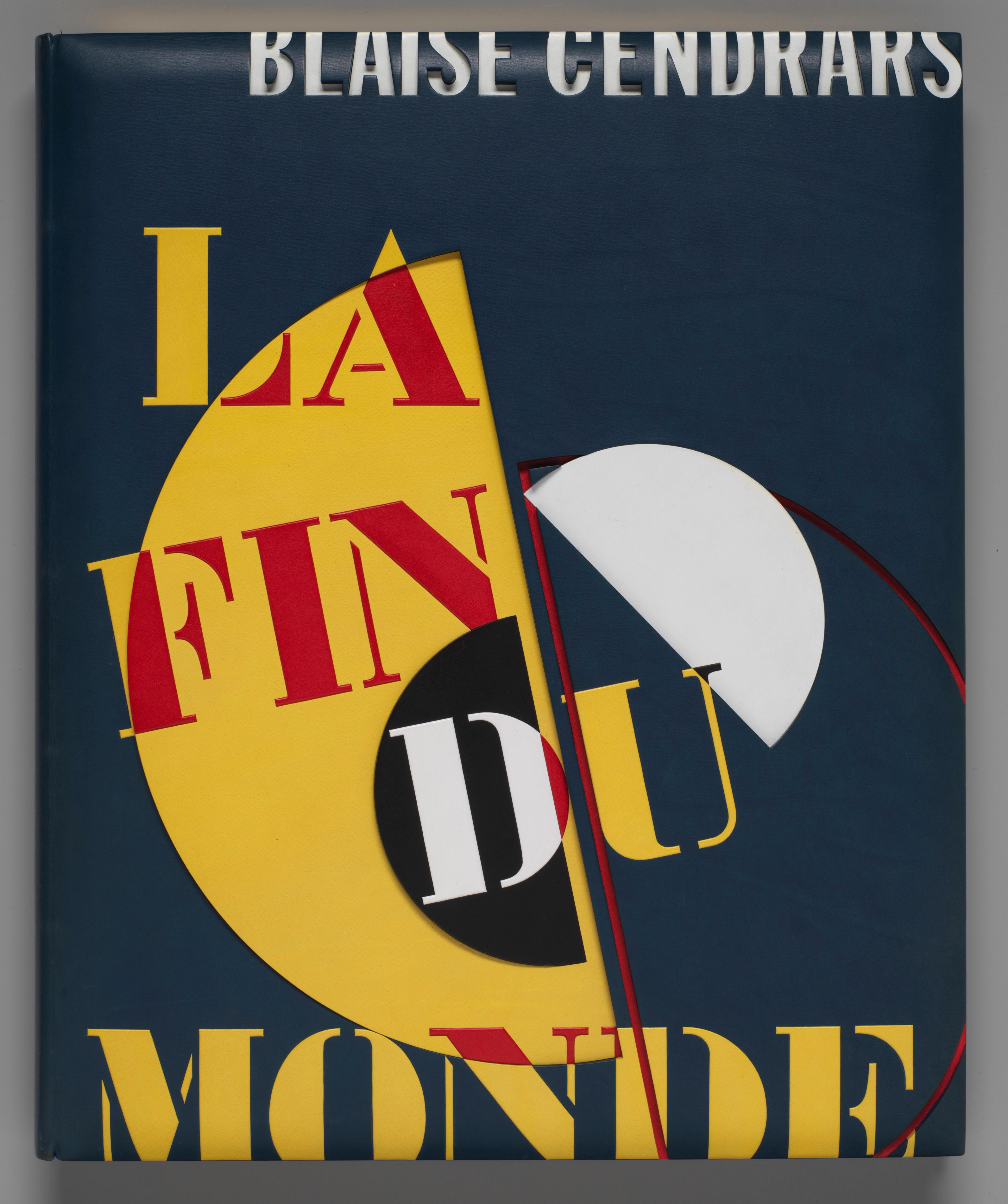
Blaise Cendrars (author) and Fernand Léger (artist). La Fin du monde filmée par l’Ange N.-D., 1919. Illustrated book with twenty-two pochoirs published by Éditions de la Sirène, Paris, and eleven compositions in gouache and pencil, in embossed leather binding, 13 3/8 × 11 1/8 × 1 5/8 in. (34 × 28.3 × 4.1 cm). Collection of the Leonard A. Lauder Cubist Library, Leonard A. Lauder Research Center for Modern Art (PN1997 .F465 1919 LALRC Quarto)
The list of Leroux’s bindings reads like a who’s who of twentieth-century artists’ books: collaborations between René Char and Wifredo Lam; Nicolas de Stael and Kandinsky; Breton, Éluard, and Dali’s L’Imaculée conception; Éluard and Picasso’s Les Yeux fertiles; Max Ernst’s collage novels La Femme 100 têtes and Une semaine de bonté; Duchamp’s Marchand de sel; and Jarry and Miro’s Ubu-Roi to name but a few. In the catalogue accompanying the exhibition at the Bibliothèque Nationale, the binder Jacques Guignard is quoted as saying that when a work is bound by an art binder, it is “conceived in perfect harmony with the text of the poet or novelist, as with the style of the painter or engraver whose plates accompany the text, or even with that of the typographer.” It is conceived, in other words, both as an artwork and as another layer of interpretation, akin to and building on the existing illustrations. Leroux’s binding for La Fin du monde displays a stylistic and compositional affinity with Léger’s geometric forms and also the chosen typeface, although it is notable that on other occasions his approach is more concerned with subject matter. For example, his design for a 1968 Anglo-American edition of Apollinaire’s roman-à-clef Le Poète assassiné (1916), with photographic illustrations by Jim Dine, is bright pink with a square disc on the front, the book title stenciled in circular form around a central pivot that rotates like a camera lens to reveal, beneath it, a Warholesque series of repeated photographic images of a woman, eyes raised. Leroux’s binding for Saint Matorel is notably also included in the Bibliothèque Nationale catalogue, described as having a mosaic-like oval design in smoke gray, constituting a “cubist relief.”
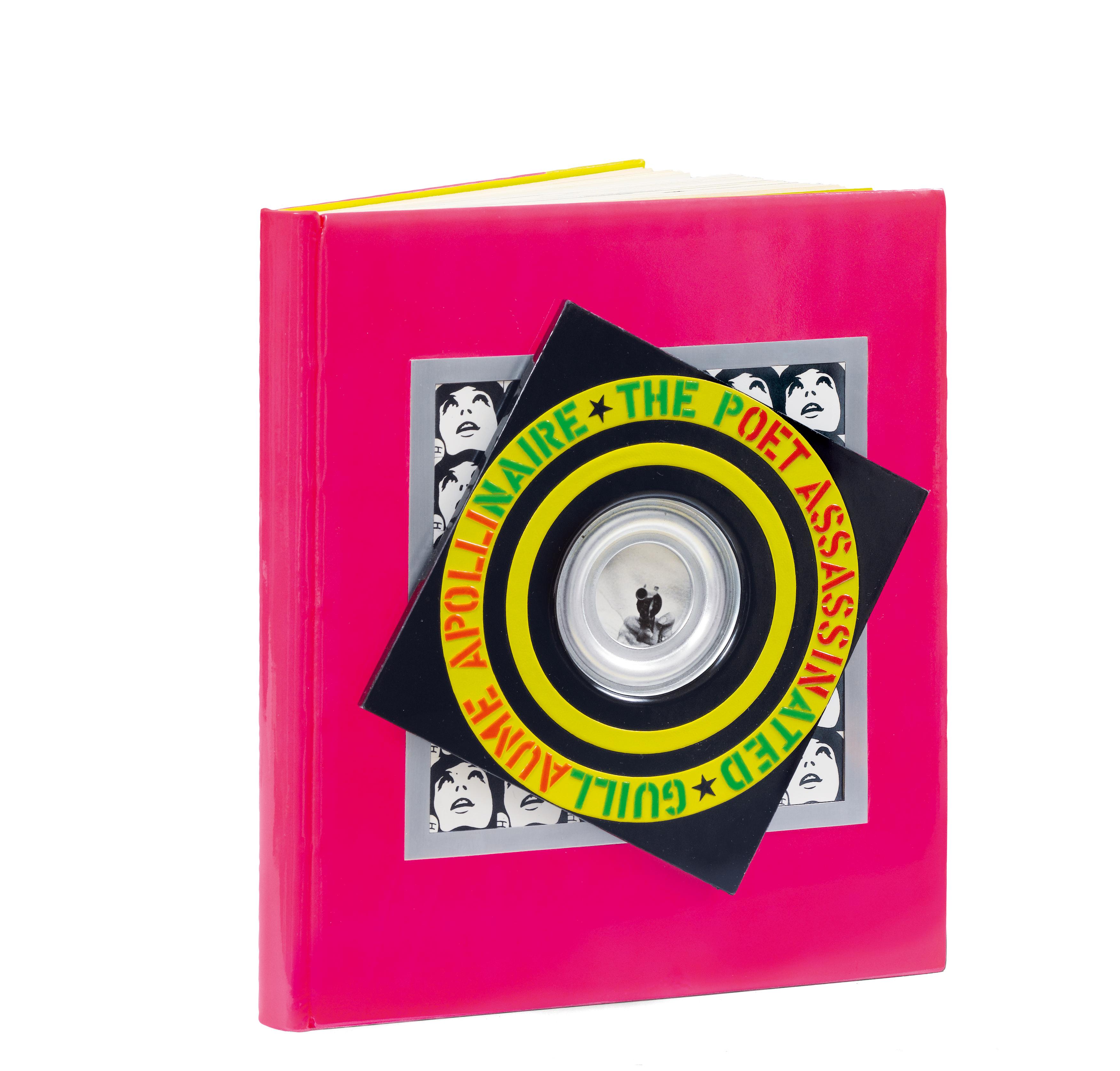
Jim Dine (American, b. 1935), design for Guillaume Apollinaire's Le Poète assassiné (1916), Tanglewood Press, 1968. Photo © 2018 Sotheby’s, Inc. © 2026 Jim Dine / Artists Rights Society (ARS), New York
When texts are revisited at a later date through illustration (as Alcools was by Marcoussis), reedition (as was often the practice of Éditions de la Sirène), or rebinding (as by Leroux), a book that once existed as a multiple is recreated as a unique object. While the motivation may be to create something collectible and therefore valuable, the process has wider connotations. Binding is usually the final stage in the process of publication: the point at which the book-as-published can no longer be changed or corrected. A luxuriously bound edition, then, might seem on the surface to be all the more authoritative, fixing the pages in a cover that is at once functionally protective, attractive, and created for posterity. But at the center of The Met’s edition of La Fin du monde is a stark reminder of what has had to take place for such a luxury edition to be created: the original yellowed spine of the 1919 La Sirène edition has been cut off and pasted onto the edge of the final page of the maquette, ahead of the luxury edition of the book. Its slim fragility is a reminder of what the book once was before it was undone and broken in order to be remade; its original appearance, thickness, and weight are lost, and it is reinvented in a new context and guise.
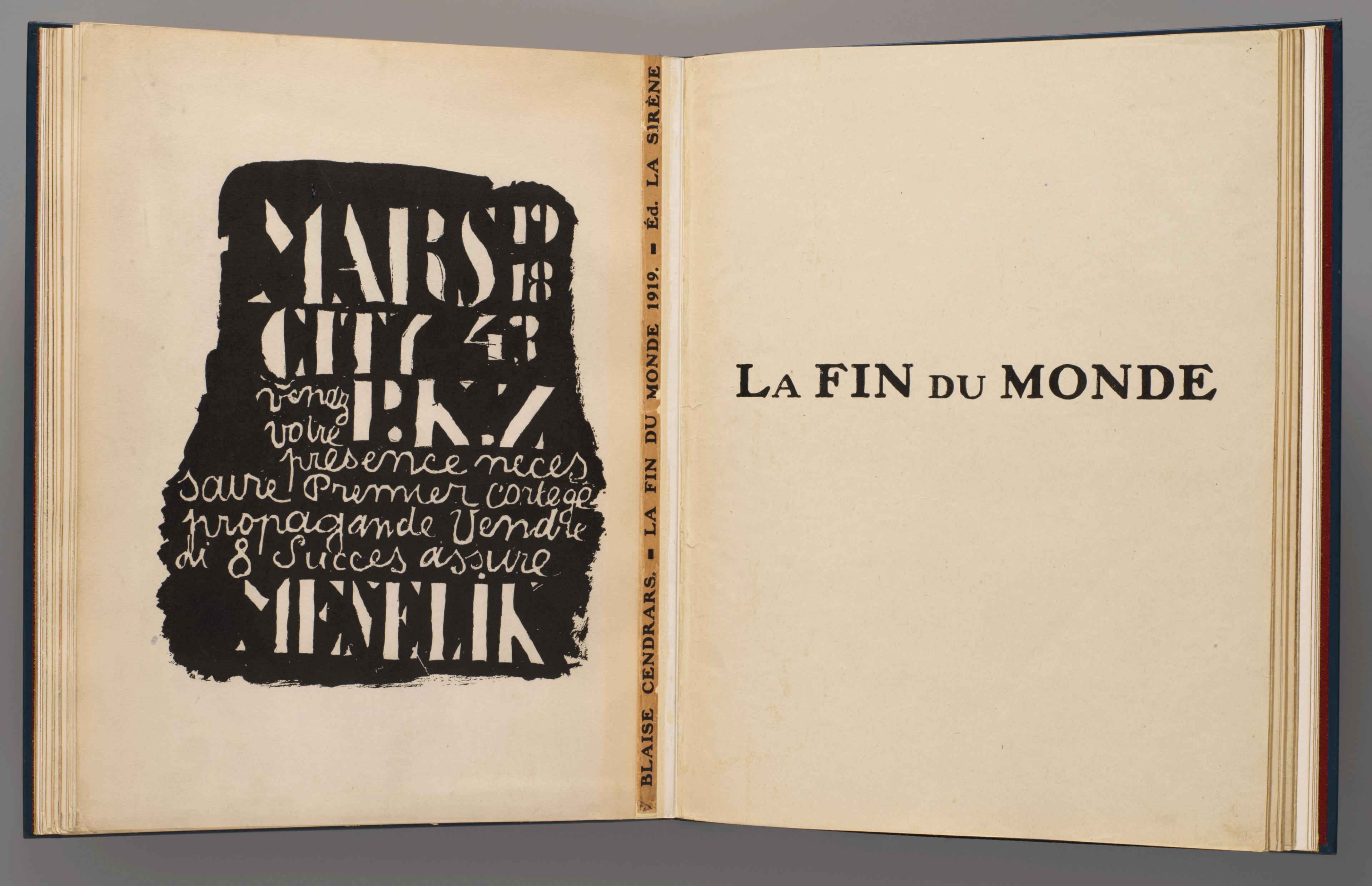
Blaise Cendrars (author) and Fernand Léger (artist). La Fin du monde filmée par l’Ange N.-D., 1919. Illustrated book with twenty-two pochoirs published by Éditions de la Sirène, Paris, and eleven compositions in gouache and pencil, in embossed leather binding, 13 3/8 × 11 1/8 × 1 5/8 in. (34 × 28.3 × 4.1 cm). Collection of the Leonard A. Lauder Cubist Library, Leonard A. Lauder Research Center for Modern Art (PN1997 .F465 1919 LALRC Quarto)
Etcetera
Writing in December 2024 about a book so closely tied to Notre-Dame, as Paris prepares for the reopening of the cathedral following the devastating fire of April 2019, adds a further dimension to this reflection. This is not the first time the cathedral has sustained fire damage, and an earlier publication than Cendrars and Léger’s was instrumental in its restoration by Eugène Viollet-le-Duc between 1845 and 1865: Victor Hugo’s Notre-Dame de Paris of 1831 not only acted as a piece of propaganda aimed at claiming the building as worthy of being saved but also supplied descriptions that would influence Viollet-le-Duc’s plans. The monument is tied not only to the written word and its authority, but also to the process of rebuilding lives and the city that would have been so prevalent in the minds of Léger, Cendrars, and the editors in 1919. The back cover of La Fin du monde, purportedly signed by the messenger Ménélik, claims this book too as a piece of propaganda in which the reader’s participation is “necessary.” Its republication in digital format by the Leonard A. Lauder Research Center for Modern Art is, as Derrida would have us remember, yet another layer in its interpretation, inviting the participation of a new generation of readers from one screen and context to another.
Notes
For an introduction to the genre of the livre d’artiste, see Stephen Bury, “The Livre d’artiste and the Artist’s Book,” in Breaking the Rules: The Printed Face of the European Avant-Garde 1900–1937 (London: British Library, 2007), 26–37.
In total, 25 numbered deluxe copies and 1200 of the cheaper editions were published.
Eric Robertson presents La Fin du monde in the context of Cendrars and cinematic writing, commenting only briefly on the “trope of original creation” as a recurring theme in Cendrars’s work. Eric Robertson, Blaise Cendrars: The Invention of Life (London: Reaktion, 2022), 102–08.
New and established writers would sometimes be paired with each other, for example an early publication by the Swiss writer Conrad Moricand, Les Interprètes: essai de classement psychologique d’après les corréspondances planétaires, with a preface by Max Jacob (1917). Jacob’s Cinématoma (1920) and Guillaume Apollinaire’s Le Flâneur des deux rives (1918) are also of note.
The archives of Editions de la Sirène are held by the Institut Mémoires de l’Edition Contemporaine (IMEC). For summary information, see “La collection de l’IMEC: La Sirène,” IMEC, https://imec-archives.com/archives/fonds/002SRN.
See Bury, “Livre d’artiste,” 26.
David Rosand, Drawing Acts: Studies in Graphic Expression and Representation (Cambridge: Cambridge University Press, 2002), 13–17.
See Christopher Green, “La Fin du monde in Context.”
For a discussion of this convention see, for example, W. J. T. Mitchell, “Word and Image,” in Critical Terms for Art History, ed. Robert Nelson and Richard Shiff (Chicago: University of Chicago Press, 2003), 51–61; and Jean Khalfa, “Introduction: Art Speaking Volumes,” in The Dialogue Between Painting and Poetry: Livres d’Artistes, 1874–1999 (Cambridge: Black Apollo Press, 2001), 11–35.
Marien Maken, Binding Space: The Book as Spatial Practice (New York: Routledge, 2018), 33.
Derrida, “Paper or Me, You Know,” in Paper Machine (2001), trans. Rachel Bowlby (California: Stanford University Press, 2005), 41–65.
Derrida, “Paper or Me,” 44.
Polizzotti, La Fin du monde, paragraph 54.
See Daniel Whistler, “The Logic of Secular Sense in Cendrars’ Epic Trilogy,” Literature and Theology 36, no. 1 (March 2022), 18–41.
This is the term used in Islam to designate believers of monotheistic religions that hold to a God who reveals himself through sacred writings and who therefore have something in common with Islam, as opposed to nonbelievers. The phrase is taken from the Qur’an: “O People of the Book! You have nothing to stand on unless you observe the Torah, the Gospel, and what has been revealed to you from your Lord.” Al-Ma-idah 5:68.
“So I went to the angel and asked him to give me the little scroll. He said to me, ‘Take it and eat it. It will turn your stomach sour, but in your mouth it will be as sweet as honey.’” Revelation 10:9.
Jean Khalfa, “Art Speaking Volumes,” 11–15.
“In the beginning was the Word, and the Word was with God, and the Word was God. He was with God in the beginning.” John 1:1–2.
See, for example, Thomas Crow, No Idols: The Missing Theology of Art (Sydney: Power Publications, 2017); Jonathan Anderson and William Dyrness, Modern Art and the Life of a Culture: The Religious Impulses of Modernism (Downer’s Grove, Ill.: InterVarsity Press, 2016); or Ben Quash and Chloë Reddaway, eds., Theology, Modernity and the Visual Arts (Turnhout: Brepols, 2024).
The unique edition of Alcools decorated with Marcoussis’s extensive watercolors is held in the Bibliothèque Nationale, Paris (RES P-YE-1354 (1)), as is a full set of the etchings (RES FOL-NFV-21). Several of the etchings are also in the collections of The Met (1981.1227.1–4). Both sets of images were published in facsimile in 2018 along with a brief study by Jean-Marc Chatelain. Guillaume Apollinaire, Alcools: Illustrations de Louis Marcoussis (Paris: Gallimard/Bibliothèque Nationale de France, 2018).
For basic information, see “Lot Essay,” Nourishment for the Soul: The Herrmann Collection of Prints by Pablo Picasso, sale cat., Christie’s, New York, September 18, 2020, lot 7, https://onlineonly.christies.com/s/nourishment-soul-herrmann-collection-prints-pablo-picasso/pablo-picasso-1881-1973-7/97902
“Il aurait du peut-être réserver ce prologue pour l’épilogue. . . . Mais les formes sont immobiles et mobiles éternellement dans le ciel et il n’y a pas d’ordre chronologique pour Dieu. Or, nous sommes dans nos oeuvres comme Jéhovah dans le siennes. Il n’y a pas d’ordre chronologique pour nous . . . Donc, prologue” (my translation). Max Jacob, Saint Matorel (1911; Paris: Gallimard, 1936), 10.
“Les deux moines ne compirment pas pourquoi Diane est suivi sans ses chasses par vingt-huit pierrots et vingt-deux moines” (my translation). Jacob, Saint Matorel, 93.
For a comprehensive commentary, including on the topic of Christianity in “Zone,” see Willard Bohn, Reading Apollinaire’s Alcools (Delaware: University of Delaware Press, 2026), 187-216.
“Le Christ qui monte au ciel mieux que les aviateurs / détient le record du monde pour la hauteur” (my translation). Apollinaire, Alcools, 9. Willard Bohn discusses the image of Christ as aviator and the various interpretations of other critics at some length in Bohn, Reading Apollinaire’s Alcools, 192–98.
“Christe d’une autre forme et d’une autre croyance” (my translation). Apollinaire, Alcools, 17.
“La Santé,” illustrated by Marcoussis in its own right with an image that quotes directly from this one, recalls Apollinaire’s experience of being incarcerated briefly in the La Santé prison.
Apollinaire, “La Cravate et la montre,” Calligrammes (1918; Paris: Gallimard, 2004), 53.
John 19:30. For the time (three o’clock in the afternoon, or “the ninth hour”), see Matthew 27:45–46,Mark 15:33–34, and Luke 23:44–46.
Green draws a comparison between Léger’s image and Apollinaire’s Horloge de demain; See Christopher Green, “La Fin du monde in Context.”
Bohn, Reading Apollinaire’s Alcools, 209.
For information on the other copies with bindings by Leroux, see Bibliothèque Paul Destribats–1ère partie, sale cat., Christie’s, Paris, July 5, 2019, lot 47, https://www.christies.com/en/lot/lot-6215570. Christie’s dates the binding to 1975.
The Bibliothèque Nationale exhibition catalogue includes The Met's copy of La Fin du monde as cat. 58 and dates the binding to 1976. See: Reliures: Monique Mathieu, Georges Leroux, Jean de Gonet, exh. cat. (Paris: Bibliothèque Nationale, 1978), 40.
Georges Le Rider, “Introduction,” Reliures, 5.
“Conçu en parfaite harmonie avec le texte du poète ou du romancier, comme avec le style du peintre ou du graveur dont les planches accompagne le texte, voire avec celui du typographe” (translation mine). Quoted in Reliures, 5.
This is included in Reliures, cat. 54, 39. For my interpretation of Dine’s illustrations, see Caroline Levitt, “Raoul Dufy, Pierre Alechinsky and Jim Dine: Depicting the Arts in Guillaume Apollinaire’s ‘Le Poète assassiné,’” in “Art in French Fiction since 1900,” special issue, Nottingham French Studies 51, no. 3 (December 2012), 232–47.
Reliures, cat. 79, 46.
The history of the cathedral’s earlier restoration was notably told through an exhibition in its crypt during its closure: Notre-Dame de Paris: From Victor Hugo to Eugène Viollet-le-Duc, September 2020 to September 2022.
As have other commentators before him, Christopher Green notes the link between the book and Cendrar’s rebirth as a left-handed poet following the amputation of his right arm. See Christopher Green, “La Fin du monde in Context.”