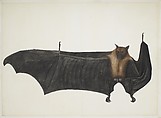
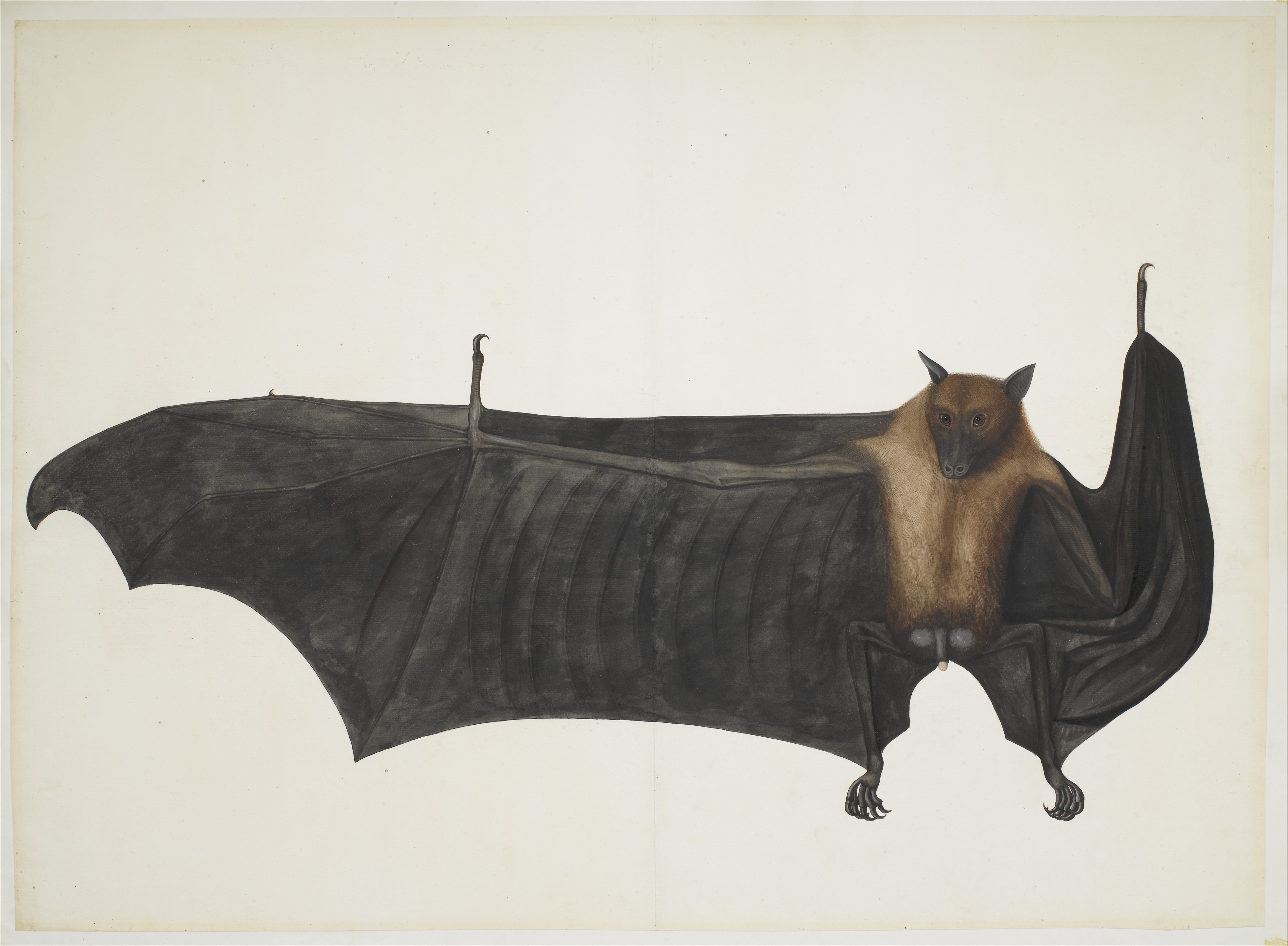
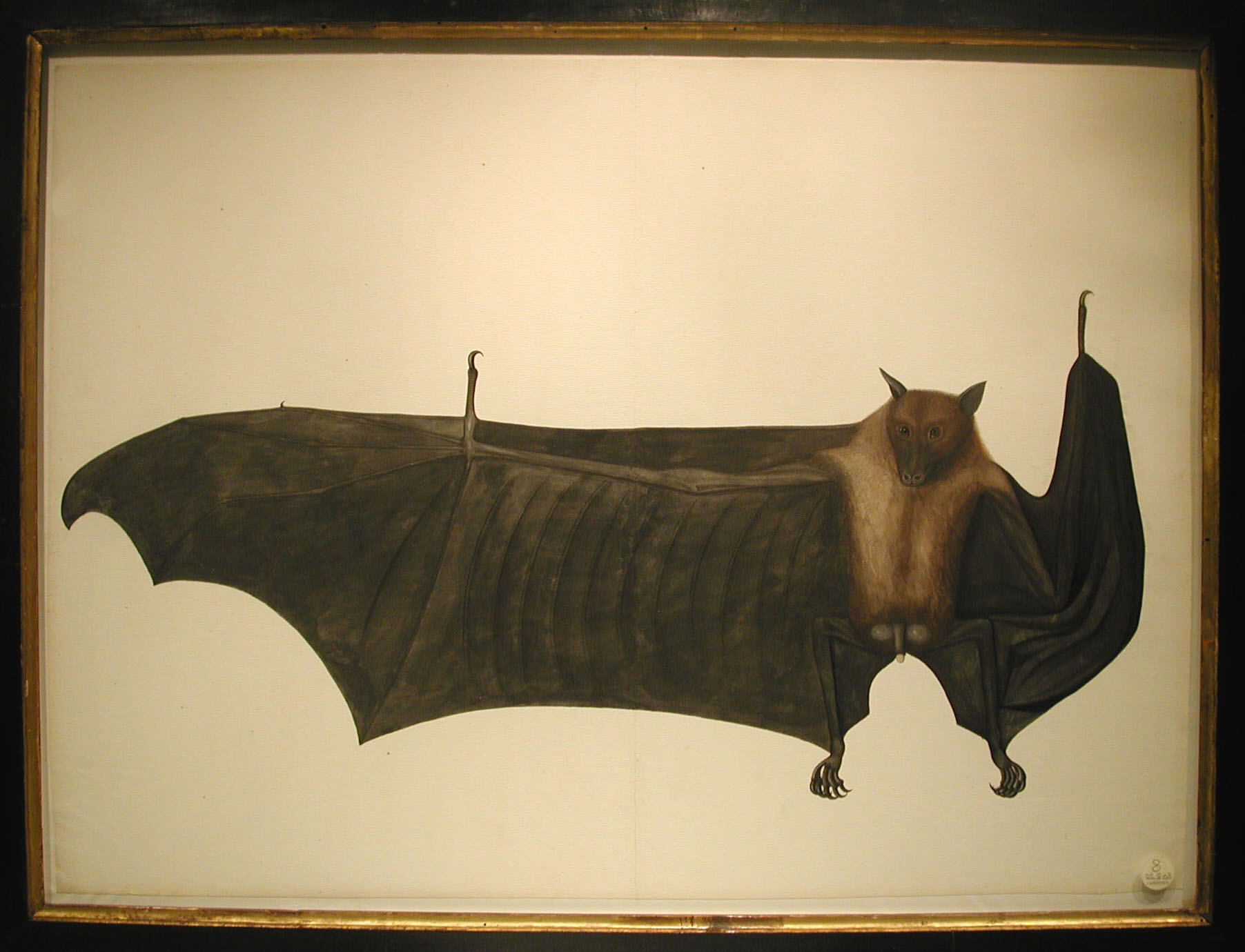
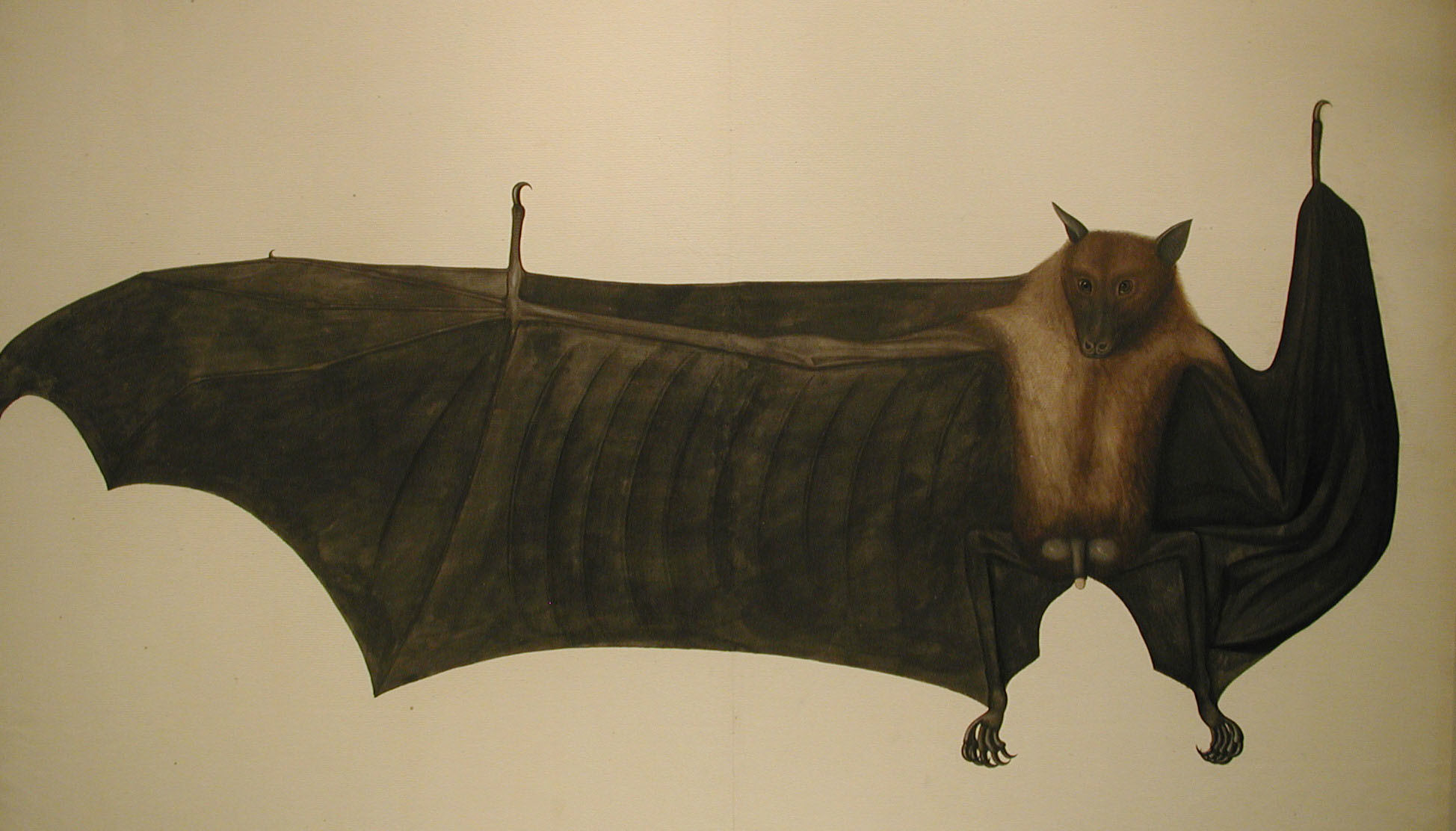
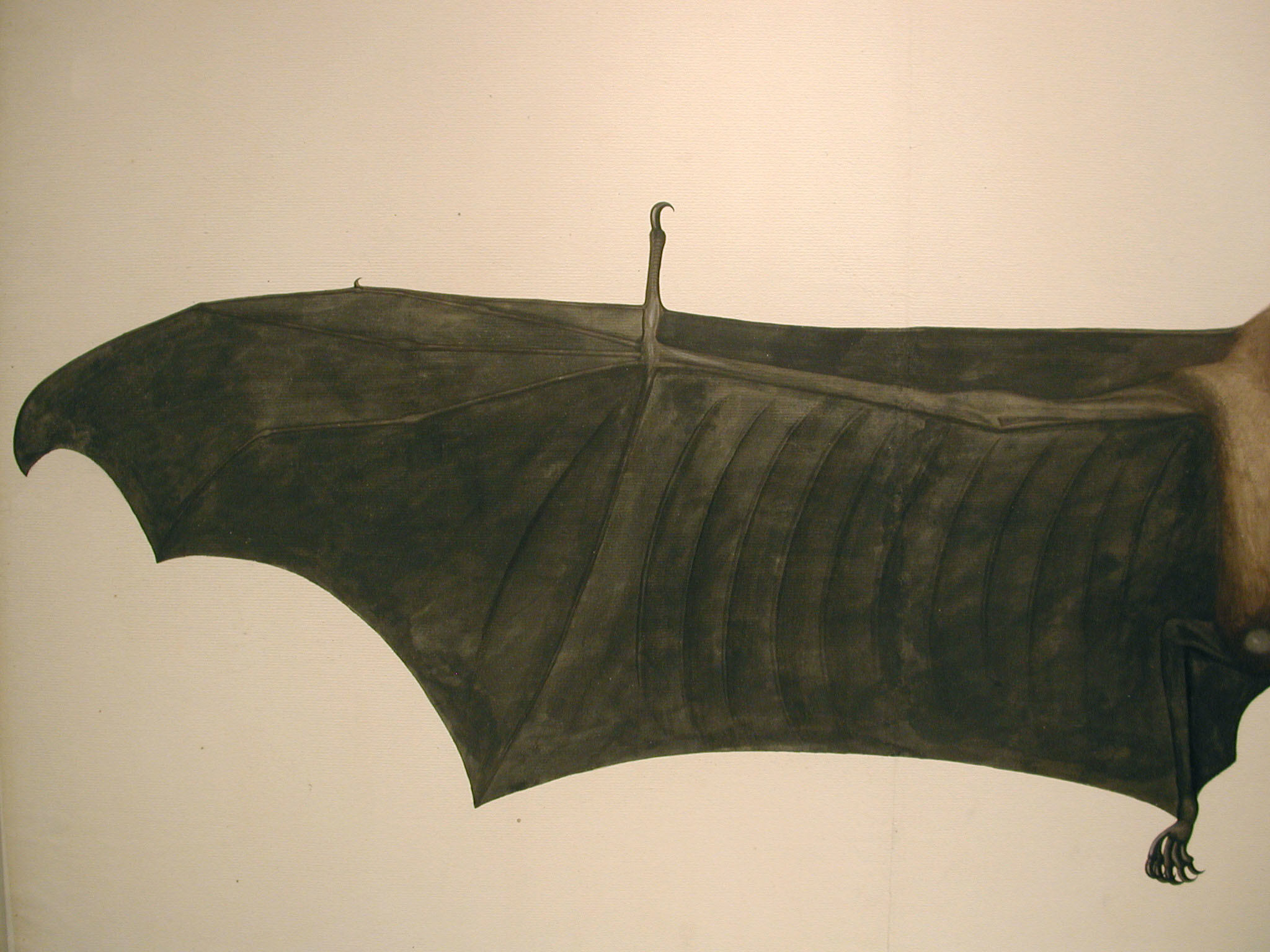
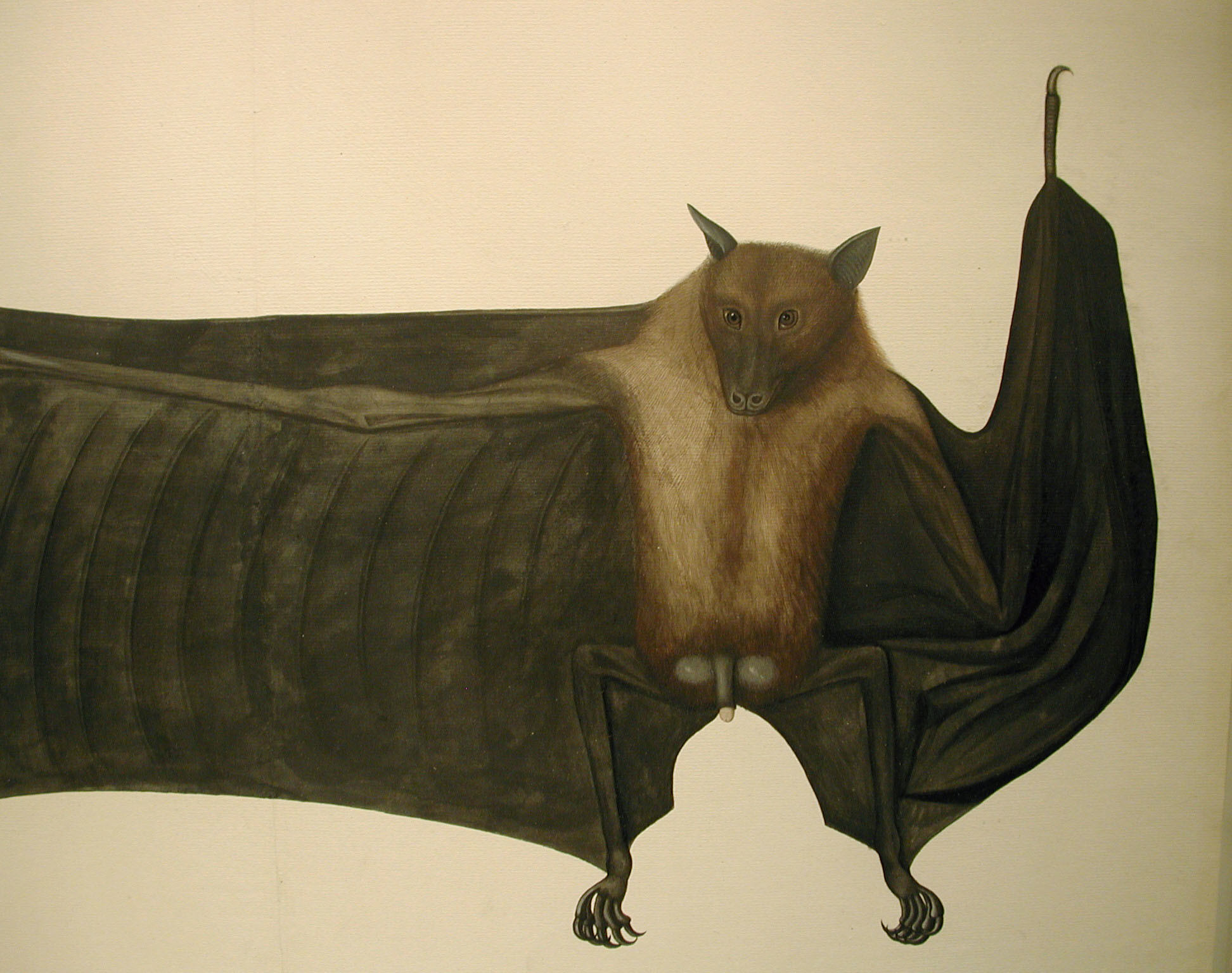
This dramatic image is of the great Indian fruit bat (Pteropus giganteus) frontally displayed with one wing out-stretched. The body is shown in considerable detail, with the bat’s fur, eyes, curling claws, and wing veins naturalistically articulated. This work is closely related to another image of a bat painted by the well-known artist Bhawani Das, who was trained in Mughal miniature painting and commissioned by Sir Elijah Impey, Chief Justice of Bengal (1774–1782), and his wife, Lady Mary, to make extensive natural history studies at their estate in Calcutta. It was perhaps made by a follower of Bhawani Das who worked in a slightly more naturalistic mode.
This artwork is meant to be viewed from right to left. Scroll left to view more.
Artwork Details
Use your arrow keys to navigate the tabs below, and your tab key to choose an item
Title:Great Indian Fruit Bat
Artist:Painting attributed to Bhawani Das (Indian) or a follower
Date:ca. 1777–82
Geography:Made in India, Calcutta
Medium:Pencil, ink, and opaque watercolor on paper
Dimensions:Painting: H. 23 1/2 in. (59.7 cm) W. 32 3/4 in. (83.2 cm) Mat size: H. 27 1/4 in. (69.2 cm) W. 35 1/2 in. (90.2 cm)
Classification:Paintings
Credit Line:Purchase, Anonymous Gift, Cynthia Hazen Polsky Gift, Virginia G. LeCount Bequest, in memory of The LeCount Family, 2007 Benefit Fund, Louis V. Bell, Harris Brisbane Dick, Fletcher, and Rogers Funds and Joseph Pulitzer Bequest, and Gift of Dr. Mortimer D. Sackler, Theresa Sackler and Family, 2008
Object Number:2008.312
Fruit Bat
With its stark composition and subtle coloring, this striking painting transcends its original purpose as a scientific record to become a work of art in its own right. Its subject is the great Indian fruit bat ( Pteropus giganteus), shown frontally with one wing outstretched and the other folded. The body is depicted in considerable detail, with the fur, claws, veins, and sexual organs articulated in shades of brown and gray. Although the artist is unknown, he is believed to have been among the circle of painters who worked for Sir Elijah Impey, chief justice of Bengal from 1774 to 1782, and his wife, Lady Mary. In 1777 the Impeys hired painters to record specimens of flora and fauna that they collected at their Calcutta estate, and, over the next five years 326 paintings of various plants, animals, and birds were made for them.[1] The works tend to show their subjects as fully as possible and with an abundance of detail, against a blank background.
Three of the artists who worked for the Impeys are known: Bhawani Das, Shaikh Zain al-Din, and Ram Das. Their names appear directly on their paintings, alongside the identification of the subject. This painting has not been thus inscribed, but it is closely related to another painting of a bat by Bhawani Das,[2] and it has always been associated with Impey patronage. One can imagine Bhawani Das and the anonymous artist of this painting working side by side, observing the animals, but whereas Bhawani Das’s work depicts a tawny-colored female bat centered on the page, with both wings outstretched, his fellow artist has created an asymmetrical composition of an emphatically male bat in shades of gray and black, one wing dramatically unfurled.
Marika Sardar in [Ekhtiar, Soucek, Canby, and Haidar 2011]
Footnotes:
1. Archer, Mildred. Company Paintings: Indian Paintings of the British Period. Victoria and Albert Museum, Indian Art Series. London, 1992, p. 97. The Impeys’ collection was dispersed at an auction in 1810.
2. Indian Painting for the British, 1780–1889. Exhibition Walpole Gallery, London. Catalogue by Niall Hobhouse. London, 2001, no. 1; sale, Christie’s London, May 22, 2008, lot 7.
Niall Hobhouse (British), London (by 2001–8; cat., 2001, no. 2); Niall Hobhouse sale, Christie's, London, May 22, 2008, no. 8 (to MMA)
London. Wallace Collection. "Forgotten Masterpieces of Indian Painting for the East India Company," December 4, 2019–September 30, 2020, no. 32.
Dalrymple, William, ed. "Indian Painting for the East India Company." In Forgotten Masters. London: Philip Wilson Publishers, 2019. no. 32, pp. 68–69, ill. (color).
"Thursday, March 22, 2008." In The Niall Hobhouse Collection. London: Christie's, London, 2008. no. 8.
"A Selection: 2008–2010." Recent Acquisitions vol. 68, no. 2 (Fall 2010). p. 44.
Ekhtiar, Maryam, Priscilla P. Soucek, Sheila R. Canby, and Navina Haidar, ed. Masterpieces from the Department of Islamic Art in The Metropolitan Museum of Art. 1st ed. New York: The Metropolitan Museum of Art, 2011. no. 285, pp. 342, 400–1, ill. p. 400 (color).
The Met's Libraries and Research Centers provide unparalleled resources for research and welcome an international community of students and scholars.
The Met Collection API is where all makers, creators, researchers, and dreamers can connect to the most up-to-date data and public domain images for The Met collection. Open Access data and public domain images are available for unrestricted commercial and noncommercial use without permission or fee.
Feedback
We continue to research and examine historical and cultural context for objects in The Met collection. If you have comments or questions about this object record, please complete and submit this form. The Museum looks forward to receiving your comments.
The Met's collection of Islamic art is one of the most comprehensive in the world and ranges in date from the seventh to the twenty-first century. Its more than 15,000 objects reflect the great diversity and range of the cultural traditions from Spain to Indonesia.