Pantaloon
Footnotes
(For key to shortened references see bibliography in Munger, European Porcelain in the Metropolitan Museum of Art. NY: The Metropolitan Museum of Art, 2018)
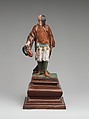
[12] At least two red-earthenware figures, one of which depicts Harlequin, were made in Delft in the years around 1700, and interestingly an example of Harlequin appears in a 1721 inventory of Augustus the Strong’s Japanese Palace, where his ceramic collec-tion was displayed; Chilton 2001, p. 322, no. 139. It has been suggested that this figure may have inspired the modelers at Meissen to make the red-stoneware commedia dell’arte figures; Chilton 1998.
Artwork Details
- Title: Pantaloon
- Manufactory: Meissen Manufactory (German, 1710–present)
- Factory director: Böttger Period (1713–1720)
- Modeler: Paul Heermann (ca. 1673–1732)
- Date: ca. 1710–13
- Culture: German, Meissen
- Medium: Red stoneware, partially polished
- Dimensions: Height: 8 1/8 in. (20.6 cm)
- Classification: Ceramics-Pottery
- Credit Line: Gift of Irwin Untermyer, 1964
- Object Number: 64.101.86
- Curatorial Department: European Sculpture and Decorative Arts
More Artwork
Related Content
 Free to download
Research Resources
The Met provides unparalleled resources for research and welcomes an international community of students and scholars. The Met's Open Access API is where creators and researchers can connect to the The Met collection. Open Access data and public domain images are available for unrestricted commercial and noncommercial use without permission or fee.
To request images under copyright and other restrictions, please use this Image Request form.
Feedback
We continue to research and examine historical and cultural context for objects in The Met collection. If you have comments or questions about this object record, please contact us using the form below. The Museum looks forward to receiving your comments.
Content Notice
The Metropolitan Museum of Art presents over 5,000 years of art from around the world, and our online collection reflects ongoing work conducted over the course of our more than 150-year history. You may encounter objects or images that may be inappropriate for some viewers or information that may be outdated.