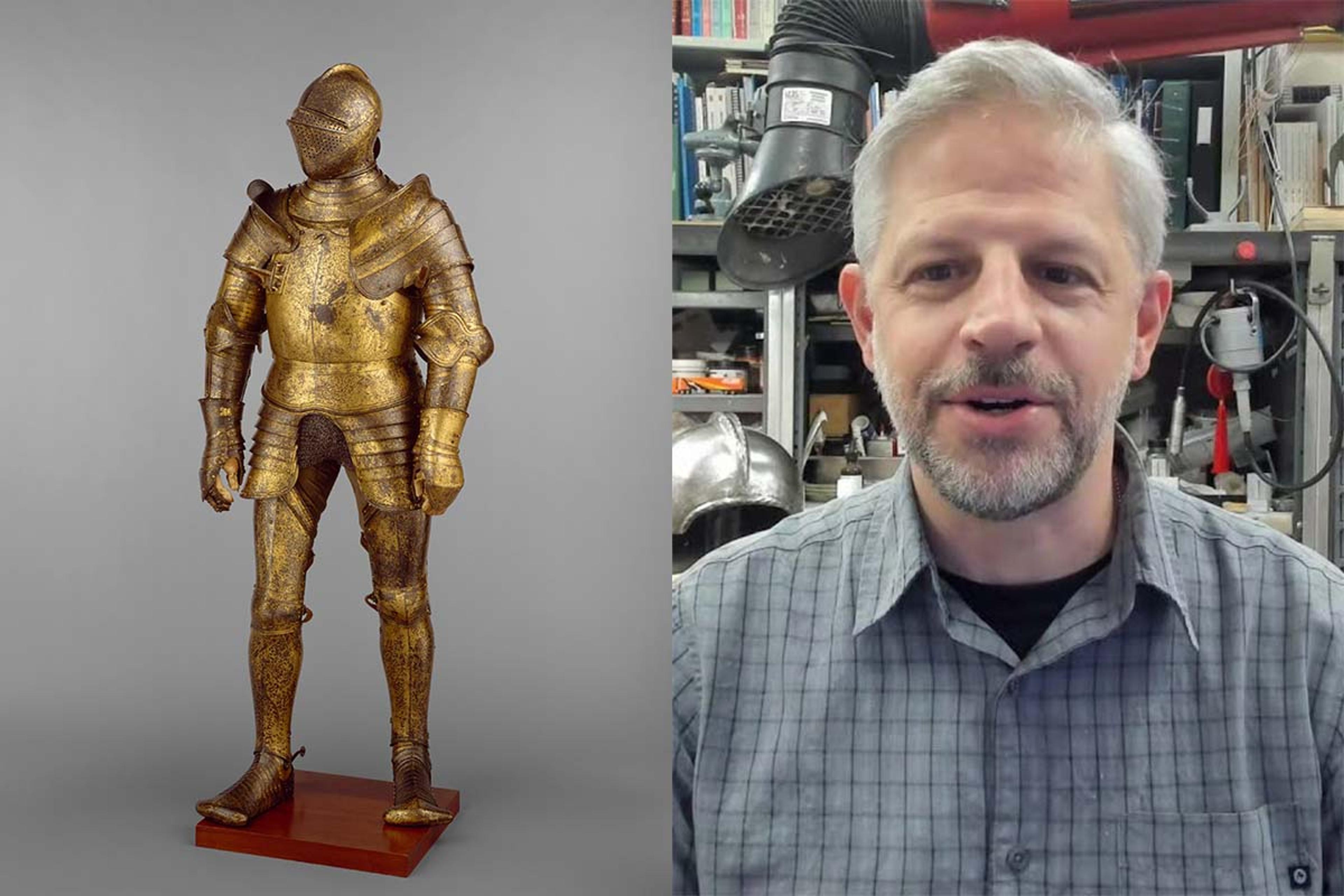
Armor Garniture, Probably of King Henry VIII of England (reigned 1509–47)
The surviving exchange elements of this armor are a reinforcing breastplate with lance rest for use in the field or in the mounted tournament with lances; a left-hand gauntlet reinforce, or manifer, also used in the tournament with lances; and a right-hand locking gauntlet for the mounted tournament with swords.
A highly unusual and innovative feature is the ventral plate, which was worn strapped to the chest beneath the breastplate in order to lessen the weight supported from the shoulders. A ventral plate is found on only one other armor, made in Greenwich in 1540 for Henry VIII.
This armor is believed to have been made for Henry VIII and presented by him to the French ambassador François de La Tour d’Auvergne, viscount of Turenne, who led a diplomatic mission to London in 1527. After the viscount’s death in 1532, the armor presumably passed to his friend Galiot de Genouilhac, grand master of artillery and grand écuyer (master of the horse) of France, from whose descendants it came to The Metropolitan Museum of Art.
Artwork Details
- Title: Armor Garniture, Probably of King Henry VIII of England (reigned 1509–47)
- Armorer: Made in the Royal Workshops at Greenwich (British, Greenwich, 1511–1640s)
- Date: dated 1527
- Geography: Greenwich
- Culture: British, Greenwich
- Medium: Steel, gold, leather, copper alloys
- Dimensions: Overall H. 73 in. (185.4 cm); Wt. 62 lb. 12 oz. (28.45 kg); reinforcing breastplate (19.131.1h) and lance rest (19.131.1t): combined Wt. 7 lb. 5.3 oz. (3324 g); reinforcing abdominal plate (19.131.1u): Wt. 2 lb. 10.6 oz. (1206 g)
- Classification: Armor for Horse and Man
- Credit Line: Purchase, William H. Riggs Gift and Rogers Fund, 1919
- Object Number: 19.131.1a–r, t–w, .2a–f, l
- Curatorial Department: Arms and Armor
Audio
4405. Armor for Field and Tournament
NARRATOR: Stuart Pyhrr.
STUART PYHRR: We’re standing in front of the so-called Genouilhac armor. This is the earliest dated armor from the royal workshops at Greenwich, just outside of London proper in those days. Created for the king, who had his personal armors made there, it was a style of armor that was very conservative in terms of its construction. The armorers were particularly concerned with safety factors, but as we see in this elaborately gilded and etched armor, they could also create works of magnificent beauty. This armor, which stands over six feet tall, was certainly commissioned by Henry the Eighth, either for his personal use, or as a gift for the French ambassador who came to England to negotiate a treaty in 1527.
DONALD LAROCCA: It’s also significant because it’s what’s referred to as an armor garniture.
NARRATOR: Donald Larocca is Curator of Arms and Armor.
DONALD LAROCCA: What garniture means is that the armor is made with matching interchangeable parts that could be put on and taken off to make the armor useful for different forms of the tournament, and for different types of battle. So it could be worn as a full cavalry armor, for instance, from head to toe or it could be worn as as a light cavalry armor with portions of the legs or arms removed.
Displayed with this, for instance, are a left hand gauntlet, what’s called a bridle gauntlet, for the tournament and a gauntlet for the right hand that’s called a locking gauntlet also for the tournament, for which your sword would be in your hand and then the gauntlet would essentially be locked over the sword, so that throughout the course of the tournament you could not drop your sword. This would have been one of the most highly evolved technical armors made at that time.
More Artwork
Related Content
Research Resources
The Met provides unparalleled resources for research and welcomes an international community of students and scholars. The Met's Open Access API is where creators and researchers can connect to the The Met collection. Open Access data and public domain images are available for unrestricted commercial and noncommercial use without permission or fee.
To request images under copyright and other restrictions, please use this Image Request form.
Feedback
We continue to research and examine historical and cultural context for objects in The Met collection. If you have comments or questions about this object record, please contact us using the form below. The Museum looks forward to receiving your comments.
Content Notice
The Metropolitan Museum of Art presents over 5,000 years of art from around the world, and our online collection reflects ongoing work conducted over the course of our more than 150-year history. You may encounter objects or images that may be inappropriate for some viewers or information that may be outdated.