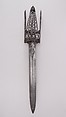
Dagger (Katar)
In sculptures of Subrahmaņya and Paravāņi from southern India, the peacock is frequently shown with one or more cobras in its beak and another clenched in its talons. These images of Paravāņi subduing serpents probably symbolize Subrahmaņya's role as the defender of the gods. Similarly the peacock on the hilt of this katar holds in its beak a pair of cobras by their tails, almost as if they were reins for its divine rider. Paravāņi is said to have been created as a result of a battle between Subrahmaņya and the giant Sura. During the fight Sura changed himself into a tree, which Subrahmaņya split in two with his spear. The two halves were transformed into the peacock Paravāņi and a rooster, both of which became enduring symbols of the god.
This katar comes from a small group of highly distinctive southern Indian weapons that were salvaged from the remains of the former royal armory in Tanjore (Thanjavur) in the mid-nineteenth century (see also acc. no. 36.25.1540). Like the katar, other weapons in the group prominently feature religious symbols, such as the chakra (discus) of Vishnu and the pāsha (noose) of Shiva. The majority of the surviving Tanjore pieces are divided between the Madras Government Museum and The Metropolitan Museum of Art.
Artwork Details
- Title: Dagger (Katar)
- Date: 17th century
- Geography: Thanjavur, Tamil Nadu
- Culture: Indian, Thanjavur; blade, European
- Medium: Steel
- Dimensions: L. 21 3/4 in. (55.2 cm); W. 5 in. (12.7 cm); Wt. 2 lbs. 3 oz. (992.2 g)
- Classification: Daggers
- Credit Line: Bequest of George C. Stone, 1935
- Object Number: 36.25.1009
- Curatorial Department: Arms and Armor
More Artwork
Related Content
 Free to download
Research Resources
The Met provides unparalleled resources for research and welcomes an international community of students and scholars. The Met's Open Access API is where creators and researchers can connect to the The Met collection. Open Access data and public domain images are available for unrestricted commercial and noncommercial use without permission or fee.
To request images under copyright and other restrictions, please use this Image Request form.
Feedback
We continue to research and examine historical and cultural context for objects in The Met collection. If you have comments or questions about this object record, please contact us using the form below. The Museum looks forward to receiving your comments.
Content Notice
The Metropolitan Museum of Art presents over 5,000 years of art from around the world, and our online collection reflects ongoing work conducted over the course of our more than 150-year history. You may encounter objects or images that may be inappropriate for some viewers or information that may be outdated.