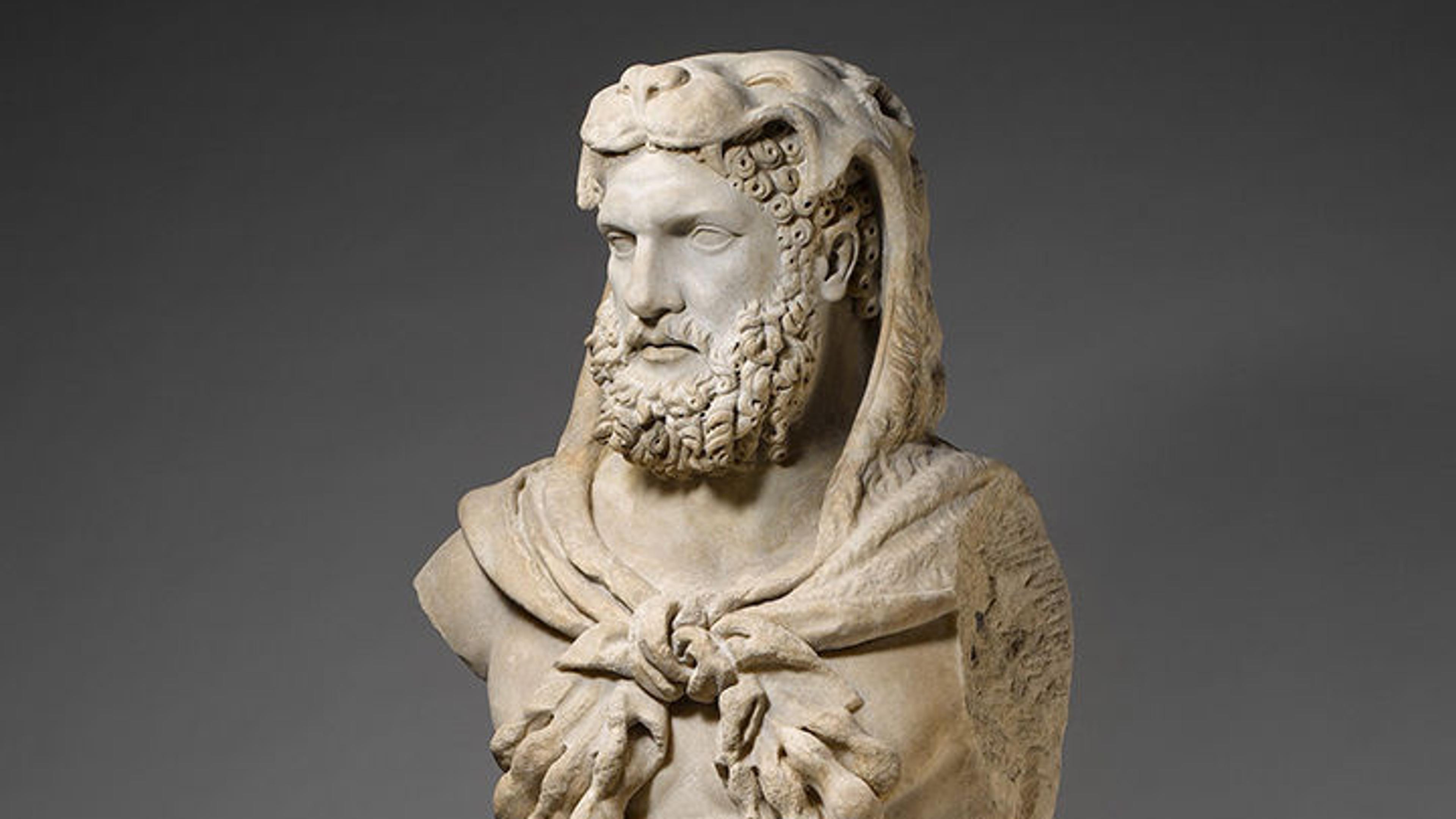
Marble statue of a bearded Hercules
This statue and the over-life-sized statue of Hercules across the courtyard in all probability were made as a pair to decorate one of the great spaces in a large public bath. Although they are much restored, their stance and attributes are essentially correct and are variants on long-established statue types that probably originated in images of the Greek hero Herakles dating to the fourth century B.C. They were part of the large collection of ancient sculpture assembled in Rome at the beginning of the seventeenth century by a wealthy Genoese banker, the Marchese Vincenzo Giustiniani.
Artwork Details
- Title: Marble statue of a bearded Hercules
- Period: Early Imperial, Flavian
- Date: 68–98 CE
- Culture: Roman
- Medium: Marble, Island
- Dimensions: H. without pedestal 93 3/4 in. (238.20 cm.)
- Classification: Stone Sculpture
- Credit Line: Gift of Mrs. Frederick F. Thompson, 1903
- Object Number: 03.12.14
- Curatorial Department: Greek and Roman Art
Audio
1271. Marble statue of a bearded Hercules
This colossal statue represents the Roman god, Hercules, known as Herakles to the ancient Greeks. He was celebrated for his courage and unusual strength. Here he wears the skin of the Nemean lion that he slew—one of his twelve near-impossible labors. The lion’s paws are tied in a knot across Hercules’s chest, and its open jaw fits neatly on top of the hero’s head. This statue and the other colossal statue of Hercules, directly behind you, were designed as a pair. Notice how well they fit in this high-ceiling court. In fact, they probably once decorated a large Roman public bath.
Both statues belonged to the Marchese Vincenzo Giustiniani, a wealthy Genoese banker who assembled a large collection of ancient sculpture in the early seventeenth century. Many of Giustiniani’s antiquities were found near the public baths that the Roman Emperor Nero constructed in 62 A.D.
In the drawing on the label before you, you’ll see that much of this statue was restored in the early seventeenth century. At this time, it was common practice to totally clean ancient sculpture, and restore any missing parts. In fact, a reputable sculptor could make a considerable living as a restorer of antiquities.
More Artwork
Related Content


Research Resources
The Met provides unparalleled resources for research and welcomes an international community of students and scholars. The Met's Open Access API is where creators and researchers can connect to the The Met collection. Open Access data and public domain images are available for unrestricted commercial and noncommercial use without permission or fee.
To request images under copyright and other restrictions, please use this Image Request form.
Feedback
We continue to research and examine historical and cultural context for objects in The Met collection. If you have comments or questions about this object record, please contact us using the form below. The Museum looks forward to receiving your comments.
Content Notice
The Metropolitan Museum of Art presents over 5,000 years of art from around the world, and our online collection reflects ongoing work conducted over the course of our more than 150-year history. You may encounter objects or images that may be inappropriate for some viewers or information that may be outdated.