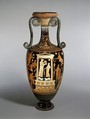
Terracotta loutrophoros (ceremonial vase for water)
Reverse, woman in naiskos flanked by youths and women
On the shoulder, obverse, Eros with alabastron and mirror within foliage
Reverse, head of a woman within foliage
This imposing and beautifully executed vase, together with its counterpart exhibited here, is of exceptional interest for the architectural structure on the obverse. A small naiskos, rendered with three columns, encloses a woman, her maid who holds out a small casket, and a metal loutrophoros. Between the level on which they stand and the podium for the shrine are two panels with a pair of confronted lions. The podium itself consists of an upper frieze of triglyphs, alternating with metopes showing Greeks fighting Amazons. The lower element is covered with tendrils enclosing a female head. Although naiskoi are common on Apulian vases, the complexity and elaboration here are unusual. The unresolved question is to what extent the representation reflects actual funerary structures and the limestone reliefs
familiar especially from Tarentum.
Artwork Details
- Title: Terracotta loutrophoros (ceremonial vase for water)
- Artist: Attributed to the Metope Painter
- Period: Late Classical
- Date: 3rd quarter of the 4th century BCE
- Culture: Greek, South Italian, Apulian
- Medium: Terracotta; red-figure
- Dimensions: 34 3/4 in. (88.3 cm)
- Classification: Vases
- Credit Line: Purchase, The Bernard and Audrey Aronson Charitable Trust Gift, in memory of her beloved husband, Bernard Aronson, 1995
- Object Number: 1995.45.1
- Curatorial Department: Greek and Roman Art
Audio
1087. Terracotta loutrophoros (ceremonial vase for water)
These two, imposing vases—beautifully executed—were used for pouring water in rites of marriage, and in the burial of those who died unwed. They’re known as loutrophoroi, recognizable by their elegant shape with a long, slender neck, and their delicate, almost lyrical, handles.
Both vases feature a woman and her handmaiden standing within a small, elevated shrine, known as a naiskos. On the larger vessel, the handmaiden casually leans against a column, as if she’s lazily passing time on a street corner. Next to her stands a metal loutrophoros, the very same kind of vessel that bears the painted scene.
These two vases are important for their exceptionally rendered details that bring to life South Italian architecture and actual tombs of the mid-fourth century B.C. Notice the pair of confronted lions on each shrine. They refer to sculpture carved in marble. If you look closely, you’ll also see that right below them the podiums have an upper frieze of triglyphs alternating with metopes showing Greeks fighting Amazons. This frieze rests on a base carved with elaborate spiral tendrils.
Having no immediate source of marble, artists in Southern Italy decorated their buildings with reliefs, like these, which they carved from local, Tarentine limestone.
More Artwork
Related Content

Research Resources
The Met provides unparalleled resources for research and welcomes an international community of students and scholars. The Met's Open Access API is where creators and researchers can connect to the The Met collection. Open Access data and public domain images are available for unrestricted commercial and noncommercial use without permission or fee.
To request images under copyright and other restrictions, please use this Image Request form.
Feedback
We continue to research and examine historical and cultural context for objects in The Met collection. If you have comments or questions about this object record, please contact us using the form below. The Museum looks forward to receiving your comments.
Content Notice
The Metropolitan Museum of Art presents over 5,000 years of art from around the world, and our online collection reflects ongoing work conducted over the course of our more than 150-year history. You may encounter objects or images that may be inappropriate for some viewers or information that may be outdated.