Ancestor figure
Periodically, the carving was repainted to refresh the vibrancy and spiritual efficacy of its decoration. Three crescent-shaped kina (shell ornaments) on the figure’s chest reference the prestige of men’s ceremonial regalia. A neck and mouth peek out from underneath a tumbuan, a mask with a long, pointed nose that recalls the flutes played during important rites. Two other faces with large white mouths and piercing red eyes appear on this mask, enhancing its foreboding presence. According to Kambot artists familiar with this carving, the dynamic figure represents a powerful spirit named Serampam.
Originally, Serampam was accompanied in the ceremonial house by a smaller carving that had been carried to the village by the community’s ancestors when they first migrated into the area. By the middle of the 20th century, following the arrivals of German and later Australian colonial authorities and missionaries, villagers were encouraged to give up their ancestral carvings and convert to Christianity, and this figure was removed from its ceremonial house.
Artwork Details
- Title: Ancestor figure
- Artist: Kambot artist
- Date: 19th century
- Geography: Papua New Guinea, Lower Sepik, Keram River
- Culture: Kambot people
- Medium: Wood, paint, fiber
- Dimensions: H. 96 × W. 23 × D. 18 in. (243.8 × 58.4 × 45.7 cm)
- Classification: Wood-Architectural
- Credit Line: The Michael C. Rockefeller Memorial Collection, Gift of Nelson A. Rockefeller, 1969
- Object Number: 1978.412.823
- Curatorial Department: The Michael C. Rockefeller Wing
Audio
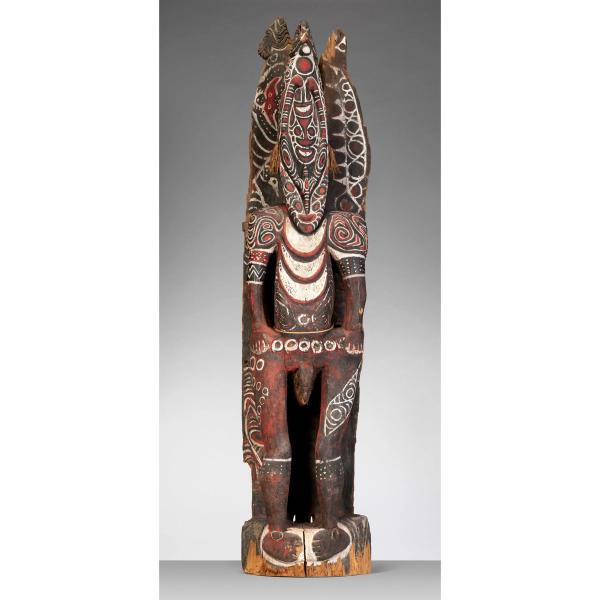
1718. Ancestral figure, Kambot artist
Simon Maro Nowep
SIMON MARO NOWEP (English translation): As a child, I often played with this carving, when I followed my father up into the ceremonial house. So when I see it now, I am moved.
KATERINA TEAIWA (NARRATOR): Maro Nowep is the son of a renowned Kambot painter, Simon Nowep. In 2014, he was shown a photograph of this exact carving, which brought back powerful memories.
SIMON MARO NOWEP (English translation): This carving is definitely the spirit of Sarampan.
When I first used to see it, I would be very afraid. I would see it and run away.
KATERINA TEAIWA: When Maro Nowep was a boy, it resided in a central, public part of the men’s ceremonial house. But back before Germans and Americans arrived in the village in the 1950s and 60s…
SIMON MARO NOWEP (English translation): …it resided in the restricted ‘taboo room.’
KATERINA TEAIWA: Its appearance was meant to be fearsome. Eventually though, Nowep conquered his fear.
SIMON MARO NOWEP (English translation): I would touch this carving, playing with its legs. But my father would say, “No, it’s forbidden to play with this carving. You will not be able to sleep at night if you play too much with it or damage it.”
KATERINA TEAIWA: Maro Nowep believes this figure was carved by his grandfather.
He sees many aspects of its appearance as expressions of the artist’s individual style.
SIMON MARO NOWEP (English translation): So the markings on the forehead that look like a face within a face are simply decoration. How they can make it look good is what they are thinking. How the carver feels, how they want to carve and decorate a figure. Well, they do what they want, according to their own thoughts.
###
Interview with Simon Maro Nowep recorded by Dr. Daniel von Rüdiger.
Listen to more about this artwork
More Artwork
Related Content
Research Resources
The Met provides unparalleled resources for research and welcomes an international community of students and scholars. The Met's Open Access API is where creators and researchers can connect to the The Met collection. Open Access data and public domain images are available for unrestricted commercial and noncommercial use without permission or fee.
To request images under copyright and other restrictions, please use this Image Request form.
Feedback
We continue to research and examine historical and cultural context for objects in The Met collection. If you have comments or questions about this object record, please contact us using the form below. The Museum looks forward to receiving your comments.
Content Notice
The Metropolitan Museum of Art presents over 5,000 years of art from around the world, and our online collection reflects ongoing work conducted over the course of our more than 150-year history. You may encounter objects or images that may be inappropriate for some viewers or information that may be outdated.