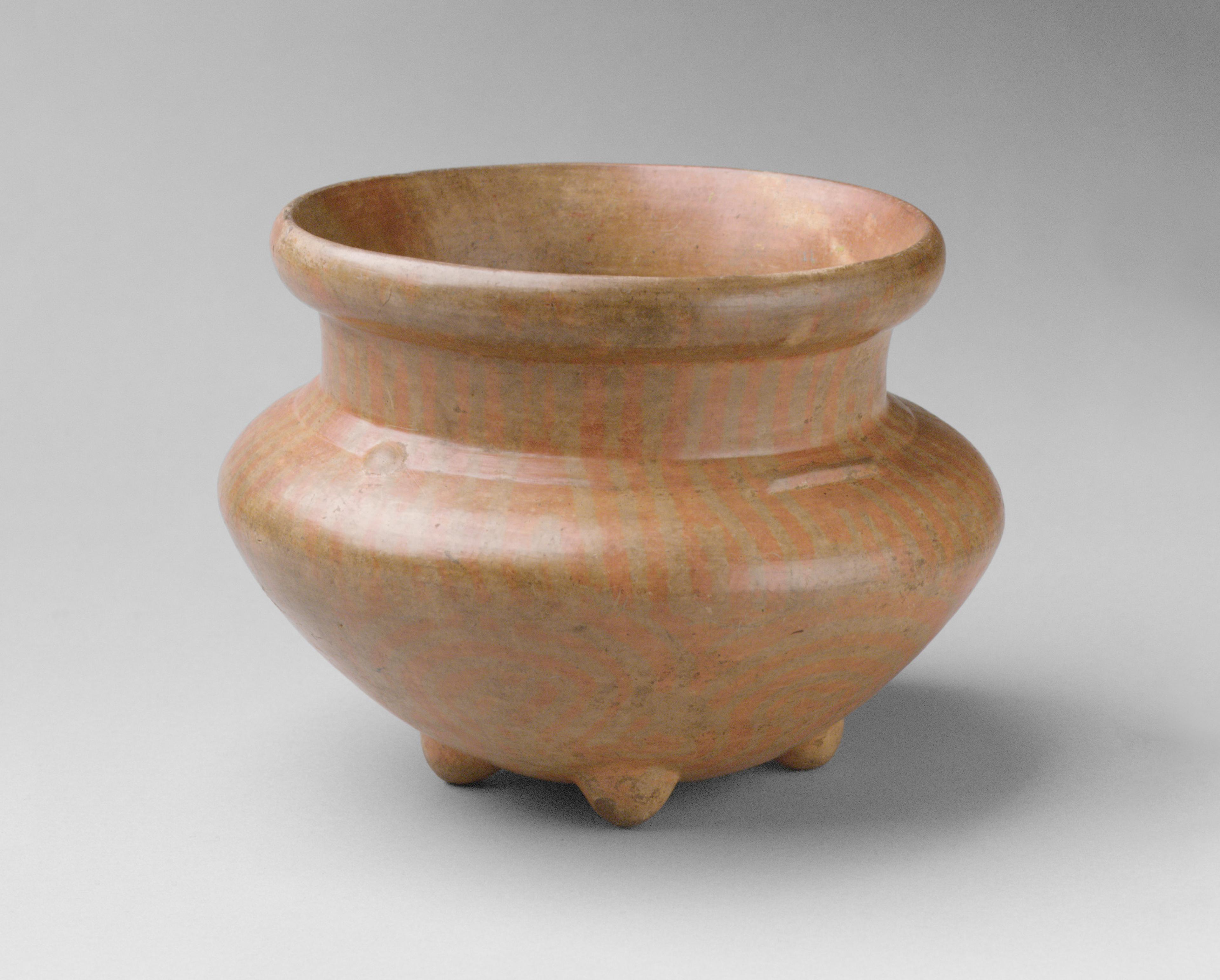
Cylindrical Vessel
This vessel dates to the Late Preclassic period (100 BCE - 250 CE) in the Guatemalan Petén, a period of major social reorganization for the Maya. Collective feasting became an important social ritual in building and reinforcing elite political power, as societies across Mesoamerica transitioned to more hierarchical social structures (Brady et al. 1999; Reese-Taylor and Walker 2002). Cylinder vases like this vessel, along with others in the museum collection (MMA 1989.314.16 , 1982.207.7 ), were used in these feasting events, and may also have been given as gifts to facilitate social bonds. Reddish-orange cylinder vessels with fireclouding were particularly popular in the southeastern region of the Petén (La Ruta Maya).
The cylinder shape of this vessel anticipates later Classic Maya vases (see MMA 1978.412.206). The incised horizontal lines segmenting the vessel body foreshadow the later Classic period polychrome cylinder, on which the vessel body is segmented into distinct areas that would be painted with glyphs and imagery.
Caitlin Reddington Davis
Sylvan C. Coleman and Pam Coleman Memorial Fund Fellow
August 2026
References
Brady, James E., Joseph W. Ball, Ronald L. Bishop, Duncan C. Pring, Norman Hammond, and Rupert A. Housely. “The Lowland Maya “Protoclassic”: A Reconsideration of its Nature and Significance.” Ancient Mesoamerica 9(1):17-38, 1999.
Estrada-Belli, Francisco. The First Maya Civilization: Ritual and Power Before the Classic Period. Routledge, 2011.
Jones, Julie, Susan Mullin Vogel, and Kate Ezra. Notable Acquisitions (Metropolitan Museum of Art) (1982–1983), pp. 73–77.
Joyce, Rosemary A. and John S. Henderson. “Forming Mesoamerican Taste: Cacao Consumption in Formative Period Contexts.” In Pre-Columbian Foodways: Interdisciplinary Approaches to Food, Culture, and Markets in Ancient Mesoamerica, edited by John Staller and Michael Carrasco. Springer, 157-173, 2010.
La Ruta Maya Fundación, Vaso 1.2.144.0406 here.
Powis, Terry G., Anne Cyphers, Nilesh W. Gaikwad, Louis Grivetti, and Kong Cheong, “Cacao Use and the San Lorenzo Olmec.” Proceedings of the National Academy of Science U.S.A.: 108 (21), 8595-8600, 2011.
Reese-Taylor, Kathryn, and Debra S. Walker. “The Passage of the Late Preclassic into the Early Classic.” In Ancient Maya Political Economies, edited by Marilyn Masson and David A. Freidel. Oxford: Altamira Press, 87-122, 2002.
Artwork Details
- Title: Cylindrical Vessel
- Artist: Maya artist (s)
- Date: 100 BCE - 250 CE
- Geography: Guatemala, Mesoamerica
- Culture: Maya
- Medium: Ceramic
- Dimensions: H. 7 7/8 in. (20 cm)
- Classification: Ceramics-Containers
- Credit Line: Gift of Arthur M. Bullowa, 1982
- Object Number: 1982.207.7
- Curatorial Department: The Michael C. Rockefeller Wing
More Artwork

Related Content
Timeline of Art History
Entries and chronologies from The Met's art encyclopedia.
Publications
Books, guides, and catalogues published by The Met.
 Free to download
Research Resources
The Met provides unparalleled resources for research and welcomes an international community of students and scholars. The Met's Open Access API is where creators and researchers can connect to the The Met collection. Open Access data and public domain images are available for unrestricted commercial and noncommercial use without permission or fee.
To request images under copyright and other restrictions, please use this Image Request form.
Feedback
We continue to research and examine historical and cultural context for objects in The Met collection. If you have comments or questions about this object record, please contact us using the form below. The Museum looks forward to receiving your comments.
Content Notice
The Metropolitan Museum of Art presents over 5,000 years of art from around the world, and our online collection reflects ongoing work conducted over the course of our more than 150-year history. You may encounter objects or images that may be inappropriate for some viewers or information that may be outdated.