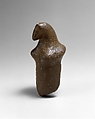
Bird Figure
While nothing is known of their original use, prehistoric stone objects serve important functions among the Enga and other contemporary Highland peoples. Unearthed by chance in gardens, washed out by streams, or rooted up by foraging pigs, the unusual stones are regarded as the work of spirits. Endowed with powerful magic, their uses range from hunting magic to healing to deadly forms of sorcery.
In recent times, stone objects were primarily associated with the fertility of pigs and sweet potatoes. Powerful stones were ritually anointed with pig's blood to magically replenish the herd and were buried in fields or placed in living shrines of colorful plants to assure abundant crops. On occasion, large groups of stones were massed for Kor nganap, a ceremonial cycle devoted to a female spirit who protected the community and brought success in warfare and traditional exchanges.
------------------------------------------------------------------------------------------------------------------
The earliest known works of Oceanic sculpture are a series of ancient stone figures unearthed in various locations on the island of New Guinea, primarily in the mountainous highlands of the interior. To date, no examples have been excavated from a secure archaeological context. Although organic material trapped within a crack in one example has recently been dated to 1500 B.C., firm dating and chronology for the figures are otherwise lacking.
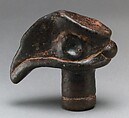
The stone sculptures fall into three basic categories: mortars, pestles, and freestanding figures. The tops of many pestles are adorned with images of human heads, birds, or bird's heads. The mortars display similar anthropomorphic and avian imagery as well as geometric motifs. Freestanding figures include depictions of humans, birds, and phalluses, as well as long-nosed animals that some scholars identify as echidnas (spiny mammals resembling hedgehogs). While the original significance and function of these stone images remain unknown, they possibly represent totemic species or ancestors and were likely used in ritual contexts. When found by contemporary New Guinea peoples, these early stone sculptures are often thought to be of supernatural origin and are reused in a variety of religious contexts, from fertility rituals to hunting magic and sorcery.
Artwork Details
- Title: Bird Figure
- Date: ca. 1500 BCE– ?1600 CE
- Geography: Papua New Guinea, Komun River region
- Culture: Mount Hagen region
- Medium: Stone
- Dimensions: H. 4 1/2 x W. 4 1/2 x D. 4 1/2 in. (11.4 x 11.4 x 11.4 cm)
- Classification: Stone-Sculpture
- Credit Line: Purchase, Discovery Communications Inc. Gift, 1996
- Object Number: 1996.373.2
- Curatorial Department: The Michael C. Rockefeller Wing
More Artwork
Related Content
Timeline of Art History
Entries and chronologies from The Met's art encyclopedia.
Publications
Books, guides, and catalogues published by The Met.
Research Resources
The Met provides unparalleled resources for research and welcomes an international community of students and scholars. The Met's Open Access API is where creators and researchers can connect to the The Met collection. Open Access data and public domain images are available for unrestricted commercial and noncommercial use without permission or fee.
To request images under copyright and other restrictions, please use this Image Request form.
Feedback
We continue to research and examine historical and cultural context for objects in The Met collection. If you have comments or questions about this object record, please contact us using the form below. The Museum looks forward to receiving your comments.
Content Notice
The Metropolitan Museum of Art presents over 5,000 years of art from around the world, and our online collection reflects ongoing work conducted over the course of our more than 150-year history. You may encounter objects or images that may be inappropriate for some viewers or information that may be outdated.