Kapeu (ear ornament)
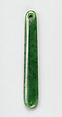
Pounamu (or greenstone) — the hardest known material in a biodegradable world of wood, fiber and bone — was as much prized by Māori for its durability and strength as for the beauty revealed in its interior landscape. An entire vocabulary describes the variety and quality of greenstone, the subtle nuances of each acknowledged with appropriate names. While geologically the rock falls into distinctly named categories (nephrite jade or bowenite), Māori classify according to visual appearance, recognizing four principal types based on color, shade and hue:
Inanga, named after the native freshwater whitebait fish (Galaxias maculatus), shoals of which can turn the rivers a cloudy, grey-green;
Kahurangi, rare and translucent, this vivid shade of green is named after the clarity and openness of the sky;
Kawakawa, the most common variety, flecked with inclusions which evoke the leaves of the native medicinal plant (Macropiper excelsum);
Tangiwai, a form of bowenite, clear like glass which achieves a luminous quality when held against the light; its name evokes the flow of tears.
This remarkable and rare stone is found buried within boulders found only in rivers specific to New Zealand’s south island, where it has lent its name to the land: Te Wai Pounamu, “the land of greenstone water.” Local tribes (iwi) of the Ngai Tahu people remain the custodians of the stone, ensuring it travels along appropriate pathways for distribution among the wider population. Māori valued pounamu in the same way Europeans valued gold. In the 1870s, Te Otatu, a Māori elder from Coromandel, remarked: “Let the gold be worked by the white men. It was not a thing known to our ancestors. My only treasure is the pounamu. Kati ano taku taonga nui i te pounamu.” (Best, 1974:175)
Sources
Best, Elsdon. Stone implements of the Māori. Wellington: Government Printer, 1974.
Maia Nuku
2015
Artwork Details
- Title: Kapeu (ear ornament)
- Artist: Māori artist
- Date: 18th–early 19th century
- Geography: New Zealand
- Culture: Maori people
- Medium: Nephrite jade (pounamu)
- Dimensions: H. 4 7/8 × W. 1 1/16 × D. 1/4 in. (12.4 × 2.7 × 0.6 cm)
- Classification: Stone-Ornaments
- Credit Line: Purchase, Lenore M. Weber Gift, 2013
- Object Number: 2013.24
- Curatorial Department: The Michael C. Rockefeller Wing
More Artwork

Research Resources
The Met provides unparalleled resources for research and welcomes an international community of students and scholars. The Met's Open Access API is where creators and researchers can connect to the The Met collection. Open Access data and public domain images are available for unrestricted commercial and noncommercial use without permission or fee.
To request images under copyright and other restrictions, please use this Image Request form.
Feedback
We continue to research and examine historical and cultural context for objects in The Met collection. If you have comments or questions about this object record, please contact us using the form below. The Museum looks forward to receiving your comments.
Content Notice
The Metropolitan Museum of Art presents over 5,000 years of art from around the world, and our online collection reflects ongoing work conducted over the course of our more than 150-year history. You may encounter objects or images that may be inappropriate for some viewers or information that may be outdated.