Krishna Killing the Horse Demon Keshi
Artwork Details
- Title: Krishna Killing the Horse Demon Keshi
- Period: Gupta period
- Date: 5th century
- Culture: India (Uttar Pradesh)
- Medium: Terracotta
- Dimensions: H. 21 in. (53.3 cm); W.16 in. (40.6 cm); D. 4 1/4 in. (10.8 cm)
- Classification: Sculpture
- Credit Line: Purchase, Florence and Herbert Irving Gift, 1991
- Object Number: 1991.300
- Curatorial Department: Asian Art
Audio
7920. Krishna Killing the Horse Demon Keshi
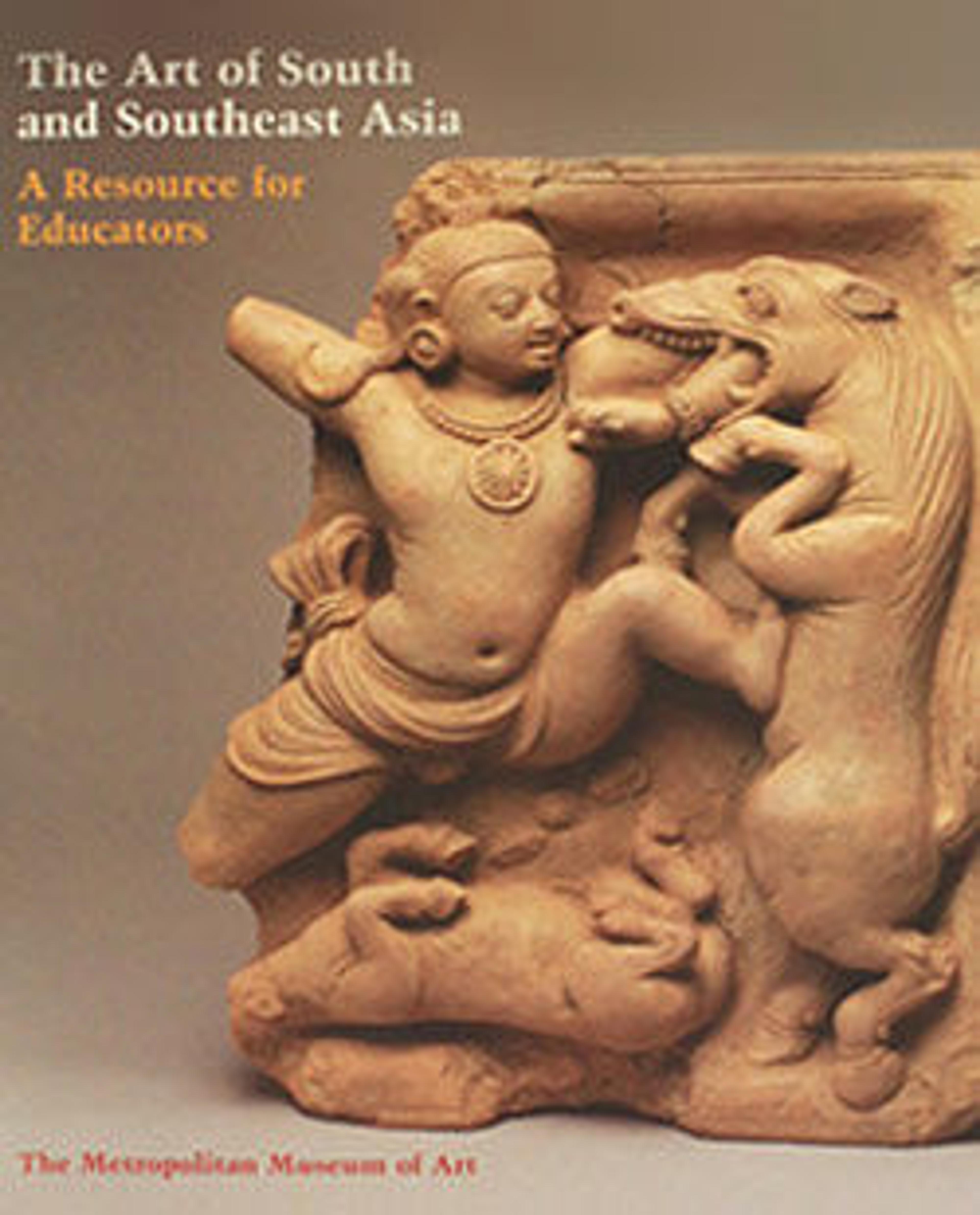
This terra-cotta plaque depicts the legendary battle of the hero-God Krishna, on the left, with the horse demon, Keshi. Krishna thrusts his left arm into the demon’s mouth. According to legend, it expanded and became red-hot. Below we see the aftermath: Keshi lies dead. The objects above his body may be balls of dung discharged in the agony of the horse’s death.
This is one of many tales about Krishna’s youthful exploits. Some of them may derive from Roman legends of the labors of Hercules. Krishna is one of several avatars, or earthly incarnations, of a Hindu god: Vishnu the preserver, who descends to earth when cosmic order is threatened. All Hindu gods are aspects of Brahman, the universal world-spirit. A North-Indian sculptor created this relief in the fifth century, during the reign of the Gupta dynasty. This is known as the classical era of Indian art.
Nearby, you’ll find a large Gupta statue of the Buddha. Gupta figures, both Hindu and Buddhist, emphasize a sense of flowing, continuous mass, with unadorned surfaces. Their rounded bodies appear slightly inflated by prana: the inner breath that fills all living creatures. In Indian tradition, regulating breath is a meditation technique used to divorce oneself from the demands of the body. A body filled with prana, therefore, is purified of earthly dross.
More Artwork

Related Content

 Free to download
Research Resources
The Met provides unparalleled resources for research and welcomes an international community of students and scholars. The Met's Open Access API is where creators and researchers can connect to the The Met collection. Open Access data and public domain images are available for unrestricted commercial and noncommercial use without permission or fee.
To request images under copyright and other restrictions, please use this Image Request form.
Feedback
We continue to research and examine historical and cultural context for objects in The Met collection. If you have comments or questions about this object record, please contact us using the form below. The Museum looks forward to receiving your comments.
Content Notice
The Metropolitan Museum of Art presents over 5,000 years of art from around the world, and our online collection reflects ongoing work conducted over the course of our more than 150-year history. You may encounter objects or images that may be inappropriate for some viewers or information that may be outdated.