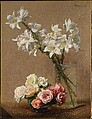
Roses in a Bowl
Artwork Details
- Title: Roses in a Bowl
- Artist: Henri Fantin-Latour (French, Grenoble 1836–1904 Buré)
- Date: 1883
- Medium: Oil on canvas
- Dimensions: 11 3/4 x 16 3/8 in. (29.8 x 41.6 cm)
- Classification: Paintings
- Credit Line: The Walter H. and Leonore Annenberg Collection, Bequest of Walter H. Annenberg, 2002
- Object Number: 2003.20.6
- Curatorial Department: European Paintings
Audio
6368. Roses in a Bowl
NARRATOR—The work of Henri Fantin-Latour is characterized by simplicity and restraint. Rarely is the arrangement in one of the artist's still-life paintings more complicated than what we see in these two examples- a vase or bouquet of flowers placed on a narrow ledge that merges imperceptibly with the wall in the background. The hazy illumination caressing Fantin’s blooms and the delicacy of the artist's gentle touch add to a poetic element that transports these still-life elements from the real to the ideal realm. The American artist James McNeil Whistler, one of artist's friends and most ardent admirers, proclaimed in his famous "Ten O'Clock Lecture:" “Fantin approached nature with the light of one who sees suggestions of future harmonies in nature's choice selection of brilliant tones and delicate tints."
More Artwork
Related Content
Research Resources
The Met provides unparalleled resources for research and welcomes an international community of students and scholars. The Met's Open Access API is where creators and researchers can connect to the The Met collection. Open Access data and public domain images are available for unrestricted commercial and noncommercial use without permission or fee.
To request images under copyright and other restrictions, please use this Image Request form.
Feedback
We continue to research and examine historical and cultural context for objects in The Met collection. If you have comments or questions about this object record, please contact us using the form below. The Museum looks forward to receiving your comments.
Content Notice
The Metropolitan Museum of Art presents over 5,000 years of art from around the world, and our online collection reflects ongoing work conducted over the course of our more than 150-year history. You may encounter objects or images that may be inappropriate for some viewers or information that may be outdated.