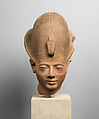
Amenhotep III in the Blue Crown
Artwork Details
- Title: Amenhotep III in the Blue Crown
- Period: New Kingdom
- Dynasty: Dynasty 18
- Reign: reign of Amenhotep III
- Date: ca. 1386–1347 BCE
- Geography: Possibly from Memphite Region; From Egypt
- Medium: Quartzite
- Dimensions: h. 35 cm (13 3/4 in); face only: h. 12.8 cm (5 1/16 in); w. 12.6 cm (4 15/16 in)
- Credit Line: Rogers Fund, 1956
- Object Number: 56.138
- Curatorial Department: Egyptian Art
Audio
3425. Amenhotep III in the Blue Crown
Amenhotep III, the ninth king of the eighteenth dynasty, inherited a vast empire. Its borders stretched from northern Syria in western Asia, to the Fifth Cataract of the Nile, in modern Sudan. During his thirty eight years of largely peaceful reign, Egypt was wealthier than ever before, and the arts flourished.
This head has rightly been called the most beautiful image of Amenhotep III. It is made from brown quartzite, a hard stone that Egyptian sculptors excelled in carving. Look at the subtle rendering of the flesh around the mouth, chin and cheeks. The full, sharply defined lips seem ready to open. The narrow slanted eyes are carved in a more stylized manner, and the furrows on the upper lids have an almost ornamental quality. This intensifies the sensuality of the face.
The king is strikingly youthful. His childlike face sits somewhat oddly on a short, thick neck that would be more fitting to an older man. Studies have shown that images like this one were made when the king was middle-aged or older. The childlike face is not a straightforward portrait, but carries a message. Statues of this type were probably created at the occasion of the king’s Heb Sed, a festival that every king ideally celebrated after a rule of thirty years. The celebration was intended to bring about a total physical and mental renewal—a second youth.
More Artwork
Related Content
 Free to download
Research Resources
The Met provides unparalleled resources for research and welcomes an international community of students and scholars. The Met's Open Access API is where creators and researchers can connect to the The Met collection. Open Access data and public domain images are available for unrestricted commercial and noncommercial use without permission or fee.
To request images under copyright and other restrictions, please use this Image Request form.
Feedback
We continue to research and examine historical and cultural context for objects in The Met collection. If you have comments or questions about this object record, please contact us using the form below. The Museum looks forward to receiving your comments.
Content Notice
The Metropolitan Museum of Art presents over 5,000 years of art from around the world, and our online collection reflects ongoing work conducted over the course of our more than 150-year history. You may encounter objects or images that may be inappropriate for some viewers or information that may be outdated.