East Wall, South Side of Nakht's Offering Chapel
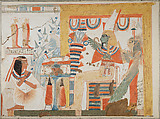
This facsimile painting copies the decoration painted on the left hand wall as one enters the tomb chapel of Nakht (Theban tomb no. 52), a scribe and astronomer who probably lived during the reign of Thutmose IV.
A large scene adorns the walls on either side of the tomb chapel’s entrance, showing Nakht and his wife Tauy pouring the contents of a libation vessel over a heap of offerings laid on reed mats, in this case for the benefit of the deities Amun, Ra-Harakhty, Osiris, Hathor, and Anubis. While the composition is similar on the right hand wall (see 15.5.19a), variations in the offerings depicted and the associated inscriptions show how the same image can be invested with different meanings.
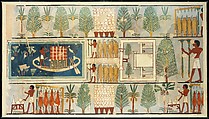
The right half of the wall is devoted to agricultural activities, organized in four registers, under the vigilant inspection of the deceased, who is seated under a canopy at the top right; indeed the caption above Nakht reads "sitting under a canopy and looking at his fields." Like Nakht, one can see, in a sequence from bottom to top, the various activities carried out in the fields, from preparing the soil to winnowing the harvested grain. These scenes refer to the production of the offerings necessary for Nakht’s survival in the afterlife.
Artwork Details
- Title: East Wall, South Side of Nakht's Offering Chapel
- Artist: Norman de Garis Davies (1865–1941)
- Artist: Lancelot Crane (British, 1880–1918)
- Period: Twentieth Century; original New Kingdom
- Dynasty: Dynasty 18
- Reign: later reign of Amenhotep II–mid-reign of Amenhotep III
- Date: 1908–1910; original ca. 1410–1370 BCE
- Geography: Original from Egypt, Upper Egypt, Thebes, Sheikh Abd el-Qurna, Tomb of Nakht, TT 52, chapel, east wall, south side [PM (4)], MMA Graphic Section, 1908–1910
- Medium: Tempera on paper
- Dimensions: Framed: 171.5 cm (67 1/2 in.); w. 226.7 cm (89 1/4 in.); th. 6.4 cm (2 1/2 in.)
Scale: 1:1 - Credit Line: Rogers Fund, 1915
- Object Number: 15.5.19b
- Curatorial Department: Egyptian Art
Audio
3272. Agricultural Scenes, Tomb of Nakht, Part 1
We’re looking at the large facsimile painting, featuring a towering man and woman. Across the top edge is a design which represents the knotted ends of a textile. This was the decoration covering one wall of the tomb chapel of a man named Nakht, and his wife. They lived around 1425 B.C. They make offerings facing towards the doorway of their tomb—and so towards the outside. This implied an offering to the god Amun, whose statue was carried once each year through the cemetery in which they were buried.
In the top right, we see Nakht sitting in the shade of a green canopy. He’s overseeing a harvest, in the two registers just to the left of him, and below. These include two women against the background of a green field. They are harvesting flax, which was always considered women’s work.
In the bottom right corner, Nakht is again under a canopy. In front of him men are plowing, sowing seeds, and felling trees. This is a very rare image of a landscape in Egyptian art—and a particularly lively one. We see the fertility of the land along the banks of the Nile. There are leafy trees, indicative of the earthly abundance from which Nakht also hopes to benefit in the afterlife. If you want to know more about the facsimiles in this room, press the PLAY button.
Listen to more about this artwork
More Artwork
Related Content
 Free to download
Research Resources
The Met provides unparalleled resources for research and welcomes an international community of students and scholars. The Met's Open Access API is where creators and researchers can connect to the The Met collection. Open Access data and public domain images are available for unrestricted commercial and noncommercial use without permission or fee.
To request images under copyright and other restrictions, please use this Image Request form.
Feedback
We continue to research and examine historical and cultural context for objects in The Met collection. If you have comments or questions about this object record, please contact us using the form below. The Museum looks forward to receiving your comments.
Content Notice
The Metropolitan Museum of Art presents over 5,000 years of art from around the world, and our online collection reflects ongoing work conducted over the course of our more than 150-year history. You may encounter objects or images that may be inappropriate for some viewers or information that may be outdated.